To calculate annual income from a pay stub, multiply your regular gross pay per paycheck by the number of scheduled paychecks in a year. For example, $2,300 paid every two weeks across 26 paychecks equals $59,800 before taxes. If your pay varies, estimate the calendar-year total by adding gross earnings already paid this year to the gross pay you reasonably expect for the remaining paydays.
For U.S. employees · Sources checked October 11, 2026 · All calculations below use fictional examples.
Your pay stub contains several income figures, and each answers a different question. Current gross pay helps estimate your annual pay rate. Year-to-date (YTD) gross pay shows what has already been paid this year. Net pay helps you plan spending after deductions.
Before calculating, decide whether you need a full-year pay-rate estimate or your expected earnings for this calendar year. Those amounts can differ when you start a job midyear, receive a raise, or work changing hours.
Which pay stub number should you use?
Use the field that matches the question you are trying to answer. The Consumer Financial Protection Bureau’s pay stub guide distinguishes gross income before deductions, net income after deductions, and cumulative YTD figures.
| Field | Meaning | Use it for |
|---|---|---|
| Current gross pay | Pay for this paycheck before taxes and deductions | Projecting steady pay across a full year |
| YTD gross pay | Cumulative gross pay recorded so far this year | Starting a calendar-year earnings forecast |
| Current net pay | This paycheck’s take-home amount | Planning cash available after deductions |
| YTD net pay | Cumulative take-home pay recorded this year | Reviewing take-home totals so far |
| Taxable wages | Wages subject to a particular tax | Checking tax records; these may differ from gross pay |
If an application asks for gross annual income, a bank deposit or net-pay figure answers a different question. Read the application’s definition and identify the income sources it asks you to include. For example, the CFPB’s mortgage glossary describes annual income as generally the year’s total earned income before tax.
How do you calculate annual income from regular pay?
Annualized gross pay = regular gross pay per paycheck × annual paycheck count. This projects your current pay across a full year. It assumes the amount continues and does not automatically account for unpaid leave or a midyear start.
- Find a representative paycheck. Use the gross amount for a complete, ordinary pay period. Separate an unusual bonus or adjustment instead of treating it as recurring pay.
- Confirm the pay schedule. Every two weeks and twice a month are different schedules. Check your payroll calendar or ask payroll if the label is unclear.
- Multiply by the annual count. Use the scheduled number of payments, then adjust for known changes.
| Pay schedule | Usual count | Example calculation |
|---|---|---|
| Weekly | 52 | $950 × 52 = $49,400 |
| Biweekly: every two weeks | 26 | $2,300 × 26 = $59,800 |
| Semimonthly: twice a month | 24 | $2,300 × 24 = $55,200 |
| Monthly | 12 | $4,200 × 12 = $50,400 |
Weekly and biweekly calendars can contain an extra payday. Count the actual scheduled pay dates when estimating a specific year. Salaried payroll may also adjust the per-check amount in an extra-payday year; Gusto’s guidance for 27-payday years explains this issue. Confirm your employer’s treatment before assuming the extra payday increases your salary.
Example: why biweekly and semimonthly matter
A $2,300 gross paycheck produces a $59,800 full-year estimate across 26 payments, but $55,200 across 24 payments. Confusing the schedules changes the estimate by $4,600. Do not multiply a biweekly paycheck by two and then by 12; that counts only 24 payments.
What if you are paid hourly?
For consistent hours, use hourly rate × paid hours per week × paid weeks. At $24 per hour for 35 hours each week across 52 paid weeks, the estimate is $43,680. If only 50 weeks will be paid, it is $42,000. These examples exclude overtime and other extra compensation.
When hours change, a typical week is an assumption, not a promise. Use expected paid hours for the remaining weeks rather than repeating your busiest paycheck.
How do you calculate annual income from YTD pay?
Expected calendar-year gross pay = YTD gross pay + expected remaining gross pay. This method keeps earnings already recorded and adds a forecast of the payments still to come.
For steady pay with no known changes, you can also estimate a full-year total using YTD gross pay ÷ regular paychecks included × annual paycheck count. The count must correspond to the YTD amount; do not divide by months worked when your formula expects paychecks.
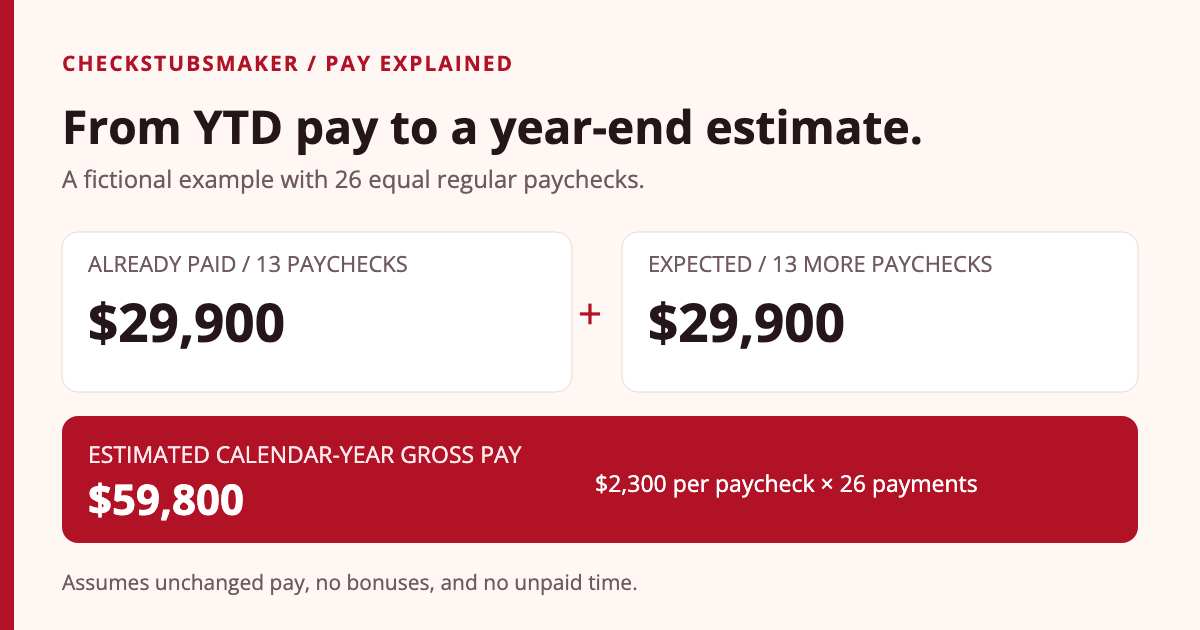
Example: halfway through a 26-payment schedule
Suppose your latest stub reports $29,900 YTD gross pay after 13 equal regular paychecks, with another 13 scheduled before year-end:
- Average gross paycheck: $29,900 ÷ 13 = $2,300.
- Expected remaining gross pay: $2,300 × 13 = $29,900.
- Expected year total: $29,900 + $29,900 = $59,800.
Do not add all your pay stubs’ YTD amounts together. Each is a cumulative snapshot, so that would count earlier earnings repeatedly. Use the latest YTD total for each employer or add individual current-period gross amounts once.
Example: you started work partway through the year
Suppose you have received five $2,300 paychecks and expect eight more this calendar year. With no other wages, your expected year total is $11,500 + ($2,300 × 8) = $29,900. Your full-year pay-rate estimate is still $59,800 across 26 payments. Label the result so someone reading it knows which figure you calculated.
If you had another job earlier in the year, add its earnings separately when the question calls for total calendar-year wages. A new employer’s YTD field should not be assumed to include wages from your previous employer.
How do bonuses, raises, and changing hours affect the estimate?
When past pay differs from future pay, a simple average can mislead. Separate recurring pay from unusual payments, then estimate what is still expected.
A one-time bonus
Assume ten regular $2,300 paychecks plus one $1,800 bonus are included in YTD gross pay of $24,800. If 16 regular paychecks remain and no additional bonus is expected, the forecast is $24,800 + ($2,300 × 16) = $61,600. Multiplying $24,800 ÷ 10 by 26 would produce $64,480 and incorrectly repeat part of the bonus.
A raise during the year
Suppose YTD gross pay is $27,600 after 12 payments at $2,300. Following a raise, the remaining 14 payments will be $2,500 each. Expected calendar-year gross pay is $27,600 + ($2,500 × 14) = $62,600. The new full-year rate of $65,000 does not describe all the pay received during the transition year.
Overtime, commissions, or unpaid time
Forecast these components separately. Keep compensation already received in the YTD amount and add only what you reasonably expect going forward. If future hours or commissions are uncertain, record a lower and higher estimate with their assumptions instead of presenting one precise number as certain.
What should you check before using the result?
- The question: Is it asking for gross pay, take-home pay, a current annual rate, or earnings for a particular year?
- The dates: Count payments expected within that year. A pay period’s work dates and its payday can cross year-end.
- The components: Have you separated regular pay, bonuses, overtime, and adjustments without counting any amount twice?
- The coverage: Does the estimate include the requested employers and income sources?
- The assumptions: Are planned raises, reduced hours, job end dates, and unpaid time reflected?
For W-2 reporting, payment timing matters. The IRS’s W-2 instructions give an example of December work paid in January being included in the following year’s W-2. They also explain that certain retirement deferrals are excluded from Box 1, so gross payroll earnings and Box 1 wages may differ.
If your goal is to check federal withholding, use the IRS Tax Withholding Estimator with your current records. An annual gross-pay estimate alone does not establish your tax bill. The IRS estimator FAQs explain how to distinguish current-period and YTD federal withholding and avoid including state tax, Social Security, or Medicare in that input.
Keep the original employer statements used for your calculation. If you need to organize genuine payroll details into a statement, you can use CheckStubsMaker’s paystub tool. Use actual source records for the statement; a projected annual amount belongs in your planning calculation, not in a field for wages already paid.
Frequently asked questions
Is annual income the same as YTD income?
No. YTD income covers the amount recorded so far this year. An annual projection also considers future payments. At year-end, check that all relevant payments and adjustments are included before treating YTD as a final total.
Can I calculate annual income from one pay stub?
Yes, as an estimate if it represents your normal pay and you know the schedule. A partial first paycheck, unusual bonus, or overtime-heavy period is a poor basis for repeating the same amount all year.
How do I estimate annual take-home pay?
Multiply a representative net paycheck by the expected payment count, or add YTD net pay to expected remaining net payments. Label it a take-home estimate. Changes to withholding, benefits, or deductions can change future net payments.
Does multiplying biweekly pay by 26 always work?
It is a useful steady-pay estimate for a 26-payment schedule. Check the actual calendar, salary arrangement, and whether you will be paid throughout the year before using it as your expected year total.
What if my pay stub does not show YTD gross pay?
Ask payroll for the cumulative earnings report, or add the current-period gross amounts from your complete set of statements for that year. Bank deposits generally show take-home amounts, so they do not reconstruct gross wages by themselves.
Sources and editorial notes
The payroll definitions and tax-reporting points above are supported by the linked CFPB and IRS resources. Gusto’s product documentation supports the extra-payday discussion. The worked calculations are original illustrations and assume the payment schedules stated in each example.
Published by the CheckStubsMaker Editorial Team. This guide explains calculation methods for U.S. employee pay; it does not determine the income a particular application will accept or provide an individual tax assessment. See our editorial policy for sourcing and corrections.