A direct deposit pay stub is the payroll statement for a payment sent electronically to a bank account. It explains earnings, employee taxes, deductions, and the final payment amount. It may also identify the payment method and masked destination accounts. Compare the current payment amount with all matching deposits, especially when pay is split between accounts or includes reimbursements.
For U.S. employees · Sources checked October 14, 2026 · All amounts and accounts below are fictional examples.
Direct deposit changes how the money reaches you. You still need the payroll details to understand how much you earned and what was withheld. A deposit entry alone cannot explain an overtime payment, retirement contribution, or tax adjustment.
How does a direct deposit pay stub differ from a bank deposit?
The pay stub describes a payroll payment: earnings, deductions, and related amounts. The bank transaction records money credited to a particular account. Keep both records when you need to reconcile what payroll calculated with what the bank received.
Nacha’s direct deposit guide explains that electronic deposits can cover payroll, bonuses, and expense reimbursements. A deposit therefore needs context before you treat the whole amount as wages.
A payroll statement does not, by itself, confirm that a particular bank credit has posted. Check the actual pay date, payment method, and destination. If your employer issued a paper check for that payment, an active direct deposit setup does not mean a bank deposit was also sent.
Labels vary. A statement may call the final amount “net pay,” “check amount,” or “payment amount.” Read its breakdown to see whether reimbursements, adjustments, or other items are included in that total.
What should a direct deposit pay stub show?
Formats differ by employer and payroll provider. These fields help you identify the payment and understand its calculation. The CFPB pay-stub handout distinguishes pay-period information, gross and net amounts, deductions, and year-to-date totals.
| Field | What it helps identify | What to check |
|---|---|---|
| Employer and employee | Whose payroll record you are reading | Correct company and employee identity |
| Pay period and pay date | Work covered and the payment date | Use the payment date to locate the relevant deposit |
| Current earnings | Salary, hours, rates, and other pay for this payment | Separate gross earnings from take-home cash |
| Employee taxes and deductions | Amounts withheld from the employee | Use current employee amounts, with each counted once |
| Reimbursements and adjustments | Items affecting the final payment | Confirm what is included and how it is treated |
| Final payment and bank allocation | Total sent and its destinations, if displayed | Add all allocations for that payment |
| YTD totals | Accumulated payroll activity for the year | Keep annual totals separate from this payment |
Gusto’s statement guidance provides an example of a provider displaying the payment method and last four bank-account digits. Your employer’s format may present those details elsewhere in the portal.
A bank allocation is also different from an employee deduction. Sending part of the payment to savings does not reduce the total paid. Employer benefit contributions shown for information should likewise be distinguished from employee withholding.
How do earnings, deductions, and reimbursements become a deposit?
Assume a fictional employee earns $2,000 in ordinary cash wages for one payment. Federal income-tax withholding is assumed to be $180. There is a $60 after-tax employee benefit deduction, with no pre-tax deductions, state/local taxes, noncash benefits, or other adjustments. Wages are below the Social Security wage base and the Additional Medicare withholding threshold.
Using the ordinary employee rates in IRS Topic 751, Social Security is $2,000 × 6.2% = $124, and Medicare is $2,000 × 1.45% = $29. The assumed $180 federal withholding is illustrative and is not calculated from a particular W-4.
Also assume the employer includes a $75 business-expense reimbursement that satisfies the accountable-plan requirements. IRS Publication 15 explains that qualifying accountable-plan payments are excluded from wages and the listed federal payroll taxes. A reimbursement label alone does not establish that treatment.
| Current item | Calculation or treatment | Amount |
|---|---|---|
| Gross cash earnings | Ordinary wages | $2,000.00 |
| Federal income-tax withholding | Assumed employee withholding | $180.00 |
| Social Security | $2,000 × 6.2% | $124.00 |
| Medicare | $2,000 × 1.45% | $29.00 |
| After-tax benefit deduction | Assumed employee share | $60.00 |
| Total employee deductions | $180 + $124 + $29 + $60 | $393.00 |
| Earnings after employee deductions | $2,000 − $393 | $1,607.00 |
| Qualifying expense reimbursement | Added to this payment; excluded from wages | $75.00 |
| Final payment amount | $1,607 + $75 | $1,682.00 |
The $75 increases the money sent without increasing the $2,000 wage amount in this example. Do not add it to taxable wages merely because it appears in the same deposit. Conversely, a nonaccountable expense allowance can have different treatment.
Start with the statement’s actual payment breakdown when comparing the bank credit. Our gross versus net guide explains wage and cash measures, and the deduction-code guide helps identify abbreviated lines.
Why can one deposit be smaller than the final pay-stub amount?
Your payroll instructions may split the payment. Gusto’s bank-account guidance, for example, describes percentage and fixed-dollar allocations. Available options depend on the employer and provider.
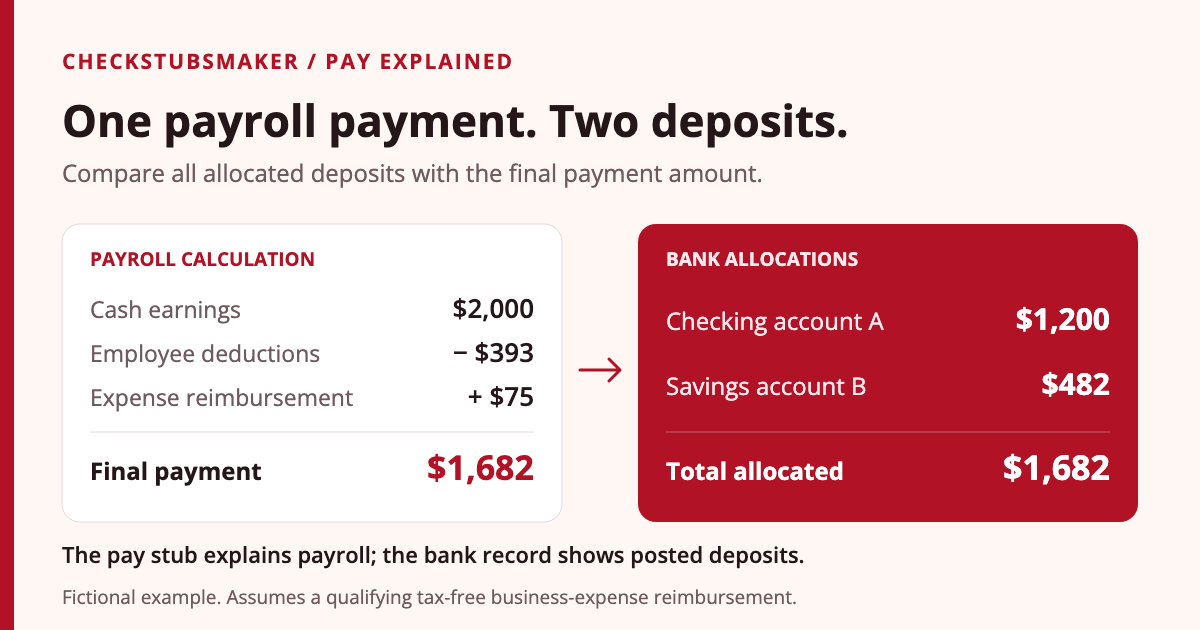
Suppose the fictional $1,682 payment above is allocated as follows:
| Destination | Instruction | Deposit |
|---|---|---|
| Checking account A | Fixed amount | $1,200.00 |
| Savings account B | Remaining payment | $482.00 |
| Total allocated | $1,200 + $482 | $1,682.00 |
The checking deposit alone is $482 below the final payment. The savings allocation explains that difference. Compare each destination separately, then add the deposits belonging to the same payroll payment. Avoid adding unrelated credits from another employer or another pay date.
What should you check when the amounts do not match?
- Match the payment. Confirm the employer, pay date, and payment method. A work-period end date can differ from payday.
- Use current figures. Compare this payment’s total rather than a YTD figure.
- Check every destination. Include all accounts receiving a split payment and inspect the destination identifiers.
- Review additions and offsets. Look for included reimbursements, separate payments, reversals, or corrections.
- Ask payroll to reconcile the remainder. Provide the statement date, expected amount, and posted amounts you cannot match.
The bank’s transaction description may differ from the employer name printed on the statement. Use the amount, date, destination, and payroll confirmation together. Our pay-schedule guide explains common date patterns.
What if the pay stub is available but the deposit is missing?
Confirm the stated payday and whether payroll used direct deposit or a check. Review payment status in the official payroll portal, then contact payroll about the missing amount and destination. Ask whether there was a return, bank error, or separate replacement payment.
Gusto’s payment-tracking guidance directs employees to their employer for pay dates and payroll amounts and provides a process for missing deposits. If an ACH trace number is available through your provider, the receiving bank can use it to investigate the payment.
Also tell payroll about recent bank-account changes. Gusto specifically warns that changing bank details after payroll submission can leave that payment directed to the old account. Follow your provider’s confirmed process and ask which payment first uses the new details.
There is no need to infer an exact bank posting time from the statement alone. Confirm the expected payment status with payroll and the bank. Keep the records and replies together until the issue is resolved.
Where can you find and save direct deposit pay stubs?
Check the employer’s payroll portal for pay history or payment statements. Select the relevant payment and download its original PDF if available. Gusto’s cited statement instructions, for example, describe viewing a payment and downloading its PDF.
If the statement is unavailable, request the specific pay dates from payroll. Use our previous-employer retrieval guide when access to an old account has ended.
Federal and state requirements differ. The Department of Labor’s FLSA guidance explains the federal recordkeeping duty and that the FLSA itself does not require employers to provide pay stubs. Check applicable state requirements for statement access.
Save the original statement securely. When sharing it for income verification, confirm the recipient’s document and redaction requirements. Use the employer and pay date in the filename, and retain the bank record separately for payment matching.
Frequently asked questions
Do you still get a pay stub with direct deposit?
Many employers provide an electronic payroll statement through a portal. Ask payroll how to access it and check the applicable statement requirements for your situation.
Does “check amount” mean I was paid by paper check?
The phrase can label the final payroll amount. Check the stated payment method and destination instead of relying on that word alone.
Should the deposit equal gross pay?
Employee taxes and deductions generally reduce the wages paid in cash. Included reimbursements and other adjustments can also affect the final payment. Reconcile the complete current calculation.
Can a direct deposit statement replace a bank statement?
They contain different information. Confirm which document the requesting organization accepts. Use the payroll record to explain earnings and deductions, and the bank record to check posted credits.
Which figures should I use when preparing a direct deposit pay stub?
Use verified payment-period earnings, employee deductions, reimbursements, and dates. When formatting records with CheckStubsMaker, reconcile the final amount and each allocation with the underlying payroll records.
Sources and editorial notes
This guide uses Nacha’s direct deposit explanation, CFPB payroll-field definitions, IRS payroll-tax and reimbursement guidance, official Gusto statement and payment instructions, and DOL recordkeeping guidance. Its examples are original and assume ordinary covered employee wages and the stated reimbursement treatment.
Published by the CheckStubsMaker Editorial Team. Read our editorial policy for sourcing and corrections.