Pay stub deduction codes are short labels for taxes, benefit contributions, and other amounts withheld from pay. FIT commonly refers to federal income-tax withholding, SS or OASDI to Social Security, and 401K to a retirement-plan contribution. Employers can use different labels, so confirm unfamiliar codes with your payroll legend or payroll department. Check the current amount, tax treatment, and whether the entry is an employee deduction or an employer contribution.
For U.S. employees · Sources checked October 13, 2026 · The paycheck below is a fictional example.
A short code can hide an important distinction. MED in a tax section may refer to Medicare, while MED in a benefits section may describe medical insurance. Start with the section heading and full description before deciding what the amount means.
Are pay stub deduction codes the same everywhere?
Payroll systems and employers can use different descriptions for similar items. A number, abbreviated benefit name, or custom label may be meaningful only within that company’s payroll setup. The ADP-hosted payroll reference, for example, describes company-defined codes alongside default labels.
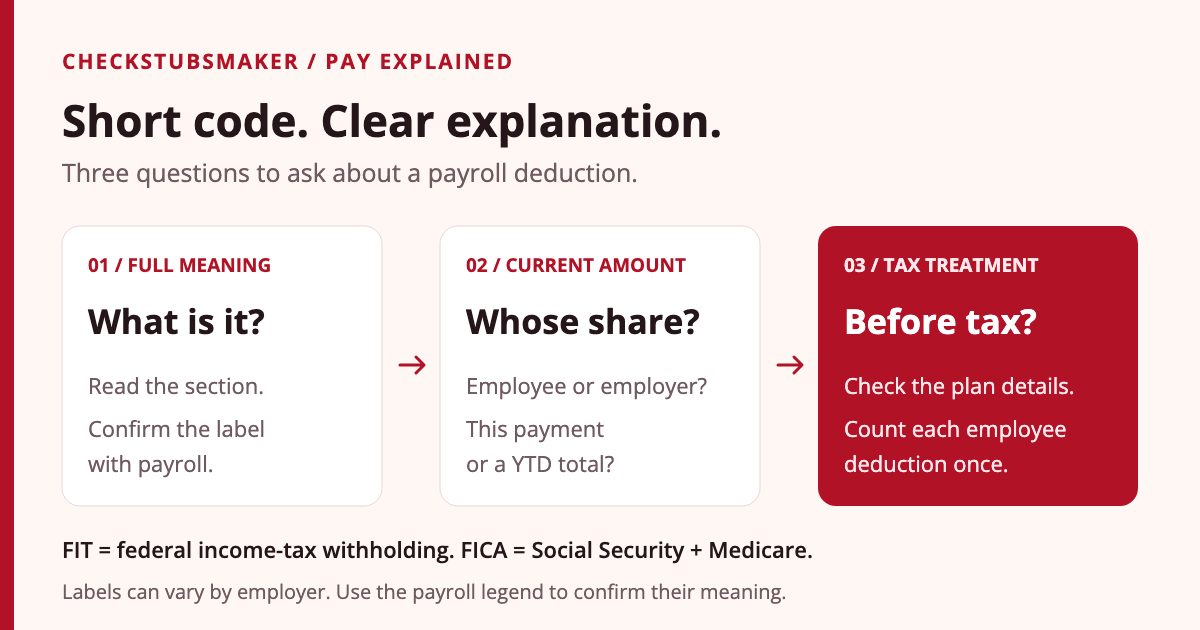
Use the glossary below as a starting point. Its labels are examples you may encounter, rather than a universal code list. To identify an entry:
- Read the section heading. Taxes, employee deductions, employer contributions, and earnings contain different kinds of amounts.
- Look for the expanded description. Check the payroll portal, statement legend, or benefits election confirmation.
- Match the current amount. Compare it with the applicable tax calculation, contribution election, premium, or other payroll instruction.
- Confirm ambiguous labels. Ask payroll for the full name and how the entry affects wages and net pay.
What do FIT, SS, OASDI, and MED mean?
Tax lines describe amounts withheld under particular tax rules. They may appear separately from benefit deductions. The IRS Social Security and Medicare guidance explains the two components of FICA and their ordinary employee rates.
| Possible label | Usual meaning | What to check |
|---|---|---|
| FIT, FITW, FED | Federal income-tax withholding | Federal taxable wages, pay frequency, and W-4 inputs |
| SS, OASDI, SOC SEC | Social Security tax | Covered Social Security wages and the annual wage base |
| MED, MEDI, Medicare | Medicare tax when listed under taxes | Covered Medicare wages and any Additional Medicare withholding |
| FICA | Social Security and Medicare collectively | Whether the statement combines them or lists them separately |
| SIT, State Tax | State income-tax withholding | The named jurisdiction and applicable withholding setup |
| Local Tax, City Tax | Applicable local income or wage tax | The locality and the specific tax identified |
For ordinary covered employee wages, Social Security is generally 6.2% and Medicare 1.45%. Federal income-tax withholding uses a different calculation; FIT is not another name for FICA. Our FICA guide explains wage limits and Additional Medicare withholding in more detail.
The IRS W-4 guidance describes withholding inputs including filing status, multiple jobs, credits, other income, deductions, and additional withholding. Those inputs help explain why two employees with similar gross pay can have different FIT amounts. State and local entries depend on the applicable jurisdiction.
What do retirement, insurance, and other deduction codes mean?
Benefit deductions reflect your payroll elections and plan setup. Other entries may arise from a separate authorization or withholding requirement. Confirm the full description and employee share rather than inferring the details from a few letters.
| Possible label | Common description | Important distinction |
|---|---|---|
| 401K, 401(k) | Employee retirement-plan contribution | Confirm whether it is traditional pre-tax, Roth, or another contribution type |
| ROTH, Roth 401K | Designated Roth retirement contribution | Different federal income-tax treatment from traditional pre-tax deferrals |
| Medical, MED | Medical insurance contribution in a benefits section | Different from Medicare tax; confirm plan and tax treatment |
| DENT, Dental, VIS, Vision | Dental or vision coverage contribution | Confirm the employee premium and whether it is before or after tax |
| HSA | Health savings account contribution | Check contribution source, eligibility, and payroll tax treatment |
| FSA, Health FSA, Dep Care | A flexible spending or dependent-care benefit arrangement | Identify the exact arrangement; their rules differ |
| DUES, Union Dues | Union membership deduction | Check the applicable instruction and current amount |
| GARN, Child Support | A garnishment or support withholding entry | Confirm the order, its type, and the amount with payroll |
| MISC, Other, a numeric code | An employer-defined entry | Request the full description and reason for the deduction |
IRS Publication 969 explains health savings accounts and health flexible spending arrangements. An HSA label does not tell you whether the amount came from an employee salary reduction or a separate employer contribution. Check the column and plan records.
Garnishment rules depend on the type of withholding. The Department of Labor’s garnishment guidance describes federal protections. Ask for the specific order and calculation if the amount is unclear.
How do pre-tax and after-tax deductions differ?
A qualifying pre-tax deduction reduces wages used for one or more tax calculations. An after-tax deduction reduces the cash remaining after applicable taxes are calculated, without reducing taxable wages. The exact tax effect depends on the deduction and the plan.
A traditional pre-tax employee 401(k) contribution generally reduces federal income-tax wages while remaining subject to Social Security and Medicare. Designated Roth contributions remain subject to federal income-tax withholding as well. The IRS retirement contribution comparison explains these distinctions.
Eligible benefits under a cafeteria plan can have different exclusions, as described in IRS Publication 15-B. The abbreviation alone cannot establish that a medical premium reduces every tax base. Ask payroll which wage amounts it changes.
Both pre-tax and after-tax employee contributions can reduce the cash paid. Avoid subtracting an item twice: a taxable-wage figure may already exclude a pre-tax contribution, while gross cash earnings still include the amount before it was withheld.
How do deduction codes add up to net pay?
Assume a fictional employee has $2,400 in ordinary cash wages, a $120 traditional pre-tax employee 401(k) contribution, and a $20 after-tax dental premium. There are no other wage adjustments, reimbursements, state/local taxes, or deductions. Wages remain below the Social Security wage base and the Additional Medicare withholding threshold.
Federal taxable wages are $2,400 − $120 = $2,280. Social Security and Medicare wages remain $2,400. Assume federal income-tax withholding is $200; that is an illustrative input, rather than a calculation from a particular W-4.
| Item or code | Explanation | Current amount |
|---|---|---|
| Gross cash pay | Earnings before deductions | $2,400.00 |
| FIT | Assumed federal income-tax withholding | $200.00 |
| SS | $2,400 × 6.2% | $148.80 |
| MED | $2,400 × 1.45% | $34.80 |
| 401K | Traditional pre-tax employee contribution | $120.00 |
| DENT | Assumed after-tax employee premium | $20.00 |
| Total employee deductions | $200 + $148.80 + $34.80 + $120 + $20 | $523.60 |
| Net pay | $2,400 − $523.60 | $1,876.40 |
Each employee deduction is counted once. The $2,280 federal taxable-wage figure is used for tax calculation; it is not the starting cash amount for subtracting the same $120 again. Our gross versus net guide explains a full payment reconciliation.
What do current, YTD, EE, and ER mean?
Current usually describes this payment. YTD means year to date and shows a running total. The CFPB pay-stub handout distinguishes these columns. Use current employee deductions to reconcile one payment, and YTD amounts to review accumulated activity.
EE often identifies the employee share and ER the employer share; confirm the statement legend. Employer contributions and employer taxes may be displayed for information. Count the amounts actually withheld from the employee when calculating take-home pay.
Likewise, an earnings adjustment or taxable noncash benefit may appear near deductions without being a separate employee premium. Our imputed-income guide explains how noncash values and offset entries can affect a statement.
How should you investigate an unfamiliar or incorrect deduction?
- Save the statement and identify the code, pay date, and current amount.
- Request the expanded name and whether it is an employee or employer entry.
- Check the contribution election, coverage period, or withholding instruction.
- Ask which tax wage bases the deduction changes.
- Compare the previous statement for a new election, correction, or catch-up amount.
- Ask payroll to explain any remaining difference and the correction process.
A useful question is: “What does code [label] mean on my [pay date] statement, why was [amount] withheld, and is it before or after tax?” If the earlier statement is missing, our pay-stub retrieval guide explains how to request copies.
Frequently asked questions
Are FIT and FICA the same deduction?
FIT refers to federal income-tax withholding. FICA covers Social Security and Medicare. Check whether your statement shows FICA as a combined amount or separate components.
Why does my pay stub show MED twice?
One line may mean Medicare tax and another medical coverage. Read their sections and expanded descriptions. Ask payroll if the distinction remains unclear.
Does every 401K deduction reduce federal taxable wages?
Confirm the contribution type. Traditional pre-tax elective deferrals and designated Roth contributions have different federal income-tax treatment; an abbreviated label may not distinguish them.
Does zero FIT mean the statement is wrong?
Zero federal withholding alone does not establish an error. It can depend on taxable pay and withholding inputs. Ask payroll to check the calculation and your W-4 information if it is unexpected.
Should I enter the employer’s contribution as my deduction when preparing a pay stub?
Use verified payroll records and distinguish employee withholding from employer amounts. When formatting a statement with CheckStubsMaker, use clear descriptions and current figures that reconcile with the actual payment.
Sources and editorial notes
This guide uses IRS payroll-tax and benefit guidance, CFPB pay-stub definitions, a payroll-provider reference for code configuration, and DOL garnishment guidance. The labels are illustrative and the paycheck arithmetic is original. Confirm employer-specific code meanings and plan details with payroll.
Published by the CheckStubsMaker Editorial Team. Read our editorial policy for sourcing and corrections.