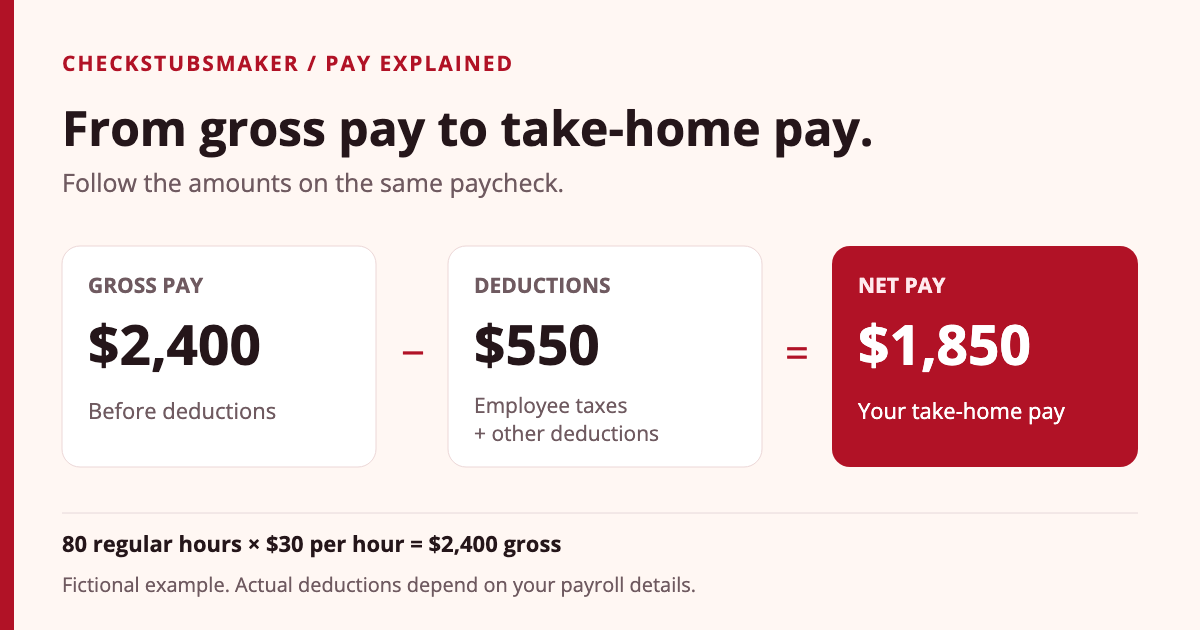
Gross pay is what you earn before employee taxes and other deductions. Net pay is the amount left after those deductions, also called take-home pay. For a straightforward wage payment, the formula is net pay = gross pay − employee taxes − other employee deductions. A paycheck with $2,400 in gross pay and $550 in total deductions has $1,850 in net pay.
For U.S. employees · Sources checked October 11, 2026 · Examples are fictional and explain the arithmetic, not your personal tax withholding.
A salary offer, a pay stub, and a bank deposit can show three different numbers without any of them being wrong. The useful question is what each number measures. Once you separate earnings, deductions, and the amount actually paid, your statement becomes much easier to check.
What is the difference between gross pay and net pay?
Gross and net describe two stages of the same paycheck. The CFPB’s guide to reading a pay stub defines gross income as pay before deductions and net income as the amount remaining afterward.
| Question | Gross pay | Net pay |
|---|---|---|
| What does it show? | Earnings before employee deductions | Take-home pay after employee deductions |
| Where should I look? | Gross earnings or total earnings | Net pay or net amount |
| What is it useful for? | Checking the earnings calculation | Planning spending from that paycheck |
| In our example | $2,400.00 | $1,850.00 |
Check whether you are reading the current column or the year-to-date (YTD) column. Current amounts belong to this payment; YTD amounts accumulate across the year. Comparing current gross pay with YTD net pay will not tell you how this paycheck was calculated.
If you need a full-year figure, follow our guide to calculating annual income from a pay stub. It explains which gross amount to use and how to handle changing pay.
How do you calculate net pay from gross pay?
Start with the gross wages for one payment, add the employee deductions for that same payment, and subtract them once. Use a complete statement so you can see what each deduction represents.
- Check the earnings. For example, 80 regular hours at $30 per hour produce $2,400 in gross wages. Review any separate overtime, bonus, or other earnings lines before using the total.
- Add employee taxes and other deductions. Include only amounts actually taken from your pay. A line describing an employer-paid contribution is not automatically an employee deduction.
- Subtract the total deductions. Compare your result with the statement’s current net-pay amount.
- Reconcile the payment. If the payment also includes a reimbursement or adjustment, read that line separately. If direct deposit is split between accounts, compare all allocations with the amount distributed.
A worked example: $2,400 gross becomes $1,850 net
This example assumes all $2,400 is subject to ordinary employee Social Security and Medicare tax, the employee is below the Social Security wage limit, and Additional Medicare withholding does not apply. The federal and state income-tax amounts are illustrative inputs; they are not calculated from a filing status or withholding election.
| Pay stub line | Amount | How it is used |
|---|---|---|
| Gross wages | $2,400.00 | Starting earnings: 80 hours × $30 |
| Traditional pre-tax 401(k) | −$120.00 | Employee retirement contribution |
| Federal income tax | −$170.00 | Assumed withholding for this example |
| Social Security tax | −$148.80 | $2,400 × 6.2% |
| Medicare tax | −$34.80 | $2,400 × 1.45% |
| State income tax | −$45.00 | Assumed withholding for this example |
| After-tax benefit deduction | −$31.40 | Assumed employee deduction |
| Total employee deductions | $550.00 | Sum of the six deductions above |
| Net pay | $1,850.00 | $2,400 − $550 |
The ordinary employee rates used here—6.2% for Social Security and 1.45% for Medicare—come from IRS Topic 751. The example excludes employer contributions from the employee’s deductions.
What deductions reduce gross pay to net pay?
Federal income-tax withholding
Federal withholding depends on payroll calculations and the information supplied on Form W-4. The IRS’s Form W-4 guidance explains that filing status, multiple jobs, credits, other income, deductions, and extra withholding can affect the amount. Two employees earning the same gross wages can therefore have different take-home pay.
Social Security, Medicare, and state or local taxes
Social Security and Medicare are separate from federal income-tax withholding. For 2026, Social Security tax has a $184,500 wage base, while Medicare has no wage-base ceiling. Employers generally begin withholding an additional 0.9% Medicare tax when wages they pay an employee exceed $200,000 in the calendar year. These details are set out in IRS Topic 751.
State or local withholding may also appear, depending on the applicable rules. Read each label rather than assuming every deduction marked “tax” is federal income tax.
Benefits, retirement, and other employee deductions
Retirement contributions and benefit deductions can reduce the cash available in your paycheck even when the money is being directed toward a benefit or savings account. The CFPB’s pay-stub worksheet helps readers distinguish taxes and other deductions from take-home pay.
Look for a separate employer-contribution column. For example, if the fictional employer contributes another $60 to retirement, do not subtract that $60 from the employee’s $1,850 net pay unless the statement separately identifies an employee deduction. Employer and employee contributions are different entries; the IRS explains both contribution types.
Why are taxable wages different from gross pay and net pay?
Taxable wages are the earnings used for a particular tax calculation. They are not the same as the amount deposited into your bank account. A statement may show separate federal, Social Security, and Medicare wage amounts.
In our simplified example, the $120 traditional pre-tax 401(k) contribution reduces wages subject to federal income tax from $2,400 to $2,280. It does not reduce the Social Security or Medicare wage amount in the example, which remains $2,400. The IRS explains this distinction for certain salary-reduction arrangements in Topic 401 on wages and salaries.
The three relevant figures are therefore $2,400 gross wages, $2,280 federal taxable wages, and $1,850 net pay. Each can be correct. A Roth contribution has different current income-tax treatment from a traditional pre-tax contribution, as explained in the IRS contribution guidance.
When checking net pay, subtract a deduction only once. Starting with $2,280 federal taxable wages and subtracting the $120 retirement contribution again would count that contribution twice.
Why did my net pay change when my gross pay stayed the same?
Compare the deduction lines on the two statements. A changed withholding election, benefit cost, retirement contribution, or payroll adjustment can change net pay without changing gross wages.
For a simple illustration, suppose gross pay stays at $2,400 and the after-tax benefit deduction increases from $31.40 to $46.40. If every other amount stays the same, total deductions rise to $565 and net pay falls to $1,835. The $15 difference has a visible explanation.
- Match the period. Compare current amounts from complete pay periods of the same length.
- Check gross first. Note changes in hours, rate, overtime, or other earnings.
- Compare each deduction. Record the old amount, new amount, and difference.
- Read payroll notes. Look for corrections, catch-up deductions, or reversals.
- Ask payroll about any unexplained item. Identify the pay date, deduction code, and amount you need clarified. Keep the original statements.
If your question is whether federal withholding is appropriate for your circumstances, use the IRS Tax Withholding Estimator with your current records. A larger paycheck caused by lower withholding does not by itself mean your final tax obligation is lower.
Frequently asked questions
Should I use gross pay or net pay for my budget?
Use the take-home money available to pay your bills as the starting point for a spending budget. Gross wages are useful for understanding compensation, but some of that amount has already gone toward taxes, benefits, or other deductions.
Is net pay the same as my bank deposit?
Often, but check the payment allocations. If $1,850 in net pay is split into $250 for savings and $1,600 for checking, either deposit alone is smaller than the net amount. Together, they reconcile to the paycheck.
Does “pre-tax” mean a deduction avoids every payroll tax?
No. The treatment depends on the deduction and the tax. The traditional 401(k) example above reduces federal taxable wages while leaving Social Security and Medicare wages unchanged. Check the specific benefit or plan treatment with payroll.
Can I work backward from net pay to find gross pay?
Only if you know the relevant deductions and adjustments. In the simple example, $1,850 net plus $550 in employee deductions equals $2,400 gross. A bank deposit alone does not reveal those deductions, so dividing it by a guessed percentage will not establish the correct gross wages.
What should I enter when creating a pay stub?
Use the actual gross earnings and the correct employee deduction amounts from your source records. Do not enter net pay into a gross-pay field or treat an annual projection as wages already paid. Review the completed statement against those records before using it.
Sources and editorial notes
This guide uses linked CFPB resources for pay-statement definitions and budgeting context, and current IRS resources for withholding, payroll-tax rates, and retirement contribution treatment. The numerical examples are original illustrations with the assumptions stated above.
Published by the CheckStubsMaker Editorial Team. This guide explains U.S. employee pay statements and does not calculate an individual’s tax liability. Read our editorial policy for sourcing and corrections.