An old uncashed paycheck may be declined by a bank, but the check’s age alone does not establish that the underlying wages have disappeared. Confirm whether the original check was paid, ask the employer about replacement, and find out whether the money was transferred to a state unclaimed-property program. Do not deposit both an original and its replacement.
For U.S. employees · Sources checked November 17, 2026 · This guide concerns ordinary employer-issued paper paychecks. Government checks, certified checks, and other instruments can have different rules.
Finding a paycheck in an old envelope creates two questions: will the bank accept this particular check, and where are the unpaid funds now? Answering the first does not necessarily answer the second.
Do paychecks expire after six months?
The Consumer Financial Protection Bureau’s stale-check guidance explains that a bank or credit union may choose to honor a check more than six months old, but federal law does not require it to do so. State requirements can differ.
That is more precise than saying every paycheck automatically becomes worthless at six months. Ask the bank about its policy and ask the issuer about the check’s current status before relying on an old payment instrument.
If a check has a printed “void after” notice, contact the employer about that notice and replacement procedure. Do not treat the printed date as an answer to every wage, bank, or unclaimed-property question.
A newer check is not guaranteed to be cashed either. The CFPB’s check-cashing guidance describes other factors, including the banking relationship, available funds, payee identification, and possible fees. Confirm the actual institution’s requirements.
What should you check before trying to deposit it?
Match the employer name, issue date, check number, and net amount to the associated pay statement. Review your payment history for the same amount and period, including any replacement or alternative payment already received.
Ask payroll whether the original check is outstanding, already paid, stopped, replaced, or transferred to a state program. A pay statement proves what payroll recorded; it does not, by itself, prove that the paper check cleared the bank.
| Employer’s finding | What to ask next |
|---|---|
| Original still outstanding | Can the employer arrange a valid replacement? |
| Original already paid | What payment record supports that finding? |
| Replacement previously issued | Was that replacement received and paid? |
| Funds transferred to a state | Which state, report year, and property reference? |
| Status not yet confirmed | Who will research it, and what records are needed? |
If the employer says the original was paid but you did not receive the money, request an investigation through the employer and relevant bank process. A second deposit attempt is not a substitute for resolving that discrepancy.
How do you request a replacement paycheck?
Contact the employer through its established payroll or HR channel. Provide the original date, check reference, net amount, and relevant employment details through the normal secure process. Ask how the original will be handled and when the replacement can be expected.
The employer may need to confirm the check was not paid and coordinate a stop-payment or other bank procedure. A software entry marked “void” does not alone establish that the bank has stopped an outstanding check.
Intuit’s official replacement-paycheck instructions, for example, distinguish the original paycheck record, check-number bookkeeping, and bank stop-payment steps. They use the original net amount in the described replacement process. The exact employer workflow depends on its system and circumstances.
If you find the original after replacement, tell payroll and follow its instructions. Do not attempt to collect both. Our paper paycheck and pay-stub guide explains the difference between the payment and its supporting earnings record.
Example: replacing a $1,500 net paycheck
Assume a fictional April paycheck correctly recorded $1,800 of gross wages and $300 of total employee taxes and deductions. The resulting paper check was $1,500. In November, the employee finds it uncashed.
Assume payroll confirms the original was never paid, completes the necessary bank handling, and arranges a pure replacement with no wage correction, extra earnings, fees, or new deductions. The replacement cash amount is $1,500 under those assumptions.
| Item | Amount | Meaning |
|---|---|---|
| Original gross wages | $1,800.00 | Earnings recorded for the original period |
| Original employee deductions | $300.00 | Taxes and deductions already recorded |
| Original net check | $1,500.00 | $1,800 − $300 |
| Replacement net check | $1,500.00 | Replaces the unpaid original payment |
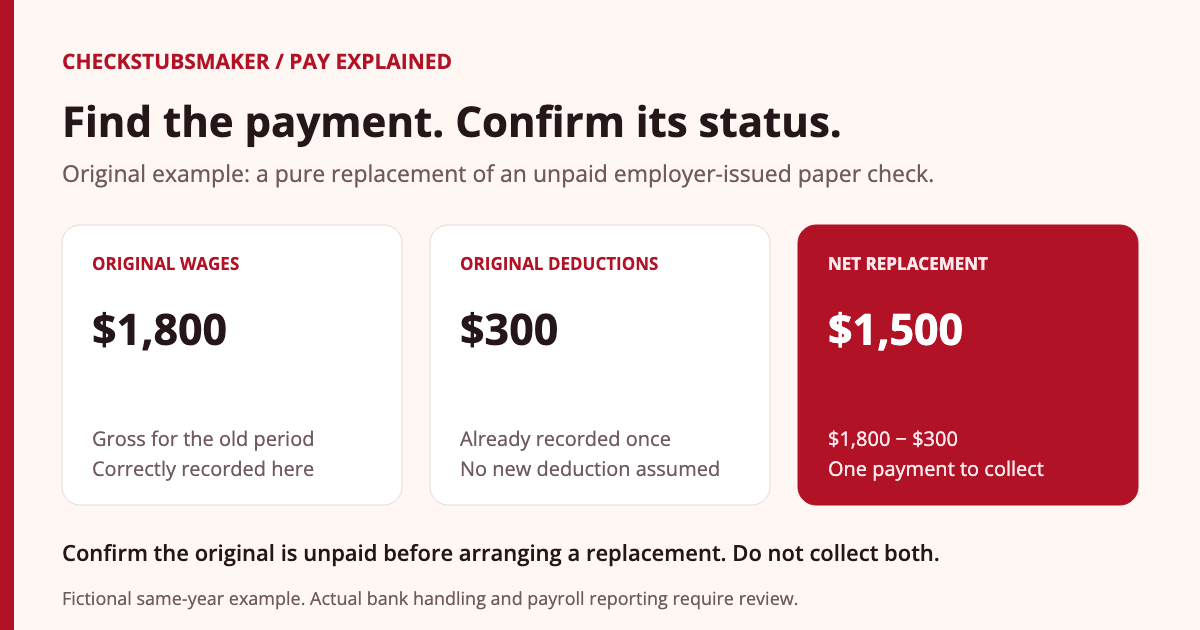
Do not add the original and replacement check amounts as though the employee should collect $3,000. Likewise, do not subtract the original $300 again merely because a replacement payment was issued.
Ask payroll to explain the earnings history, check references, and any tax reporting, particularly if the payment crosses calendar years or the original wage record was wrong. This fictional same-year example does not determine the correct reporting year for every unreceived or reissued payment.
What if the employer already transferred the money?
Uncashed payroll funds can become subject to state unclaimed-property procedures. For example, North Carolina’s official unpresented-check guide specifically includes payroll and wage checks. The applicable reporting rules depend on the state and circumstances; do not apply one state’s timeline nationwide.
If payroll reports a transfer, request the state name, reporting employer or holder name, amount, report year, and any property reference. Those details help distinguish the correct claim from unrelated search results.
USA.gov’s unclaimed-money guide directs people to state unclaimed-property offices. Use the relevant official program’s claim instructions and document requirements. An employer’s old check may no longer be the practical way to collect funds that have already been transferred.
The DOL Workers Owed Wages database is a separate resource for back wages collected by the Wage and Hour Division. It is not a nationwide register of every employer’s uncashed paycheck, so an absent search result does not prove the check was paid.
Which records should you preserve?
- The original earnings statement and check details.
- Relevant bank records and any returned-check explanation.
- The employer’s finding about the original payment.
- The replacement reference and confirmation of receipt.
- Any state transfer details and claim confirmation.
A useful request is: “I found an uncashed paycheck dated [date], check [reference], for [net amount]. Please confirm its payment status and explain the replacement or unclaimed-property process, including how the original will be handled.”
If the issue is unpaid wages rather than a routine replacement, contact the relevant labor agency or qualified adviser promptly. Bank acceptance rules, wage-claim deadlines, and unclaimed-property procedures are separate matters. See documenting a payroll discrepancy and off-cycle paycheck records.
Frequently asked questions
Is every paycheck worthless after six months?
No. Bank acceptance of an old check and the location or status of the underlying funds require separate checks.
Can I cash the earnings statement instead?
No. A pay stub records earnings and deductions; it is not the paper payment instrument.
Should a replacement always be the gross wage amount?
No. For the pure replacement example here, the unpaid net amount is $1,500. Ask about any actual adjustments separately.
Can I deposit the original after receiving a replacement?
Do not try to collect both. Notify payroll and follow its instructions for the original.
Does no match in the DOL database mean no money is owed?
No. That database concerns back wages collected by the Wage and Hour Division, not every outstanding employer check.
Prepared by the CheckStubsMaker Editorial Team using CFPB, state unclaimed-property, USA.gov, DOL, and official payroll-provider sources with an original example. See our editorial policy.