To correct a pay-stub error, contact the employer’s payroll or HR team with the affected pay date, the incorrect line, the expected information, and supporting records. Ask for an employer-issued correction and, if money is affected, a payment reconciliation. Check the corrected statement, any adjustment payment, and YTD totals. Editing a downloaded PDF does not correct the employer’s payroll records.
For U.S. employees · Sources checked October 23, 2026 · All hours, rates, and amounts below are fictional. Correction procedures and payment deadlines depend on the issue and applicable rules.
A statement can show the wrong dates even when the payment is right. It can also look complete while omitting hours or a deduction adjustment. Identify the type of error first so your request addresses the underlying record and any money still due.
What exactly is wrong on the pay stub?
Save the original statement and identify the pay date, work dates, and specific line. Separate what you know from what you still need payroll to explain. A different code or display format is not automatically an incorrect calculation.
| Possible issue | What to compare | What to request |
|---|---|---|
| Missing hours or incorrect rate | Time records, compensation terms, and pay basis | Earnings recalculation and any required payment |
| Unexpected deduction | Code meaning, enrollment, authorization, or relevant order | Explanation of the entry and correction if inaccurate |
| Incorrect period or pay date | Payroll schedule and actual payment record | Correct dates and any resulting reporting review |
| Incorrect personal information | Employer’s employee record | Update through the secure payroll process |
| Wrong YTD total | Prior statements, separate payments, and corrections | A transaction-by-transaction reconciliation |
Use our pay-period versus pay-date guide to distinguish work dates from payment dates. For unfamiliar entries, begin with the deduction-code guide and confirm the employer’s own definitions.
DOL Fact Sheet 21 explains that covered employers must keep accurate required records for non-exempt employees. That federal recordkeeping obligation is distinct from state requirements governing employee wage statements.
Which documents should you gather before contacting payroll?
- The original statement: retain the employer-issued file with its payment reference.
- The relevant work record: daily time entries, approved time corrections, or applicable compensation terms.
- The deduction record: enrollment confirmation, deduction instructions, or the employer’s explanation.
- The payment evidence: posted deposit, paper-check record, payroll-card history, or cash receipt.
- The comparison period: earlier and later statements that help explain the difference.
Keep your own calculation in a separate note. Mark the disputed line on a copy if useful, while preserving the unedited original. Give payroll the dates and figures it needs rather than sending unrelated financial documents.
For a bank comparison, check all split-payment destinations and use net pay rather than gross. Our direct-deposit guide explains that reconciliation. For cash wages, compare the statement with the actual cash payment record.
How should you ask payroll to correct the statement?
Use the employer’s established payroll channel. Include the statement’s date and a short description of the discrepancy. Ask whether the issue affects only the displayed information or also earnings, deductions, payment, and reporting.
Subject: Payroll review requested for [pay date]
My statement for [pay period], paid on [date], shows [recorded entry]. My supporting record shows [expected entry]. The difference appears to be [hours or amount]. Please review the attached records, explain the calculation, and provide an official correction if needed.
Please also confirm any additional or replacement payment, its expected date, and whether current/YTD totals or annual reporting will change.
The wording is an original request template, not a legal notice or statutory form. Adapt it to the facts. Use the secure process for sensitive employee information instead of placing a full Social Security number or bank account number in an ordinary email.
If a manager must approve a time correction, ask payroll which workflow applies and keep the approval record. Do not assume changing a time entry automatically changes a completed payroll run.
What does a missing-hours correction look like?
Assume a fictional hourly employee worked 40 regular hours in one workweek at $20 per hour. Payroll recorded only 38 hours. There is no overtime, bonus, reimbursement, or other earning in this simplified example.
| Entry | Calculation | Gross amount |
|---|---|---|
| Originally recorded | 38 hours × $20 | $760.00 |
| Correct earnings | 40 hours × $20 | $800.00 |
| Gross adjustment | 2 missing hours × $20 | +$40.00 |
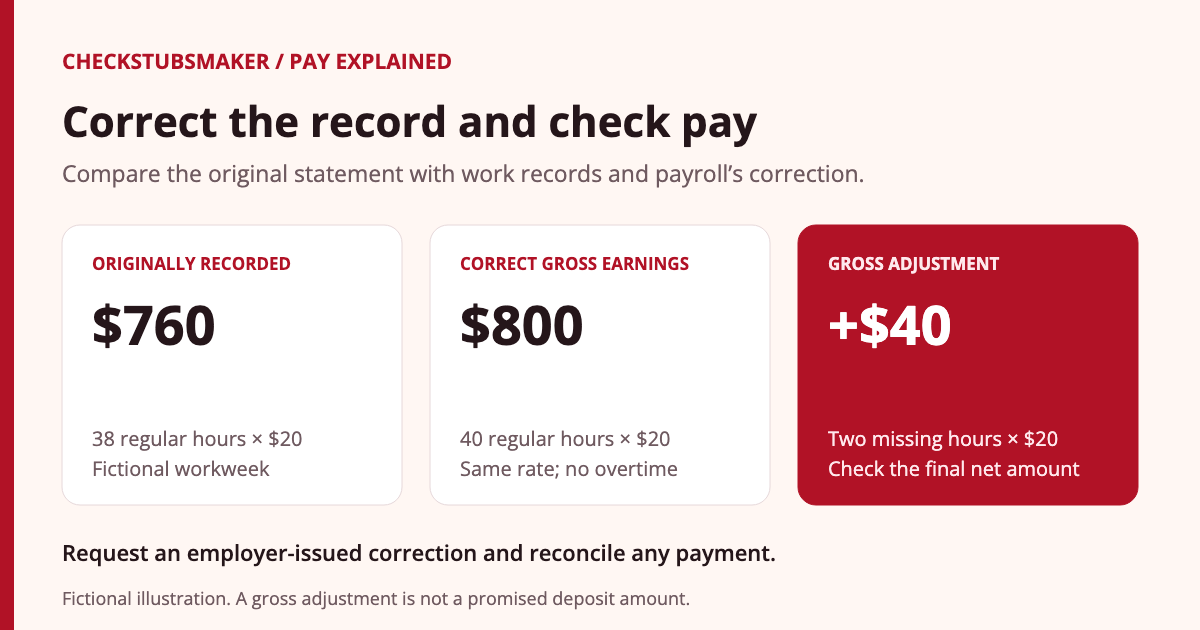
Payroll might use a separate adjustment or reverse and replace the original entry, depending on its process. The corrected records should explain how the original $760 and the additional $40 result in $800 total gross earnings for that work.
Do not add a replacement statement’s full $800 to the original $760 as though both were new earnings. In a reversal-and-replacement example, $760 − $760 + $800 = $800. The net change is still $40 gross.
If overtime is involved, calculate the affected workweeks and applicable rates separately. Our overtime guide explains the basic comparison. A correction for omitted earnings is also different from a later rate adjustment described in the retro-pay guide.
What should you check after payroll issues a correction?
- The corrected field: verify the hours, rate, dates, code, or personal information you reported.
- The gross-to-net calculation: reconcile the correction’s earnings, employee deductions, and payment adjustments.
- The actual payment: match any additional, reversed, or replacement transaction with payroll’s explanation.
- The running totals: confirm that corrections appear once in current and YTD records.
- The supporting records: retain the original, correction, response, and payment evidence together.
For a simple same-year adjustment, suppose the original gross YTD was $15,200 and already included the $760. If the only further activity is the $40 gross correction, the revised gross YTD would be $15,240. Other payments or reversals require a fuller reconciliation.
Use our YTD guide to avoid counting the current correction twice. A fixed record and a completed payment are separate items to confirm.
What if the error also affects a W-2?
The IRS incorrect-W-2 guidance tells employees to ask the employer to correct errors. A corrected payroll statement does not by itself establish that an already issued annual form was corrected.
The SSA’s W-2c guidance explains the employer’s process for correcting submitted wage statements. Ask which annual forms, if any, need correction and request the official employee copy when applicable.
If a return has already been filed using wrong information, follow the IRS guidance for the actual situation. Our last-pay-stub tax guide explains why a payroll statement should not simply replace the proper annual filing documents.
What if payroll does not resolve the error?
Follow up in writing with the original request, relevant evidence, and the specific unresolved amount or field. Ask for a status and the expected correction or payment date. Escalate through the employer’s payroll or HR process where appropriate.
For concerns covered by federal wage laws, the DOL complaint process explains how to contact the Wage and Hour Division and what information to gather. State rules may govern additional wage or statement issues; the state labor-office directory can help identify the relevant agency.
Do not assume every issue has the same correction deadline or that an internal review suspends a filing deadline. Preserve records and seek qualified help when the applicable rights or timing are disputed. Keep unresolved records according to the considerations in our retention guide.
Frequently asked questions
Can I fix the error by editing my downloaded pay stub?
No. Request the employer’s official correction. A changed PDF does not update payroll, payment history, or annual reporting.
What if I was paid correctly but the pay period is wrong?
Request a date correction and ask whether other records are affected. A display correction does not automatically require another wage payment.
Will a $40 gross correction always add $40 to my bank account?
No. Applicable withholding and other adjustments can affect the correction’s net amount.
Should I keep the incorrect statement?
Yes. Keep it with the official replacement or adjustment and the explanation of what changed.
Does a corrected pay stub automatically correct my W-2?
No. Ask payroll to review annual reporting separately and provide the appropriate corrected form if needed.
Prepared by the CheckStubsMaker Editorial Team using the primary sources linked above and original examples. See our editorial policy for sourcing and correction standards. Payroll procedures and legal obligations depend on the error, employment arrangement, and applicable rules.