An off-cycle paycheck comes from a payroll run outside the employer’s regular payroll schedule. It may pay omitted wages, a bonus, a final payment, or another adjustment. Read the reason, covered work dates, earnings, deductions, and payment status before treating it as a second ordinary paycheck. A separate payroll run does not necessarily change your regular pay frequency.
For U.S. employees · Sources checked November 14, 2026 · Employer procedures, provider settings, payment speeds, and wage-payment deadlines vary. The correction example uses fictional amounts and does not calculate an individual tax obligation.
An unexpected statement between normal paydays can be reassuring or confusing. It might close a missing-hours gap, deliver an award, or document a replacement payment. The useful question is what this payroll run changes in the complete pay history.
What is off-cycle payroll used for?
ADP’s payroll explanation defines an off-cycle run by its position outside the regular schedule. Common reasons include correcting payroll discrepancies and issuing certain additional or final payments. The term describes processing timing; it does not identify one universal type of earnings.
| Reason | What to compare | Important distinction |
|---|---|---|
| Omitted earnings | Time records and the original payment | A correction may add only the missing difference |
| Bonus or award | Award terms and earnings code | One-time earnings are not automatically recurring salary |
| Final payment | Separation details and applicable requirements | Final-pay rules vary; there is no universal deadline here |
| Replacement or payment change | Original reference, void/reissue records, account activity | Replacement money is not automatically new earnings |
A provider may use different labels, including correction payroll, special payroll, or an additional check. Ask for the reason recorded by your employer. An internal run name alone does not explain whether cash was newly issued or a record was changed.
Which dates should you check?
Identify the statement’s pay date, the work period affected, the processing date if supplied, and the actual payment status. A correction paid now may relate to work included in an earlier period. It does not necessarily mean those hours were worked again.
For example, a statement paying four omitted hours from an earlier two-week period should be reconciled with that original period’s time record. Its later pay date is a separate fact. Our pay-period and pay-date guide explains the difference.
Ask when the employer actually submitted the payment and which delivery method was used. A payroll calculation, a submitted bank instruction, and a posted account credit are different stages. Do not assume every off-cycle payment arrives the same day or uses the same account as regular pay.
Example: correcting four missing hours without paying the period twice
Assume a fictional employee worked 80 straight-time hours across two workweeks, with no week above 40 hours. The hourly rate is $25, and no other earnings affect this example. The original payroll accidentally included only 76 hours.
| Item | Calculation | Gross amount |
|---|---|---|
| Original recorded wages | 76 hours × $25 | $1,900.00 |
| Correct full-period wages | 80 hours × $25 | $2,000.00 |
| Off-cycle wage adjustment | 4 missing hours × $25 | $100.00 |
| Reconciled period total | $1,900 + $100 | $2,000.00 |
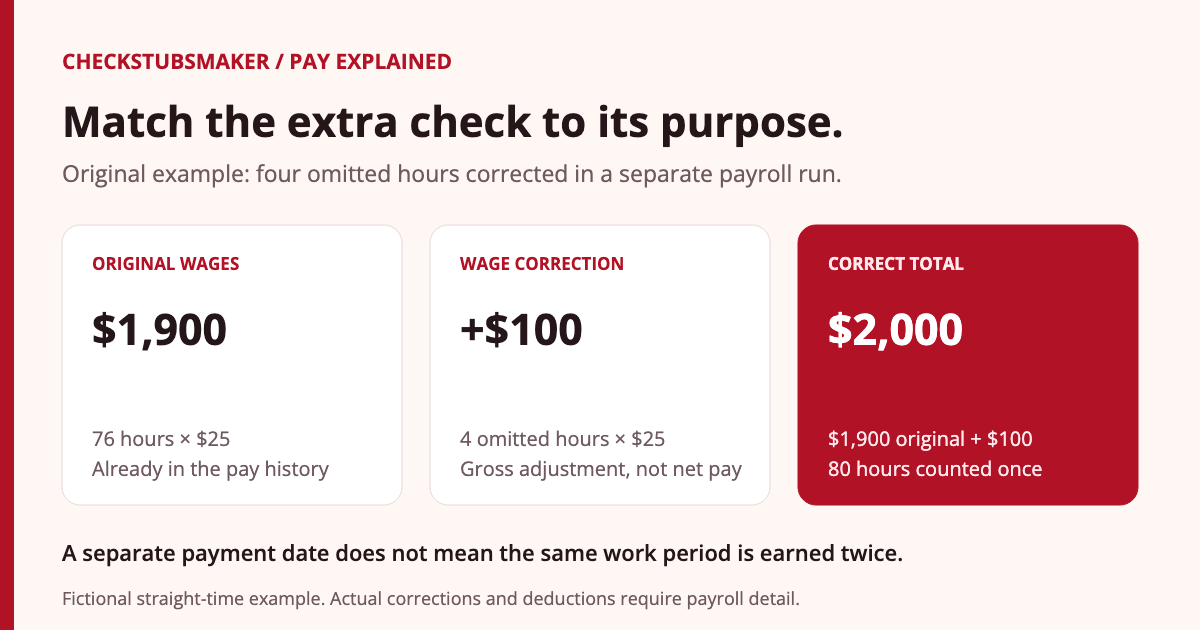
Assume the correction statement separately records $23 of employee deductions and a $77 net payment. Those are supplied fictional payroll amounts, not a tax computation. The difference between $100 additional gross wages and $77 delivered is explained by the assumed deductions.
If the original gross YTD was $38,000 and already included the $1,900, the $100 addition would make gross YTD $38,100, assuming no other intervening payment or adjustment. Do not add an entire replacement $2,000 on top of a YTD figure that already contains the original wages.
Actual corrections can use a difference-only adjustment or reversal-and-replacement accounting. Ask payroll which display applies. Keep both the original and corrected statements. See correcting a pay-stub error and reading YTD totals.
Are off-cycle checks always taxed differently or free of benefit deductions?
No. The payment’s nature and applicable rules matter more than the off-cycle label. Ordinary wage corrections, bonuses, and qualifying expense repayments should not be assumed to receive the same treatment. The IRS Employer’s Tax Guide describes regular and supplemental-wage withholding and expense-payment distinctions.
For a bonus-specific explanation, see bonus pay and withholding. For an expense payment, see reimbursements on a pay stub. Neither the size of the payment nor the existence of a separate statement establishes a universal tax rate.
Provider settings can also affect the display. Gusto’s off-cycle instructions, for example, describe defaults that vary with the reason selected and settings available during setup. That is documentation for its system, not a rule for every employer.
Ask whether insurance, retirement, support withholding, or another deduction should apply to this particular payment. A skipped deduction does not alone prove an error, and a repeated deduction deserves explanation rather than an assumption that every extra check is deduction-free. Compare the actual election, plan, order, or payroll rule.
Is a reissued payment extra income?
Not merely because another statement or transaction exists. A replacement can deliver money that an original payment failed to deliver, while a correction can add genuinely omitted earnings. Those situations require different reconciliations.
Ask whether the original payroll remains valid, was reversed, or was replaced. Match the payment references and confirm the status of each bank credit or paper check. A payroll void entry alone does not establish that the bank recovered a payment.
Likewise, a downloaded advice marked non-negotiable is not a cashable check. If the payment method changed, use the direct-deposit guide or paper-paycheck guide to identify which record delivers funds and which only explains payroll.
What should you ask if the extra check is unclear?
- Request the reason for the off-cycle run and the affected work period.
- Identify the original statement and whether it remains valid.
- Reconcile added wages, reversals, deductions, and revised YTD figures.
- Confirm payment amount, destination, reference, and status.
- Keep the explanation and any employer-issued correction with the original records.
A focused request is: “Please explain how off-cycle payment [reference/date] changes my statement for [original period], including whether it adds earnings or replaces a payment, the deduction treatment, and the updated YTD totals.”
For final wages, review the rules that apply to your location and circumstances. The DOL’s last-paycheck guidance distinguishes the federal position from state requirements. An off-cycle processing label does not determine the legal due date.
Frequently asked questions
Does an off-cycle check change me from biweekly to weekly pay?
Not by itself. A separate run can coexist with the regular schedule. Confirm any actual schedule change with payroll.
Is every off-cycle payment a bonus?
No. The run may concern a correction, final payment, replacement, or another payroll event.
Should the correction pay the entire period again?
Not necessarily. A difference-only correction can add only the omitted amount; reversal-and-replacement processing uses another display.
Is an off-cycle payment guaranteed to arrive immediately?
No. Submission, approval, delivery method, cutoffs, and bank processing affect timing.
Why did my YTD change between regular paydays?
An additional payment or adjustment can change the running total. Reconcile the intervening activity rather than adding overlapping YTD amounts.
Prepared by the CheckStubsMaker Editorial Team from primary payroll-provider, IRS, and DOL sources with an original correction example. See our editorial policy.