A payroll overpayment means an employee received more pay than was properly due for the payment in question. To review it, establish the correct earnings, compare them with what payroll paid, and request a written gross-to-net reconciliation. The gross error, extra cash received, and proposed repayment amount are separate figures that need explanation.
For U.S. employees · Sources checked November 17, 2026 · State recovery rules and federal tax-year treatment can differ. The examples identify a fictional error; they do not authorize a wage deduction or prescribe a repayment amount.
A notice saying “you were overpaid $100” is incomplete without the affected pay period and calculation. You need to know whether $100 describes excess wages, an extra bank payment, or a proposed recovery after tax adjustments.
How do you establish whether the payment was excessive?
Start with the agreed rate, actual work, eligible earnings, and the period being paid. Compare those inputs with the statement and payment record. A higher deposit alone does not prove an overpayment: it might reflect a legitimate bonus, reimbursement, correction, or separate earnings period.
Common items to investigate include an incorrect rate, duplicate payment, extra units entered, or earnings carried forward after their intended end date. Treat these as possibilities to verify, not proof that any unfamiliar entry is an error.
Keep a wage error separate from a payment-routing issue. Two deposits can be legitimate split payments from one net paycheck. Conversely, the same net amount sent twice can require a payment reconciliation even when the original earnings calculation was correct.
Our retro-pay guide explains legitimate adjustments for earlier earnings, and our pay-period versus pay-date guide helps identify the correct dates.
Example: a $100 gross error is not necessarily $100 extra cash
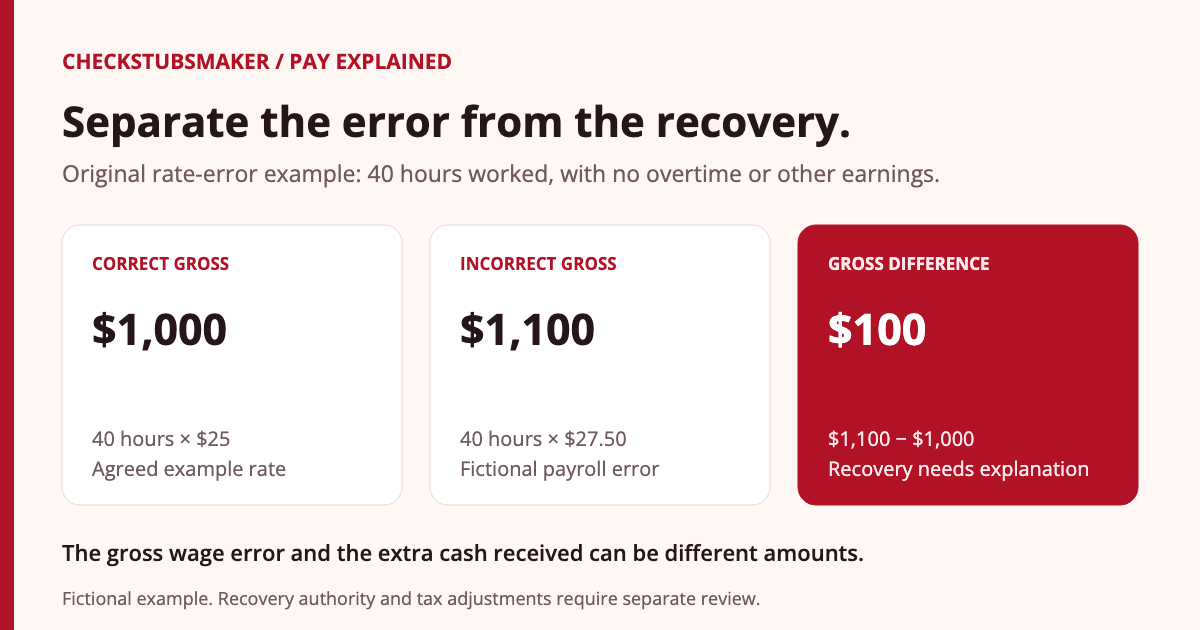
Assume a fictional employee works 40 hours at an agreed $25 per hour, with no overtime, premiums, or other earnings. Payroll incorrectly uses $27.50. The correct gross amount is 40 × $25 = $1,000; the incorrect amount is 40 × $27.50 = $1,100.
For a separate cash comparison within this example, assume payroll’s confirmed recomputation shows $200 of employee taxes on the correct payment and $220 on the incorrect payment, with no other deductions. These tax amounts are invented reconciliation inputs, not withholding estimates.
| Component | Correct payment | Incorrect payment | Difference |
|---|---|---|---|
| Gross wages | $1,000.00 | $1,100.00 | $100.00 |
| Assumed employee taxes | $200.00 | $220.00 | $20.00 |
| Net payment | $800.00 | $880.00 | $80.00 |
The employee received $80 more cash in this scenario, while the gross wage difference is $100. Payroll must explain what happens to the $20 tax difference and how that treatment relates to any requested repayment.
This does not establish that every employee must repay only the net difference, or always repay the gross difference. The applicable recovery arrangement and tax treatment must be established for the actual case. See gross versus net pay for the underlying reconciliation.
Can the employer automatically take it from the next paycheck?
Do not assume that identifying an error authorizes any particular recovery method. Whether a debt is established and whether an employer may deduct money from wages are related but distinct questions.
For example, the New York Department of Labor says wage deductions for overpayments must comply with Part 195. The regulation’s overpayment section includes conditions concerning the qualifying error, notice, recovery limits, and a dispute process. Those are New York rules, not a nationwide formula.
The California Labor Commissioner’s deductions guidance describes significant restrictions on wage offsets, including past salary advances paid in error. A method used by an employer in another state should not be treated as automatic permission in California.
Ask which jurisdiction’s rules apply, what recovery method is proposed, when it would occur, and how to dispute the amount or terms. Do not assume a general written consent overrides every wage protection. If the explanation remains disputed, consult the relevant labor agency or qualified adviser with the actual records.
Why does the year of repayment matter?
Record both the original payment date and the proposed repayment date. An error corrected during the same calendar year can have a different federal tax-reporting path from wages repaid in a later year.
The wage-repayment section of IRS Publication 15 distinguishes current-year and prior-year wages. For prior-year repayments, its instructions do not simply allow the employer to reduce current-year wages or remove the repaid amount from prior-year Form W-2 box 1. Social Security and Medicare corrections have their own instructions.
Ask payroll to explain the applicable reporting and any documents you will receive. Do not assume that filing an amended income-tax return is the standard solution. Individual repayment deductions or credits, where available, require separate review of the relevant return rules.
Keep the employer’s calculation and repayment confirmation for that review. A deposit screenshot alone does not show how payroll handled the wage and tax records.
How might an overpayment correction appear on a pay stub?
Look for an adjustment tied to the original period, an explained recovery entry, tax changes, or a replacement statement. The code and display depend on the employer’s system and the chosen correction process.
| Record or event | Question to ask |
|---|---|
| Earnings adjustment | Which original wages and dates does it correct? |
| Tax adjustment | Which taxes and reporting year are affected? |
| Recovery deduction | Does this entry collect cash, and under what authority? |
| Bank reversal or separate repayment | Has money already been returned outside this paycheck? |
| Remaining balance | What is still outstanding after all confirmed recoveries? |
A gross earnings correction and a cash recovery can perform different functions. Do not automatically call them duplicates, but ask payroll to show that the same cash is not collected twice. If you already returned money separately, the next statement’s recovery needs to reconcile with that payment.
Read current and year-to-date totals in context, especially when the original payment falls in another year. A lower net paycheck alone cannot establish that the final wage and tax records are correct.
What should a complete written explanation include?
- The affected periods, pay dates, and reason for the claimed error.
- The agreed inputs and correct-versus-paid gross earnings.
- The taxes, deductions, and resulting net difference.
- The proposed recovery amount, method, schedule, and applicable process.
- Any money already returned, tax reporting changes, and final balance.
A focused request is: “Please provide the gross-to-net reconciliation for the claimed overpayment, including the tax-year treatment, recovery authority and schedule, and credit for any amount already returned.” Preserve the original statement and the employer’s correction. See requesting a pay-stub correction.
Frequently asked questions
Does an employer’s mistake mean the employee may always keep the money?
No. Establish the actual entitlement and applicable recovery rules rather than assuming either automatic ownership or automatic deduction permission.
Is the gross overpayment always the extra deposit?
No. Taxes and other deductions can make the net difference smaller, as the fictional example shows.
Can a repayment cross into a different tax year?
It can, but that timing can change reporting treatment. Ask payroll for the relevant dates and documents.
Does a negative earnings row prove money was recovered?
Not by itself. Confirm whether the entry corrects records, collects cash, or does both through the documented process.
What if I already repaid the employer separately?
Keep the receipt and ask for it to be reflected in the reconciliation before any remaining recovery is calculated.
Prepared by the CheckStubsMaker Editorial Team using primary IRS and state labor-agency sources with original examples. See our editorial policy.