A post-tax deduction on a pay stub reduces the employee’s cash pay without excluding that amount from the applicable taxable wages. “After tax” describes the deduction’s payroll tax treatment. It does not mean the money must reach your bank account before it can be deducted. Confirm the specific deduction and which wage bases it affects.
For U.S. employees · Sources checked November 17, 2026 · Examples assume ordinary employee wages and specified deduction treatments. Actual tax results depend on the plan, jurisdiction, and employee’s circumstances.
A deduction can reduce take-home pay while leaving federal income-tax wages unchanged. Another deduction can reduce those wages but still remain subject to Social Security and Medicare taxes. Reading only the net-pay total hides that distinction.
What does “post-tax” mean in payroll?
It describes how a deduction is treated when payroll determines taxable wages and take-home pay. The deduction is taken from employee cash, but it does not produce the applicable payroll wage exclusion that a qualifying pre-tax contribution would produce.
An employee’s designated Roth 401(k) contribution is a useful example. The IRS designated Roth FAQ explains that designated Roth contributions are included in gross income when contributed and are subject to applicable wage withholding. The contribution is still sent to the retirement plan rather than deposited as spendable cash in the employee’s account.
Do not identify the tax treatment from a vague benefit name alone. An insurance-related entry, for example, needs its actual plan terms and payroll setup checked. In the example below, the premium is expressly assumed to be an after-tax employee deduction.
How is a post-tax deduction different from a pre-tax deduction?
The difference is the treatment of the relevant taxable wage base. Both kinds can reduce the cash ultimately paid to the employee. A pre-tax label is incomplete unless you also identify which tax it concerns.
| Employee contribution | Federal income-tax wages | Social Security and Medicare wages |
|---|---|---|
| Traditional pre-tax 401(k) | Generally excluded from the current wage base | Generally included, subject to applicable tax rules |
| Designated Roth 401(k) | Included in the current wage base | Generally included, subject to applicable tax rules |
The IRS retirement-contribution withholding chart supports this distinction. It concerns tax treatment, not a recommendation to choose one retirement option over another. Our 401(k) pay-stub guide explains the related contribution fields.
Also separate employee deductions from employer-paid contributions. An employer contribution displayed for information is not automatically another amount to subtract from your take-home pay. Confirm which column records employee money.
Example: a paycheck with two post-tax deductions
Assume a fictional paycheck has $2,500 of cash wages, no pre-tax deductions, no noncash earnings, and no adjustments. Payroll has calculated a combined $500 of employee tax withholding. This $500 is an assumed amount for the reconciliation, not a tax estimate or a rate that readers should apply to their own pay.
The employee also contributes $125 to a designated Roth 401(k) and pays a $40 premium that this fictional plan treats as an after-tax employee deduction. Assume no other deductions or split payments.
| Component | Effect on cash payment | Running amount |
|---|---|---|
| Gross cash wages | Starting earnings | $2,500.00 |
| Assumed employee taxes | Subtract $500 | $2,000.00 |
| Employee Roth 401(k) | Subtract $125 | $1,875.00 |
| Assumed after-tax premium | Subtract $40 | $1,835.00 |
| Net payment | Amount remaining under these assumptions | $1,835.00 |
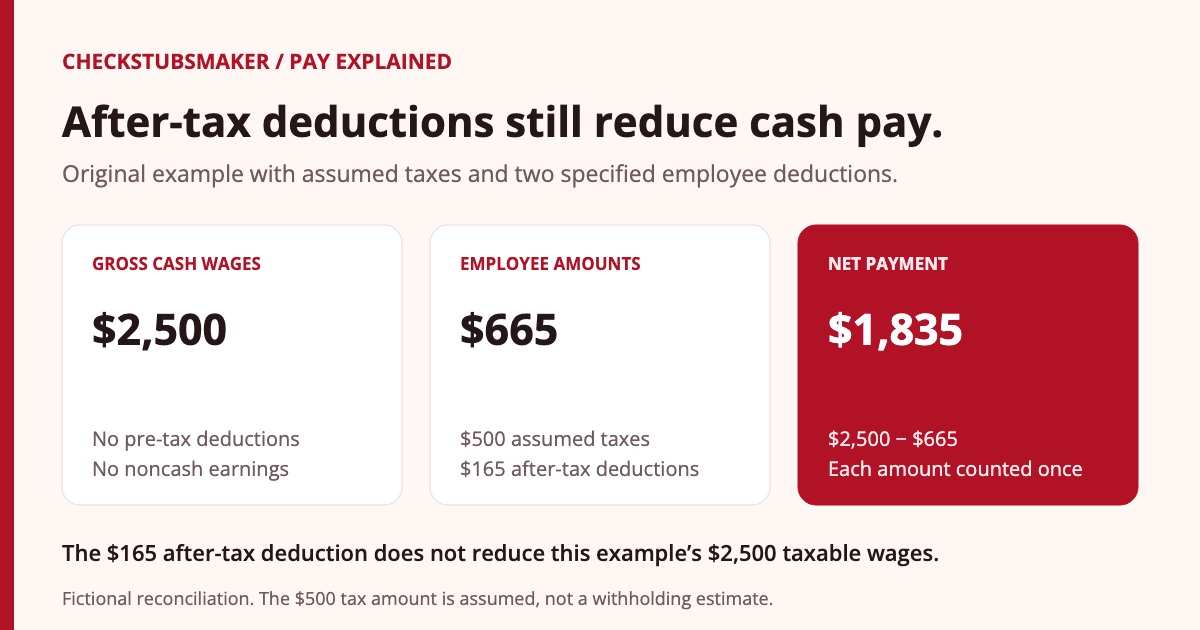
The arithmetic is $2,500 − $500 − $125 − $40 = $1,835. The two post-tax deductions total $165. Do not subtract that $165 again if it is already included in the statement’s total employee deductions.
Under these assumptions, the federal income-tax wage base remains $2,500. It is not $2,335 merely because $165 goes toward after-tax deductions. The example does not calculate the employee’s final annual income-tax bill.
Why can gross pay, taxable wages, and net pay differ?
They answer different questions. Gross pay describes earnings before employee deductions. Taxable wages identify the earnings subject to a particular tax’s rules. Net pay is the cash remaining after the statement’s employee taxes and deductions, with any other applicable payment adjustments accounted for.
For a separate comparison, suppose the same $2,500 of wages instead includes a $125 qualifying traditional pre-tax 401(k) deferral. With no other wage-base adjustments, federal income-tax wages would generally be $2,375, while Social Security and Medicare wages would generally still include the $2,500. This comparison changes the deduction assumption; it does not reuse the earlier $500 tax amount to predict a new net paycheck.
IRS Topic 401 on wages and salaries explains why certain salary-reduction amounts can be excluded for income-tax purposes while remaining subject to Social Security and Medicare taxes. See our taxable-wages guide for a fuller statement comparison.
“Post-tax” also does not settle every possible issue on an individual income-tax return. The payroll classification alone cannot establish whether a separate deduction or credit is available under the relevant return rules.
How do you check an unfamiliar after-tax entry?
- Find the complete deduction name and the employer’s code legend.
- Confirm whether the amount is an employee deduction or employer information.
- Compare the current amount with the effective benefit or contribution election.
- Ask which taxable wage bases the deduction changes.
- Reconcile the deduction once in gross-to-net totals.
Read current and year-to-date columns separately. A current deduction of $125 and a year-to-date deduction of $1,000 do not mean $1,125 was taken from this paycheck. See pay-stub deduction codes.
If an election is a percentage, identify the plan’s applicable compensation base before checking it. A five-percent election applied to $2,500 is $125, but a different eligible-compensation definition can change the result. Do not assume that every earnings row is included in every benefit calculation.
What should you ask payroll about a possible error?
Ask: “Please explain deduction [code] on my [pay date] statement, including the employee amount, effective election, calculation base, and federal income-tax, Social Security, and Medicare treatment.” Attach only the relevant information through the employer’s normal secure process.
If a mistake is confirmed, request the employer’s corrected record and an explanation of the cash and tax adjustments. Editing a personal copy does not change payroll records or tax reporting. Our correction guide explains what to preserve.
Frequently asked questions
Are post-tax deductions the same as income-tax withholding?
No. Tax withholding pays tax amounts; a post-tax benefit or contribution deduction has its own purpose and tax treatment.
Does a post-tax deduction lower take-home pay?
An employee cash deduction generally does. Check whether the amount is already included in total deductions before subtracting it.
Does a Roth 401(k) employee deduction reduce current federal income-tax wages?
Designated Roth employee contributions are included in current income rather than excluded like qualifying traditional pre-tax deferrals.
Does pre-tax mean exempt from every payroll tax?
No. Different taxes can use different wage bases. Check the particular contribution and tax.
Does an after-tax label prove the amount is correct?
No. The amount, election, effective date, compensation base, and payroll treatment still need to agree.
Prepared by the CheckStubsMaker Editorial Team using IRS guidance and original reconciliation examples. See our editorial policy.