Biweekly pay means getting paid every two weeks, usually 26 times per year. Semimonthly pay means getting paid twice each month, normally 24 times per year. For the same $62,400 annual salary, equal full-period payments would be $2,400 on a 26-paycheck schedule or $2,600 on a 24-paycheck schedule, before deductions. Confirm your employer’s calendar because some biweekly years contain 27 paydays.
For U.S. employees · Sources checked October 12, 2026 · All dollar examples are fictional gross-pay calculations.
“Every two weeks” and “twice a month” sound similar until you compare the actual payments. One follows a repeating 14-day interval; the other follows two dates in each calendar month. Understanding that difference helps you interpret a pay stub, compare salary offers, and plan around the money arriving in your account.
What is the difference between biweekly and semimonthly pay?
The practical difference is the rule that determines the next payday. A biweekly schedule advances by two weeks. A semimonthly schedule uses two designated dates per month, such as the 15th and the last day. Gusto’s pay-schedule documentation describes those two arrangements separately.
| Feature | Biweekly | Semimonthly |
|---|---|---|
| Payment pattern | Every two weeks | Twice per calendar month |
| Typical yearly count | 26 regular paychecks; sometimes 27 | 24 regular paychecks |
| Typical date pattern | Every other Friday, for example | Two set dates, such as the 15th and month-end |
| Gap between scheduled dates | 14 days before calendar adjustments | Varies with the selected dates and month length |
| What to confirm | Actual payday count for the year | Both scheduled dates and the periods they cover |
The IRS’s 2026 Publication 15-T, Worksheet 1A, Table 3, uses 26 for biweekly and 24 for semimonthly in its annual pay-period table. That standard comparison is useful, but an actual payroll calendar is still necessary when counting payments received in a particular year.
How much is each paycheck for the same annual salary?
For an unchanged salary split into equal full-period payments, divide the annual amount by the number of payments used by payroll:
Gross pay per paycheck = annual salary ÷ scheduled salary payments.
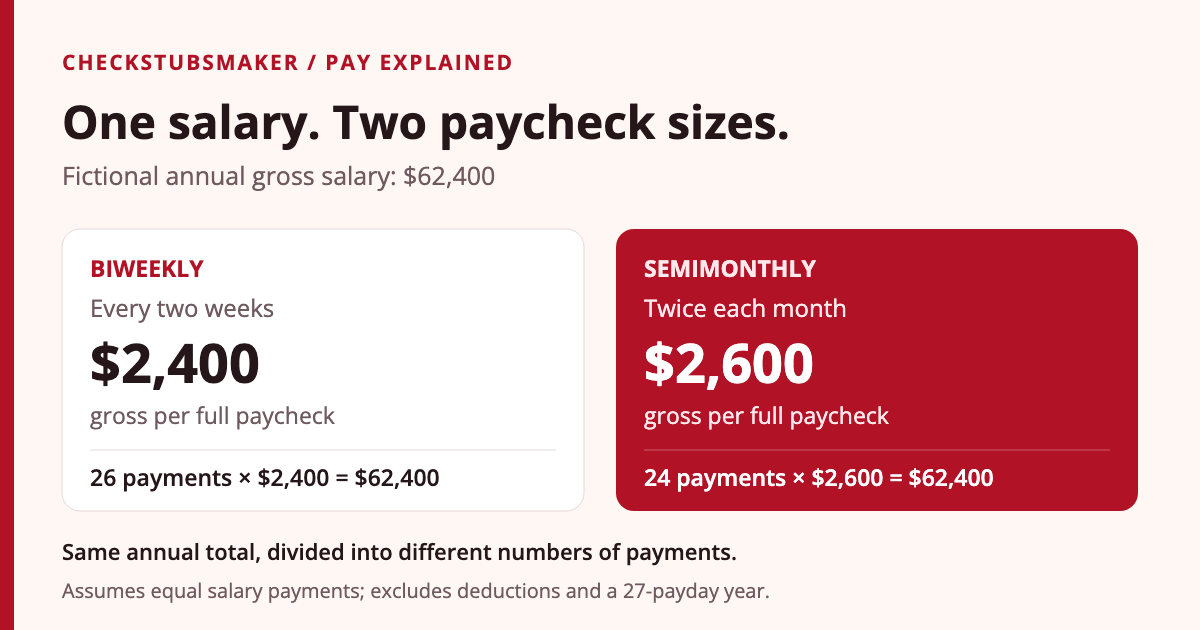
Suppose the fictional annual salary is $62,400, with a full year of employment, no unpaid time, no bonus, and no midyear salary change. The following comparison assumes 26 equal biweekly payments or 24 equal semimonthly payments.
| Calculation | Biweekly | Semimonthly |
|---|---|---|
| Annual gross salary | $62,400 | $62,400 |
| Payments in this example | 26 | 24 |
| Division | $62,400 ÷ 26 | $62,400 ÷ 24 |
| Gross per full paycheck | $2,400 | $2,600 |
| Annual check | $2,400 × 26 = $62,400 | $2,600 × 24 = $62,400 |
The $200 difference between the individual checks comes from dividing the same total into different numbers of payments. A larger individual paycheck does not, by itself, show a larger annual salary. Conversely, two offers of $2,400 per paycheck would need closer examination: $2,400 × 26 is $62,400, while $2,400 × 24 is $57,600 under these assumptions.
These are gross figures. Employee taxes and other deductions determine what remains available to spend. Our guide to gross pay versus net pay shows how those amounts fit together on one paycheck.
Why do biweekly schedules have three-paycheck months?
A two-week interval keeps moving through calendar months. In a hypothetical 31-day month, biweekly paydays might fall on the 1st, 15th, and 29th. A semimonthly schedule set for the 15th and last day would instead have two scheduled dates: the 15th and 31st. This is a pattern illustration before any weekend or holiday adjustment.
The distinction also changes monthly cash flow in the salary example:
- Two biweekly payments: $2,400 × 2 = $4,800 gross received that month.
- Three biweekly payments: $2,400 × 3 = $7,200 gross received that month.
- Two semimonthly payments: $2,600 × 2 = $5,200 gross received that month.
The annual salary divided by 12 is also $5,200, but that is a monthly average. It does not mean a biweekly employee receives exactly $5,200 during each month. For spending plans, list the actual deposit dates and net amounts beside the bills due between them.
What changes in a 27-payday year?
ADP’s payroll-calendar guide notes that biweekly calendars can sometimes contain 27 pay periods. Count your employer’s actual paydays and ask how salary payments will be handled. Do not automatically apply the 26-payment example to that year.
The arithmetic explains why this matters: 27 unchanged checks of $2,400 would total $64,800, rather than $62,400. That calculation illustrates a possible total; it does not promise an extra salary payment. Your employer’s documented arrangement determines the amount of each payment.
Do weekends or holidays change the schedule type?
A calendar adjustment can move an individual payment without changing the underlying frequency. Gusto, for example, documents moving a payday that falls on a weekend or bank holiday to the preceding business day. Other payroll arrangements should be checked against the employer’s own calendar. One early deposit is insufficient evidence of a new pay schedule.
How can you tell which schedule your pay stub uses?
Read the pay-period dates and the pay date separately. The CFPB’s pay-stub handout identifies the pay period as the calendar days covered by the paycheck. The date you receive the payment can be later than the end of that period.
- Find the period start and end. Record the work dates covered, not just the bank-deposit date.
- Compare several regular statements. A repeating two-week period suggests biweekly payroll. Two recurring calendar portions per month suggest semimonthly payroll.
- Check the listed frequency. If the statement or payroll portal labels the schedule, use that label and confirm it with the calendar.
- Exclude separate payments when identifying the pattern. A bonus, correction, or other payment outside the regular run can add a deposit without adding a normal salary period.
- Ask payroll if the fields disagree. Request the regular frequency, period boundaries, payment dates, and treatment of any calendar adjustment.
For a fictional example, work from April 1 through April 15 paid on April 22 still covers an April 1–15 work period. The payment lag is a separate detail. Gusto’s documentation distinguishes the pay period from payday and describes paying after the work period as paying in arrears.
Do hourly pay and deductions work the same way?
For hourly employees, use the actual paid hours and applicable rates on the statement. A semimonthly period is not automatically 80 hours: the number of workdays changes with the calendar. In a simplified example with regular hours only, 72 hours at $25 produces $1,800 gross, while 88 hours at $25 produces $2,200 gross. The schedule name alone does not establish either amount.
Pay frequency also does not turn two workweeks into one overtime test. The U.S. Department of Labor’s Fact Sheet 23 explains the general federal workweek rule for covered, nonexempt employees and says hours cannot be averaged across two or more weeks. A payroll period and a workweek serve different purposes.
When comparing take-home pay across schedules, read the deductions individually. The IRS publishes separate withholding calculations for biweekly and semimonthly payroll in Publication 15-T. A benefit deduction can also be collected according to an employer’s particular arrangement. Ask which checks carry it rather than assuming a third paycheck is free of deductions.
What should you check when your employer changes pay frequency?
A transition deserves a period-by-period review. A smaller first paycheck may cover a shorter period; a different regular payment may simply reflect a new divisor. Compare the records before deciding whether annual compensation changed.
- Confirm the annual salary or hourly rate. Check the written compensation information separately from the new paycheck size.
- Map the last old period and first new period. Look for which dates each payment covers and ask about any gap or overlap.
- Check deductions and payment allocations. Record which amounts will be taken on each new payday.
- Update the household payment calendar. Review bills due before the first new deposit and between subsequent deposits.
- Use the remaining schedule for projections. Add amounts already paid to the expected future payments instead of multiplying one transition check by 24 or 26.
Our guide to calculating annual income from a pay stub explains how to combine year-to-date earnings with a forecast when pay changes during the year.
Frequently asked questions
Is biweekly pay the same as twice a month?
No. Every two weeks follows a 14-day pattern, while twice a month follows two designated calendar dates. Use the employer’s explicit frequency and calendar if an offer uses unclear wording.
Does semimonthly pay mean the 15th and 30th?
Not necessarily. Those dates are only one possible description, and February does not have a 30th. Confirm whether the policy uses a specific date, the last day of the month, or another pair of dates.
Does switching to biweekly mean my salary was reduced?
A lower individual check is not enough to establish a reduction. In the $62,400 example, $2,600 paid 24 times and $2,400 paid 26 times reach the same annual gross total. Check the salary agreement and the actual transition periods.
How many paychecks will I receive if I start midyear?
Count the scheduled payments that apply to your employment, including any partial first period. The standard full-year count does not describe a partial year at one job.
Which schedule should I enter when creating a pay stub?
Use the actual payroll frequency and the correct start date, end date, and payment date from your records. Enter the earnings and deductions for that payment. Choosing a schedule for a document does not change the arrangement under which the wages were paid.
Sources and editorial notes
The linked payroll documentation supports the schedule definitions and calendar mechanics. CFPB supports the distinction between pay fields; IRS guidance supports the standard pay-period counts and frequency-specific withholding methods; Department of Labor guidance supports the workweek distinction. All salary, hourly-pay, and calendar-pattern examples are original illustrations.
Published by the CheckStubsMaker Editorial Team. This guide explains common U.S. payroll schedules; your employment records and payroll calendar determine your payments. Read our editorial policy for sourcing and corrections.