To get pay stubs from a previous employer, check your former payroll portal, then ask HR or payroll for copies covering specific pay dates. Include your name, employment dates, and employee ID if available. If online access has ended, ask for a secure delivery method. A W-2, tax transcript, or bank statement may help document income, but each shows different information and does not automatically replace a pay stub.
For U.S. employees · Sources checked October 13, 2026 · The dates below are fictional examples.
Leaving a job can mean losing access to a work email address or payroll account. Start by identifying the exact records you need. A request for two recent payment statements is easier to fulfill than a request for every document connected with your employment.
What is the best way to get old pay stubs?
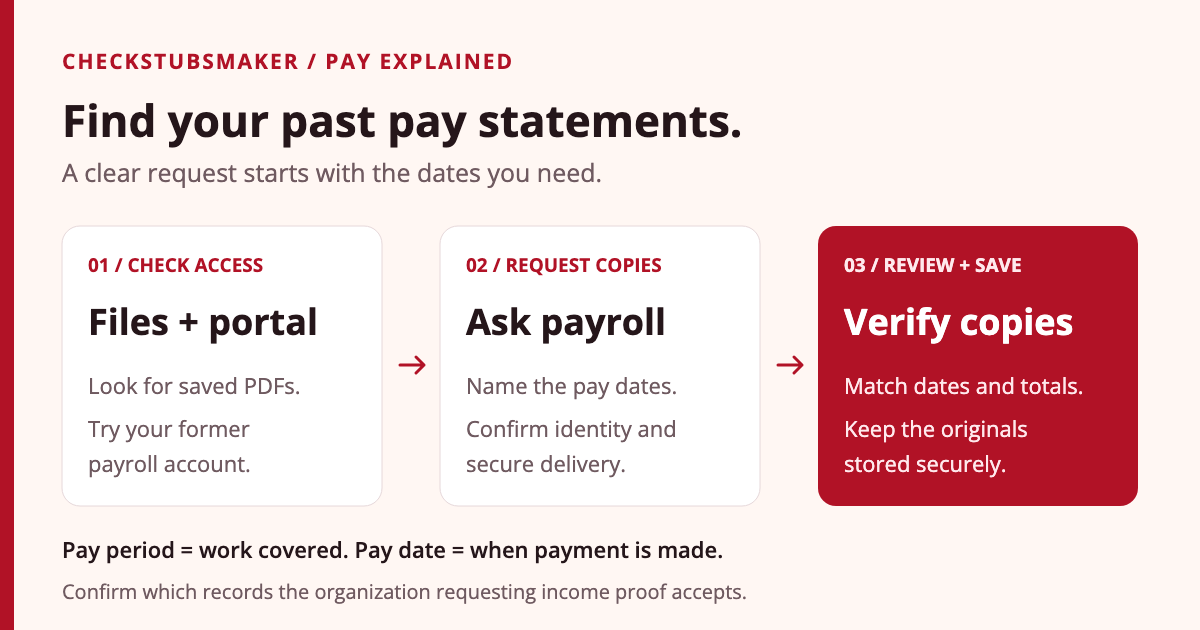
Use this order to locate employer-issued records and keep track of what is still missing:
- Define the request. Ask the organization requesting your income proof which dates, document types, and file formats it accepts.
- Search your own files. Look for saved PDFs, paper statements, payroll emails, and separation paperwork identifying the payroll provider.
- Check your former employee account. Use the provider’s official website or your saved employer link. Look for pay history or payment statements.
- Request missing copies from payroll. Give the specific pay dates or date range. Ask whether archived records are held in an older system.
- Confirm delivery and review the files. Keep the request, reply, and downloaded copies together. Check that every requested payment is represented.
A locked account does not, by itself, establish that the payroll records have been deleted. Access permissions and record storage are separate questions. Ask payroll about both.
Can you access ADP or Gusto after leaving a job?
Access depends on the provider and the account your employer set up. Do not assume that every portal has the same policy or keeps the same amount of history.
ADP
Try your existing account through ADP’s official employee login page. ADP explains that employers control online payroll access and supply registration codes. If you cannot recover the account, contact your former HR or payroll department; ADP’s employee support guidance also directs authentication and paycheck questions to that department.
If both your old and new jobs use ADP, confirm which employer’s records you are viewing. A current job’s login does not prove that the former job’s statements are available there.
Gusto
Gusto’s sign-in guidance says employees paid through Gusto can still access their profile and pay records after leaving. Check the personal email associated with the account, and follow its recovery process if that address is outdated.
Its pay-stub instructions describe downloading PDFs from pay history. They also note that older statements may be in another payroll system. If an expected period is missing, ask which provider processed that payment.
Other payroll systems
Check the official help page for that provider. A former work email, employer-only sign-in, or changed phone number can prevent account recovery. Ask the employer to confirm the approved recovery route rather than creating a second account and assuming it will contain the old records.
How should you ask a previous employer for pay stubs?
Send a short request through a verified payroll or HR contact. This original template provides the information needed to locate the records without including sensitive identity documents in the first message.
Subject: Request for copies of past pay statements
Hello Payroll Team,
I previously worked for [company] from [start date] to [end date]. Please provide copies of my pay statements for the payments dated [dates], or for the period [date range].
My name during employment was [name], and my employee ID was [ID, if known]. I no longer have access to [former portal or work email].
Please let me know how to verify my identity and receive the records securely. PDF copies would be helpful. Could you confirm receipt and the expected delivery date?
Thank you,
[name]
[current contact information]
Keep a dated copy. If payroll needs additional identity verification, use its confirmed process. Avoid sending a full Social Security number, bank details, or an ID scan in an ordinary initial email.
Should you request pay dates or pay periods?
Include both when you know them. The pay period describes the work covered; the pay date identifies when the payment was made. A deposit appearing in October can cover work performed in September.
Suppose a former employee needs the two most recent statements from a fictional biweekly job:
| Statement | Work period | Pay date |
|---|---|---|
| First | September 1–14, 2026 | September 18, 2026 |
| Second | September 15–28, 2026 | October 2, 2026 |
Requesting only “October’s pay stubs” could omit the September 18 payment. Naming both pay dates removes that ambiguity. These dates illustrate the distinction; they are not a standard schedule for every employer.
If you only know deposit dates, say so. Provide those dates as clues and ask payroll to identify the matching statements. Our biweekly versus semimonthly guide explains why different schedules produce different date patterns.
Must a former employer provide copies, and how long are records kept?
For U.S. employees, separate federal recordkeeping rules from applicable state access rules. The Department of Labor’s FLSA guidance says the federal law requires accurate wage and hour records but does not itself require employers to give employees pay stubs.
DOL Fact Sheet 21 describes at least three years of payroll-record retention under the FLSA and two years for records supporting wage calculations. Those periods do not promise a particular online-access window or unlimited copies of every historical statement. State rules may add requirements.
For example, California’s labor agency explains that current and former employees can request inspection or copies of their payroll records, with compliance as soon as practicable and no later than 21 calendar days after the request. That is a California rule, not a nationwide deadline. Payroll-record and general personnel-file rules also differ.
Check the rules for your situation through the appropriate agency. The DOL state labor office directory provides a starting point for finding state contacts.
What if the company closed or does not answer?
Search separation documents for a payroll contact, successor company, benefits administrator, or records custodian. If the business was acquired, ask the successor where historical payroll records are held. Contact the payroll provider through its official support channel to learn what access or recovery help is available; do not assume it can release records independently.
For an unanswered request, send a follow-up referencing the original date and missing statements. Ask for confirmation of the correct contact and any applicable response deadline. If an access requirement or unpaid-wage issue remains unresolved, contact the relevant labor agency for guidance.
Meanwhile, explain the delay to the organization requesting income proof. Ask whether an extension or a specific alternative document is acceptable. Acceptance depends on that organization’s requirements.
Can a W-2, IRS transcript, or bank statement replace a pay stub?
These records answer different questions. Confirm acceptance before substituting one:
| Record | Useful information | Main limitation |
|---|---|---|
| Employer-issued pay stub | Earnings, deductions, and payment details for a specific payroll payment | One statement may not cover the full requested period |
| Form W-2 | Reported annual wage and tax information | Does not itemize every individual paycheck |
| IRS wage and income transcript | Information returns reported to the IRS, including W-2 data | May be incomplete for the year being processed; W-2 state/local details are excluded |
| Bank statement | Deposits recorded in that account | Does not establish gross wages, hours, or individual payroll deductions |
IRS Topic 159 explains wage and income transcripts, their availability for the past ten tax years, and reporting limitations. A transcript contains reported tax information; it is not a collection of your old pay stubs.
A bank deposit can help match a payment, but net cash does not reveal the original gross earnings. Reimbursements, split deposits, and separate payments can complicate a comparison. Our gross versus net guide explains those payroll measures, while W-4 versus W-2 explains the annual form’s role.
What should you check when the copies arrive?
- Match the employer and your employee identity.
- Check each pay date and the work period covered.
- Distinguish current-payment amounts from year-to-date totals.
- Check earnings, deductions, and net pay; investigate unexpected differences.
- Ask whether a corrected statement supersedes an earlier copy.
- Save the original files securely with clear employer and pay-date filenames.
Keep an unedited original even if the recipient allows a redacted submission. If you need to prepare a statement from payroll records, use verified earnings, deductions, and dates. CheckStubsMaker can help format accurate details, but a newly prepared document does not recover an employer’s historical record or establish the recipient’s acceptance.
Frequently asked questions
Can I request pay stubs after quitting?
Yes, you can ask your former HR or payroll department for copies. Whether a particular request is legally required, and the response deadline, depends on the applicable rules.
What if I no longer have my work email?
Check whether the payroll account uses a personal email. If recovery depends on the old work address, ask the former employer or the provider’s official support team about the approved recovery process.
Can I get pay stubs from the IRS?
IRS wage and income transcripts provide reported tax-form data, rather than individual payroll statements. Request actual pay-stub copies from the employer or its payroll system.
Can I get statements from several years ago?
Ask payroll about archived records and which systems processed those years. Federal retention rules and state requirements do not guarantee permanent employee portal access.
How quickly should a former employer respond?
There is no single nationwide deadline established by the federal pay-stub guidance above. Check applicable state rules and ask payroll for an expected delivery date. California’s cited payroll-access rule uses a 21-calendar-day limit.
Sources and editorial notes
This guide uses official ADP and Gusto access instructions, Department of Labor recordkeeping guidance, California payroll-record access guidance, and IRS transcript information. Its request template and date example are original. State requirements and document acceptance depend on the situation.
Published by the CheckStubsMaker Editorial Team. Read our editorial policy for sourcing and corrections.