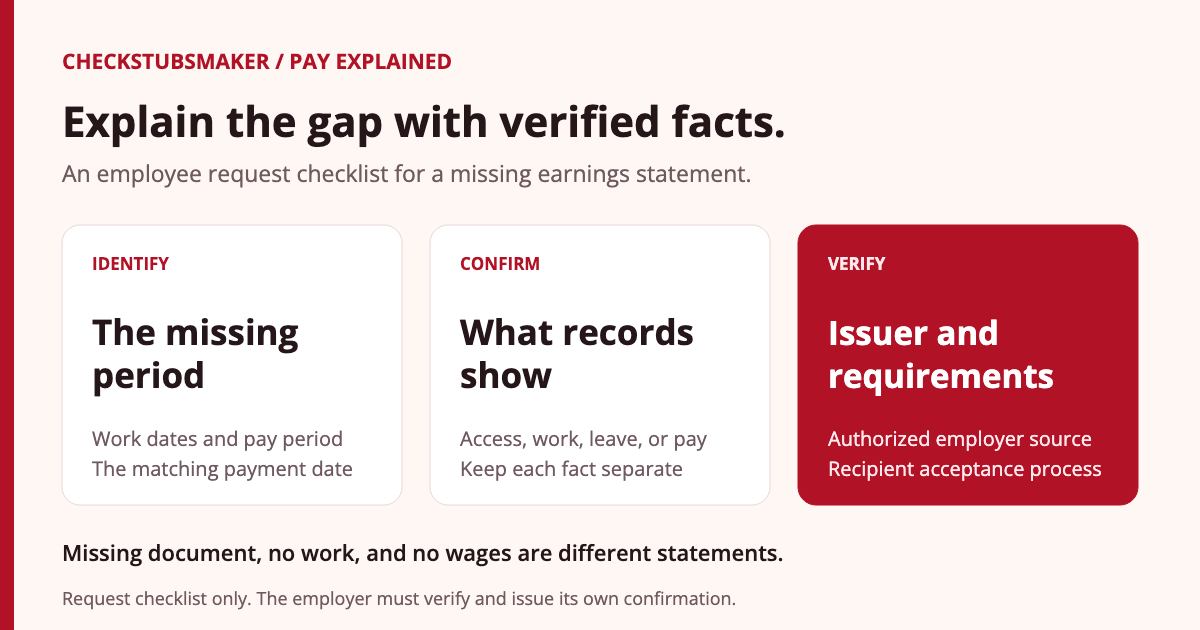
Ask payroll or an authorized HR representative for a factual letter explaining the missing pay-stub period and what the employer’s records confirm. First ask the recipient whether it requires a particular form or additional records. A statement that a stub is unavailable is different from a statement that no work occurred or no wages were paid.
For U.S. employees · Sources checked November 11, 2026 · A letter’s acceptance depends on the recipient and purpose. This guide provides an employee request checklist, not an employer-issued certification or a substitute payroll statement.
A useful letter resolves a specific gap. “No pay stub for that week” is too vague when a reviewer needs to know whether the week belongs to a longer payroll period or whether wages were paid on another date.
What exactly needs to be explained?
| Situation | What remains to confirm | Useful next step |
|---|---|---|
| Portal access is unavailable | Whether an earnings statement exists elsewhere | Request a duplicate or authorized access |
| Requested week falls inside a longer pay period | Which statement covers the dates | Identify the matching period and pay date |
| No work was scheduled | Whether leave or another payment still applied | Ask the employer to review payroll and leave records |
| No payment appears on one date | Whether payment was due or made another way | Reconcile the actual payroll and payment timeline |
ADP’s access guidance, for example, directs employees to employer-provided access. An access problem should be described as an access problem until the employer confirms more.
Use our pay period versus pay date guide to identify the relevant dates, and consecutive-statement checklist when several records are requested.
Will an employer letter replace a missing pay stub?
Ask the recipient. A landlord, lender, agency, or other reviewer may want its own form, a direct employer response, recent statements, or additional proof. A letter confirming employment may not supply all the earnings details the reviewer needs.
One specific example is Washington DSHS Employment Verification, form 14-252. It separates employee authorization from the employer-completed section and asks for actual gross income and other employment details. That form illustrates a particular program’s verification process, not a national replacement-stub standard.
Ask which dates are required, whether the employer must respond directly, and what evidence is needed for the gap. Keep the recipient’s instructions with your request.
What should you ask the employer to include?
Request only accurate details supported by the employer’s records and relevant to the recipient’s requirements:
- The employee and employer names, with appropriate identifiers.
- The exact work dates, payroll period, and pay date being addressed.
- The reason the requested statement is unavailable, if known.
- Whether the statement exists and how a copy may be obtained.
- Any earnings, payment, leave, or employment facts the employer can actually confirm.
- The authorized representative’s name, role, date, and verification contact.
If the recipient requires letterhead, a signature, a specific form, or a secure direct response, include that instruction. These are request items to confirm, not universal legal letter requirements.
Avoid asking the issuer to certify “no income” merely because a document is missing. A payroll representative may be able to confirm employer-paid amounts but cannot necessarily certify the employee’s income from every source.
Example: no hours worked can still include paid leave
Assume a fictional employee worked no hours during October 19–25, 2026, but had eight hours of approved paid leave during that week. Assume those hours are paid at $25 per hour: the leave component is $200 gross before deductions.
Also assume the employer’s statement covers October 12–25 and pays on October 30. The employee may not have a separate statement labeled only October 19–25 because the employer uses the longer payroll period.
| Fact assumed | Accurate interpretation | Unsupported shortcut |
|---|---|---|
| Zero actual work hours in the requested week | No work performed during those dates | No wages of any kind were earned |
| Eight paid leave hours at $25 | $200 gross leave component | Zero gross income for that week |
| One statement covers October 12–25 | The requested week is inside a longer period | No payroll record exists at all |
The $200 is only an assumed component. Other earnings and the complete statement would need separate review. Our paid-leave guide explains why leave entries and hours worked should be distinguished.
How can you phrase the employee’s request?
You can adapt this request to payroll: “I need to explain a missing earnings statement for [dates] to [recipient]. Please confirm which pay period and pay date cover those dates, whether a statement exists, and how I can obtain it. If a letter is appropriate, please describe the verified reason for the gap and the employer records relevant to the recipient’s attached requirements.”
This is a request from the employee. The employer should independently check, issue, and authorize any confirmation. Do not copy an employer signature, invent a representative, backdate a letter, or add unsupported payroll amounts.
If the issue is a disputed payment or suspected error, describe that separately. A letter about document availability does not resolve a wage dispute; see organizing wage-dispute records.
What should you check before submitting the letter?
Compare the names, date ranges, gross-versus-net labels, and explanation with your original records. Ask the issuer to correct a factual error rather than editing the employer’s statement yourself.
Confirm the recipient’s secure submission method and whether it will contact the employer. Share only the identifiers the process requires. Keep the issued letter, supporting records, and correspondence together.
For broader comparisons, see pay stubs versus employment verification. For sensitive documents, see sharing payroll records.
Frequently asked questions
Does a missing stub prove I had no income?
No. It establishes a document gap until the underlying facts are confirmed.
Can the letter cover a week inside a biweekly period?
It can explain the verified relationship if the employer confirms it. The recipient decides what additional evidence is needed.
Who should issue an employer confirmation?
Use an authorized employer representative or the employer’s approved verification process.
Can I guarantee the recipient will accept the letter?
No. Obtain the recipient’s requirements first and follow any requested verification steps.
Should I edit an incorrect employer letter myself?
Ask the issuer for a corrected version and keep the correspondence. Preserve the original records.
Prepared by the CheckStubsMaker Editorial Team using primary provider and government verification guidance and an original date-and-leave example. See our editorial policy. No document acceptance or income eligibility outcome is promised.