PTO means “paid time off.” On a pay stub, it can identify paid leave used during the payment period or the hours remaining in a leave balance. Read the section heading and units: a PTO earnings line shows pay for leave, while an available-balance field usually tracks time you can use. Check the employer’s policy to understand accrual, approval, carryover, and payout rules.
For U.S. employees · Sources checked October 17, 2026 · All hours and dollar amounts below are fictional examples.
A statement can correctly show eight PTO hours paid and twenty hours still available. Those numbers answer different questions. Separate the leave ledger from the earnings calculation before deciding whether time or money is missing.
What do accrued, used, and available PTO mean?
Start by finding the leave category and the period covered. A company may combine vacation and personal leave in one PTO bank or maintain separate vacation, sick, and other policies. Labels and display formats vary, so use the employer’s legend and policy description.
Gusto’s employee time-off guidance distinguishes available hours, requested hours, earning policy, and request status. It also explains that used time and balances appear on pay stubs.
| Possible field | What it describes | What to confirm |
|---|---|---|
| Beginning or previous balance | Time carried into the period | Which date and leave policy the balance belongs to |
| Earned or accrued | Leave credited under the policy | Current-period credit versus a cumulative total |
| Used or taken | Leave recorded as used | The dates and whether the figure is current or YTD |
| Available or remaining | Time shown as available under the system’s rules | Whether future requests or other reservations affect it |
| PTO pay or vacation earnings | Wages paid for leave in this payment | Paid hours, applicable rate, and dollar amount |
| Adjustment or carryover | A separate change to the leave ledger | The reason, date, and applicable rule |
Check whether the unit is hours or days. Twenty hours is not twenty dollars, and a “day” may have a defined length in the policy. A YTD-used figure also differs from the remaining balance. Our YTD guide explains how to distinguish current entries from accumulated totals.
How do you check a PTO balance calculation?
For a straightforward leave ledger, begin with the previous balance, add credited time, subtract used time, and include any separate adjustments. Use entries covering the same policy and cutoff date.
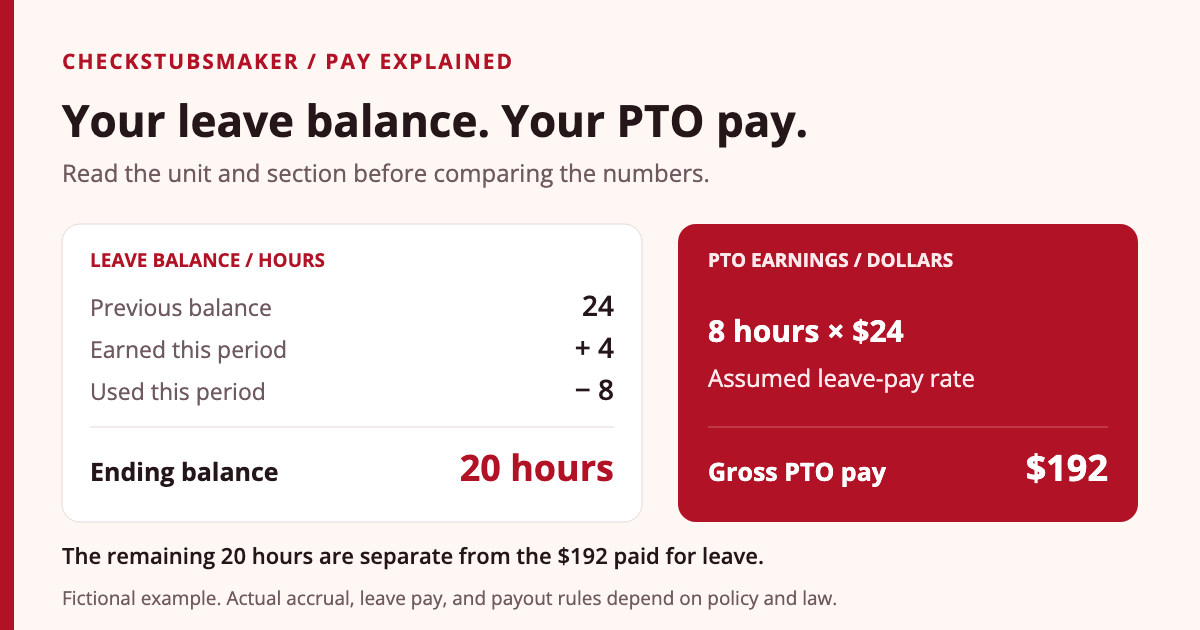
Assume a fictional employee starts the period with 24 PTO hours, earns 4 hours under the employer’s policy, and uses 8 hours. There are no other adjustments, carryover changes, caps affecting the credit, or future reservations in this example.
| Balance item | Treatment | Hours |
|---|---|---|
| Previous balance | Starting time available | 24 |
| Time earned this period | Add credited leave | +4 |
| Time used this period | Subtract recorded leave | −8 |
| Ending balance | 24 + 4 − 8 | 20 |
The ending balance is 20 hours. The employee used eight hours but still earned four, so the balance fell by four hours overall. Looking only at the eight-hour absence would miss that new credit.
If a portal and pay stub show different balances, first compare their cutoff dates and request statuses. A live portal may reflect activity outside the statement period. Ask payroll which transactions are included before adding or subtracting an item again.
How does PTO become pay on the earnings statement?
Now assume this employee is hourly and receives a fictional weekly payment. The employee worked four eight-hour days and took eight hours of paid leave on another day. The hourly wage and the policy’s PTO pay rate are both $24, with no other work, premiums, bonuses, or earnings.
| Earnings line | Hours | Rate | Gross pay |
|---|---|---|---|
| Regular hours worked | 32 | $24 | $768 |
| Paid time off | 8 | $24 | $192 |
| Total paid hours and gross earnings | 40 | — | $960 |
The PTO line contributes 8 × $24 = $192 to gross earnings. The 20-hour ending leave balance is separate. It is not another payment to add to the $960 total.
This example assumes a specific leave-pay rate. Check your policy and actual earnings line rather than assuming every leave category uses the same formula. Salaried statements can display leave hours without using the hourly calculation above.
IRS Publication 15 explains that vacation pay is subject to withholding as a regular wage payment, with supplemental-wage treatment in specified situations such as an additional lump-sum payment for unused vacation. Compare gross PTO earnings with the payroll calculation before comparing the final bank deposit. Our gross versus net guide explains that distinction.
Do PTO hours count toward overtime?
Under the federal FLSA hours-worked rule, paid leave for time not worked need not be counted as hours worked for overtime. The Department of Labor’s Hours Worked Advisor explains this treatment for vacation, holidays, and sick time.
The example above has 40 paid hours but only 32 worked hours. Those totals serve different purposes. The eight PTO hours do not, by themselves, turn the leave into worked time for the federal weekly overtime calculation.
Check the actual workweek and all hours worked, including work outside the regular schedule. State law, contracts, or an employer’s benefit policy may provide additional protections or pay. Our overtime guide explains the difference between an overtime earnings line and ordinary paid hours.
Why might PTO accrue differently between employees or statements?
Some policies credit time based on hours worked; others add a fixed amount on a schedule. A policy may grant a yearly amount at once rather than building the balance each paycheck. Unlimited policies may not maintain an earned-hours bank.
Gusto’s policy guidance describes these different configurations. It also distinguishes balance caps, usage limits, reset dates, and negative-balance settings. Confirm the policy assigned to you and how those settings apply under the relevant law.
A zero earned-this-period entry therefore needs context. It could reflect the credit schedule or a balance cap, rather than proof that approved leave was unpaid. Conversely, a positive balance does not establish that a future request has been approved.
Keep the leave policy’s year separate from payroll YTD. A policy might use an employment anniversary while payroll wage totals follow a calendar year. Compare the stated dates before assuming both counters reset together.
Does unused PTO carry over or get paid out?
Check the applicable law, employment agreement, and policy. The DOL’s vacation-pay FAQ explains that the FLSA itself does not require payment for vacation, sick leave, or holidays. Other legal and contractual requirements can apply, including requirements for certain government contracts.
State rules can affect what an employer may do with earned time. For example, California’s labor agency treats earned vacation as wages and applies vacation rules to the combined PTO plans described in its guidance. It explains nonforfeiture, accrual caps, and payment of earned unused time when employment ends, subject to the stated qualifications.
That is a state-specific example. Do not assume a displayed balance is an automatic cash payout everywhere, or that an annual policy reset permits forfeiting earned leave. Ask payroll which rule applies to your leave category and situation.
What should you do when PTO hours or pay look wrong?
- Identify the policy. Distinguish vacation, sick leave, combined PTO, and other categories.
- Check units and dates. Compare hours with hours and use the same statement or policy period.
- Review the leave ledger. Reconcile the starting balance, new credits, used time, and adjustments.
- Match request status. Confirm whether the absence was requested, approved, used, and included in payroll.
- Check the earnings calculation. Match paid leave hours to the applicable rate and gross amount.
- Ask for a specific explanation. Give payroll the leave dates, policy name, pay date, and disputed hours or dollars.
For example: “My prior PTO balance was 24 hours, this period credited 4, and I used 8. Which entry explains an ending balance other than 20?” Use the actual figures from your records. If a statement is missing, our pay-stub retrieval guide explains how to request copies.
Frequently asked questions
Is PTO a deduction from my wages?
A reduction in leave hours is different from a payroll deduction. PTO used can reduce the time balance while creating an earnings line for paid leave. Check which section contains the entry.
Why does my portal balance differ from my pay stub?
Compare cutoff dates, future requests, and recent payroll activity. The portal may show transactions not included in the statement snapshot. Ask for the ledger behind each balance.
What does a negative PTO balance mean?
It may reflect leave used before it was earned under an allowed policy, or an adjustment requiring explanation. Confirm the employer’s rules and the entries that produced it.
Does PTO always reset on January 1?
No. Policy schedules and applicable carryover rules differ. Check whether your leave year follows the calendar, an anniversary, or another defined period.
Which PTO details should I use when preparing a pay stub?
Use verified leave hours and actual payroll earnings. When formatting records with CheckStubsMaker, keep the balance ledger separate from paid leave amounts and reconcile both with the underlying records.
Sources and editorial notes
This guide uses official Gusto time-off guidance, DOL leave and hours-worked guidance, IRS vacation-pay withholding guidance, and California’s vacation FAQ as a clearly identified state example. The calculations are original and use the stated fictional policy and pay-rate assumptions.
Published by the CheckStubsMaker Editorial Team. Read our editorial policy for sourcing and corrections.