An LLC owner should receive a pay stub for actual employee payroll wages, not simply because money moves from the business to the owner. Federal tax classification and the owner’s role matter. An individual owner of a disregarded single-member LLC generally is not its employee; an LLC taxed as a corporation can have different payroll obligations. Confirm the classification before creating or requesting payroll records.
For U.S. domestic LLC owners and employees · Sources checked November 11, 2026 · General recordkeeping education. This guide does not recommend a tax election, determine reasonable compensation, or resolve special ownership situations.
The letters LLC identify a legal business form. They do not tell a lender, payroll processor, or owner whether a particular transfer is wages, a distribution, a draw, reimbursement, or another transaction.
Why does the LLC’s tax classification matter?
The IRS LLC classification FAQ explains that a domestic LLC may be disregarded, treated as a partnership, or classified as a corporation for federal income-tax purposes. Default rules and elections can affect the result, and special situations exist.
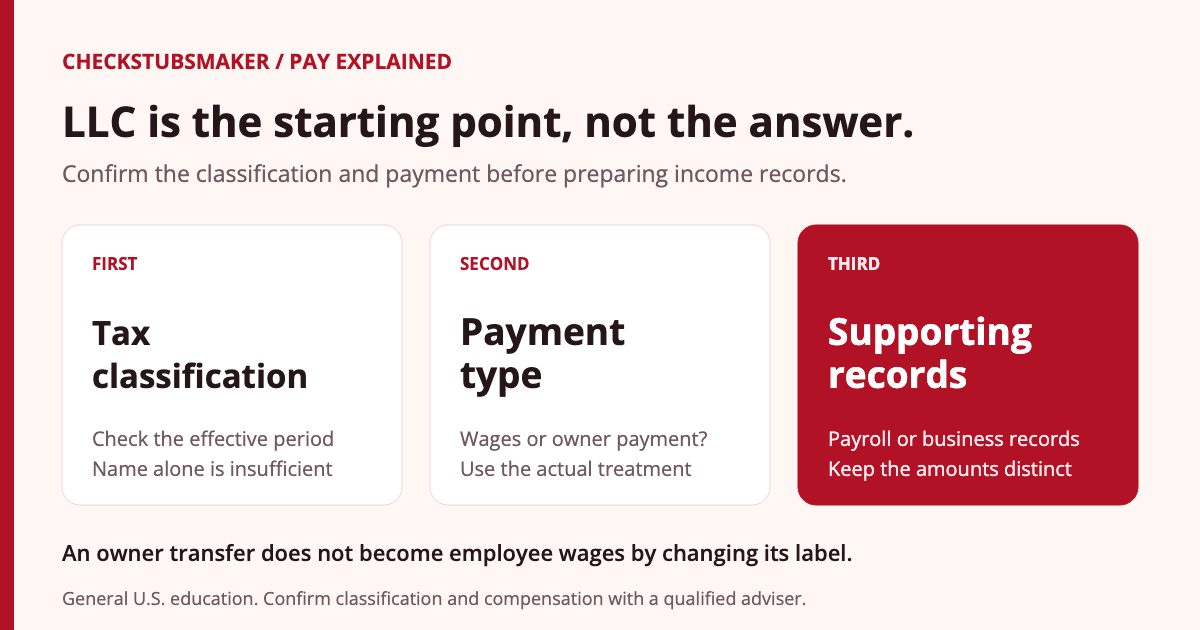
Find the classification actually in effect for the period. Do not infer it from the company name, bank-account label, number of employees, or a document template. Ask the business’s tax professional to confirm the records and effective dates.
A later change does not automatically make earlier transfers payroll. Keep records organized by the classification and payment treatment that actually applied.
Does every LLC owner pay themselves through payroll?
| Situation | General distinction | Recordkeeping implication |
|---|---|---|
| Individual owner of a disregarded single-member LLC | Generally not an employee of that LLC | Track owner payments and underlying business results accurately |
| Owner treated as a partner in an LLC taxed as a partnership | Partner payments differ from employee wages | Use the applicable partnership records |
| Owner working for an LLC taxed as a corporation | Employee wages may be required for services | Maintain actual payroll and related tax records |
| Employee who is not an owner | Employment payroll is separate from owner withdrawals | Request employer-issued earnings statements |
IRS Publication 3402 explains that an individual owner of a disregarded single-member LLC generally is not the LLC’s employee, even though the business may have employees and employment-tax duties for their wages.
The IRS paying-yourself guidance states that partners are not employees and should not receive a W-2 in place of partnership reporting for distributions or guaranteed payments. It also explains that corporate officers generally are employees, subject to the stated exception for no or minor services without pay entitlement.
For S corporations, IRS compensation guidance addresses reasonable wages for shareholder-employee services before non-wage distributions. A convenient “draw” label does not settle the tax treatment. No salary amount or distribution ratio in this guide is recommended.
What if you are an employee of an LLC?
If you work for the LLC as an employee, read the earnings statement like another employment payroll record. Check the issuer, employee identity, pay period, pay date, earnings, employee deductions, and net pay. Confirm any confusing legal name or payroll-provider name with the employer.
There is no special national pay-stub design created merely by adding LLC to a business name. Applicable statement requirements and the actual payroll process still matter. Our pay-stub reading guide explains the common fields.
Example: the same transfer amount can need different records
Consider two separate fictional businesses. Their classification and payment treatment are assumed solely to demonstrate record differences.
| Scenario | Assumed facts | Correct description within this example |
|---|---|---|
| A: disregarded LLC owner payment | Individual owner withdraws $2,000; no employee payroll for the owner | An owner withdrawal, not a statement of $2,000 gross wages |
| B: corporate-classified LLC payroll | Confirmed employee wages of $2,500 less assumed $500 employee deductions | A $2,000 net payroll payment supported by its earnings statement |
In scenario A, the $2,000 withdrawal alone does not establish business profit for the month. It could differ from the period’s operating results. In scenario B, $2,500 − $500 = $2,000 reconciles the assumed payroll; the $500 is not calculated from real tax rates.
Do not turn scenario A into scenario B by adding invented hours or withholding. If earlier payments were recorded incorrectly, ask the qualified payroll or tax adviser about an appropriate correction using the actual facts.
How can an owner document income without an employee pay stub?
Ask the recipient for its self-employment or business-owner documentation checklist. Depending on the purpose, it may request tax records, business statements, a profit-and-loss report, bank records, or other supporting information. Acceptance varies.
Connect the summary to underlying invoices, receipts, supported expenses, and payment records. Label owner withdrawals separately from business revenue so the same money is not counted twice. Our self-employment ledger guide explains an organized starting point.
If you also have legitimate employee wages, keep that payroll evidence distinct from other owner transactions. A summary can explain the relationship, while the original records support each amount.
What should you confirm before preparing the records?
- The classification and effective dates for the period.
- The owner’s role and actual services.
- Whether the payment was processed and reported as wages.
- Which amounts are owner transactions, reimbursements, or other items.
- What the recipient needs and how to submit sensitive information securely.
Use the employment-status record guide and employment-verification comparison for related questions. A document’s title alone cannot decide classification.
Frequently asked questions
Does an LLC name mean the owner is an employee?
No. Confirm tax classification, role, and actual payment treatment.
Can a disregarded single-member LLC have employees?
Yes. Its obligations for employee wages are separate from the individual owner’s general nonemployee treatment.
Is every owner transfer gross pay?
No. Identify the transaction and supporting records before describing it as wages.
Does this guide recommend becoming an S corporation?
No. Election decisions and their effects require a review of the business’s facts.
Can a pay-stub template fix incorrect historical payroll?
A template cannot correct tax or payroll treatment by itself. Use actual records and the appropriate professional correction process.
Prepared by the CheckStubsMaker Editorial Team from primary IRS guidance and original assumed scenarios. See our editorial policy. No individual entity classification or compensation amount is determined.