Read a pay stub in this order: identity and dates, current earnings, taxes, other deductions, net pay, payment destinations, and YTD totals. Check each amount against the relevant record instead of starting with the deposit alone. A pay stub explains a payroll calculation; the amount reaching one bank account may be only part of the payment.
For U.S. employees · Sources checked November 9, 2026 · Layouts and legal statement requirements vary. The original example uses assumed deductions and tax amounts to teach reconciliation, not tax calculation.
Consumer.gov’s paycheck guide describes a pay stub, also called an earnings statement, as a record of earnings and amounts taken out for taxes and benefits. You may obtain it through payroll even when wages arrive by direct deposit.
1. Is this the right statement and period?
Confirm the employee and employer names, then identify the pay-period start, pay-period end, and pay date. A recently issued statement can describe work performed earlier.
The Department of Labor’s recordkeeping overview treats payment date, period covered, hours, rates, earnings, and deductions as distinct payroll-record items. That overview describes employer recordkeeping duties for the workers it covers; it does not prescribe one nationwide employee pay-stub layout.
| Section | Question | Useful comparison |
|---|---|---|
| Identity and dates | Whose pay and which period? | Employment details and pay calendar |
| Earnings | What was earned in this period? | Hours, rate, salary terms, and earnings notices |
| Taxes | Which amounts were withheld? | Tax labels, wage bases, and payroll explanation |
| Other deductions | What else was collected? | Benefit elections or other supporting instructions |
| Net and distribution | What was payable, and where did it go? | Deposit allocation and payment records |
| YTD and balances | Is this a current amount, running total, or hours balance? | Prior statement and account history |
Our pay-period versus pay-date guide explains the date fields in more detail.
2. What did you earn before deductions?
The CFPB’s pay-stub reading guide distinguishes gross earnings, deductions, net income, and YTD figures. Gross earnings are the starting amount before applicable deductions.
For an hourly entry, compare the relevant hours with the stated rate. Then identify separate earnings such as overtime, a bonus, paid leave, or a correction. Do not combine different rates before understanding what each line represents.
For a salaried entry, check the payment against the applicable salary and pay schedule. Hours shown on a salaried statement need interpretation in that employer’s system.
Use our hours guide and overtime guide when those entries need investigation. Gross pay and the wage base used for a particular tax can also differ; see the taxable-wages guide.
3. Which taxes and other deductions apply?
Federal Reserve Education’s pay-stub lesson separates tax deductions from elected benefits, and explains that pre-tax and after-tax deductions have different effects.
Locate federal income tax, Social Security, Medicare, and any applicable state or local entries. Then identify benefit premiums, retirement contributions, and other deductions. The presence and treatment of a line depend on the actual employment and arrangement.
Ask payroll for an unfamiliar code instead of deciding its meaning from the abbreviation alone. Our deduction-code guide provides a reading framework.
Check whether an employer contribution is informational rather than an employee deduction. In the example below, only the listed employee deductions are subtracted. A separately displayed employer-paid benefit would require its own interpretation.
4. Does the gross-to-net calculation reconcile?
Assume a fictional statement records 80 regular hours at $25 per hour, giving $2,000 gross earnings. Assume all hours in this illustration are properly classified as regular, and there are no other earnings, reimbursements, or adjustments.
Also assume $300 total tax withholding, a $100 employee retirement contribution, an $80 employee health premium, and a $20 other employee deduction. The tax total is given, not calculated. The example does not determine pre-tax treatment or a withholding rate.
| Current-period entry | Calculation or assumption | Amount |
|---|---|---|
| Gross earnings | 80 regular hours × $25 | $2,000.00 |
| Taxes withheld | Assumed total across tax entries | −$300.00 |
| Employee retirement | Assumed contribution | −$100.00 |
| Employee health premium | Assumed contribution | −$80.00 |
| Other employee deduction | Assumed amount | −$20.00 |
| Net pay | $2,000 − $300 − $100 − $80 − $20 | $1,500.00 |
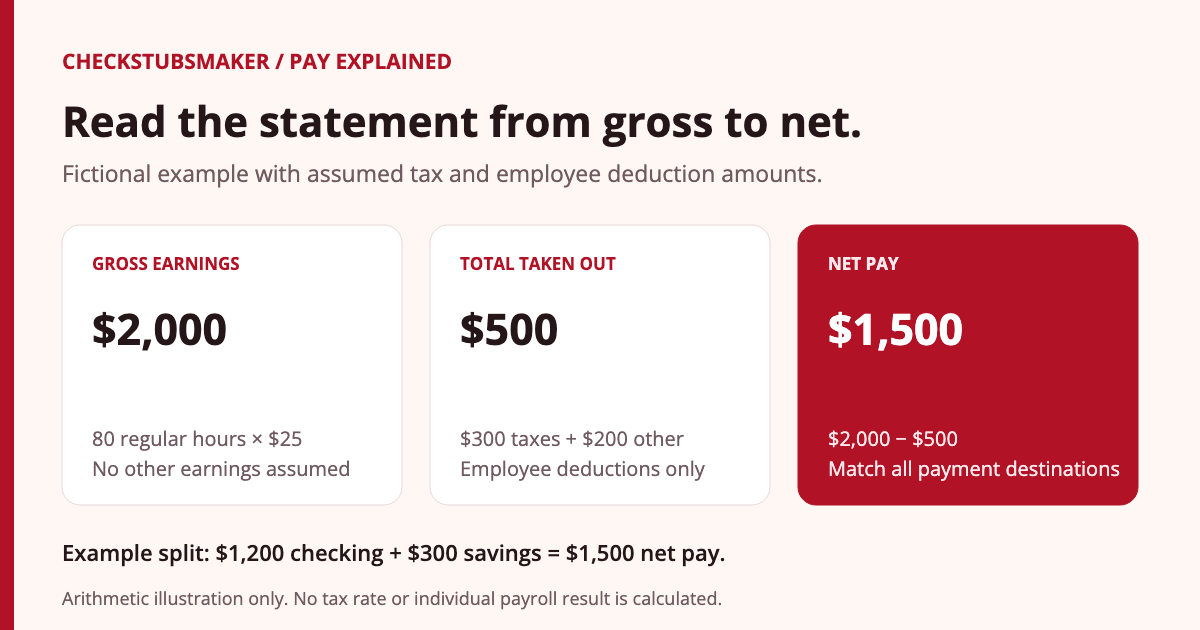
This confirms the example’s arithmetic. It does not prove that any real earnings classification, deduction, or tax calculation is correct. Our gross-versus-net guide develops that calculation step.
5. Where did the net payment go?
Compare the payment distribution with the statement’s net amount. Under the fictional example, a $1,200 checking deposit plus a $300 savings deposit would account for the $1,500 net pay.
Looking only at the checking account would make the payment appear $300 short. Verify the allocation before treating the difference as missing earnings.
Also identify any payment already made separately, reimbursement, or adjustment on the actual record. The direct-deposit guide explains how to locate the payroll statement, while the bank-statement comparison helps match calculation and receipt.
6. Are you reading current amounts or running totals?
YTD means year to date. Read it alongside, rather than in place of, the current-period column. If prior gross YTD is $18,000 and current gross is $2,000 with no adjustment, new gross YTD would be $20,000.
A positive YTD deduction does not prove the same deduction was collected again on the latest check. Use the current field to identify this period’s activity and the YTD guide for the accumulated total.
Check units on leave records. Forty hours of leave is not a $40 payment. Our PTO guide explains how to keep leave balances and earnings entries separate.
7. What should you do when something does not match?
Compare the current statement with the prior one, identify the exact changed line, and gather the supporting time, pay-rate, election, or payment record.
A useful payroll request is: “Please explain [label/amount] on the statement for [period], paid [date]. My supporting record shows [specific difference]. Please identify any adjustment and confirm whether a corrected statement is needed.”
Keep the original and the response. Our correction guide explains how to document the issue.
Frequently asked questions
Is a pay stub the same as the payment?
The statement explains earnings and deductions. Payment records show how money was delivered.
Which amount is take-home pay?
Start with net pay, then confirm any distribution or separate-payment details.
Should every earnings dollar have the same tax treatment?
No. Gross earnings and the wage base for each tax can differ. Ask about the actual entries.
Should I subtract employer contributions again?
Verify the heading and purpose. An informational employer amount is not automatically another employee deduction.
Can YTD tell me what was deducted on this paycheck?
Use the current-period deduction for that question. YTD is the running total.
Prepared by the CheckStubsMaker Editorial Team using primary payroll-education sources and an original reconciliation example. See our editorial policy. The example does not determine an individual payroll or tax result.