A self-employment ledger records business income and expenses with enough detail to trace the totals to supporting records. Identify the business, reporting period, dates, descriptions, categories, amounts, and references. Keep owner withdrawals separate from business expenses. A ledger summarizes actual business activity; it is different from an employer pay stub and does not automatically satisfy every proof-of-income request.
For U.S. readers · Sources checked November 1, 2026 · The example concerns a fictional sole proprietor using a simplified cash-basis record. It does not calculate a tax return, benefit eligibility, or an individual deduction.
Client receipts, profit, bank balance, and money taken out for personal use can all be different amounts. A useful ledger makes those differences visible instead of calling every bank credit “pay.”
What is a self-employment ledger?
HealthCare.gov’s glossary describes a detailed, accurate record of self-employment income and expenses, which can be kept in a spreadsheet, accounting software, or a handwritten record. Its definition is not a requirement to buy a particular template.
The IRS recordkeeping overview likewise explains that a business can choose a suitable system that clearly shows income and expenses, subject to the records needed for its activities.
A sole proprietor’s ledger documents business activity. It does not become an employer-issued wage statement merely because its headings resemble payroll. A company that actually runs payroll for employees has separate payroll-record obligations.
What should you include in a practical ledger?
Use a heading for the business or proprietor, covered dates, currency, and accounting basis used. Then keep one traceable entry per transaction or an explained summary supported by transaction-level detail.
| Field | What to record | Why it helps |
|---|---|---|
| Date and description | Relevant transaction date and business purpose | Connects activity to the reporting period |
| Source or payee | Client, vendor, or other identifiable counterparty | Explains where the amount came from or went |
| Category and amount | Receipt, expense, withdrawal, or other appropriate classification | Prevents unlike transactions from being combined |
| Supporting reference | Invoice, receipt, payment, or account reference | Makes the entry traceable |
| Notes or adjustments | Explanation for a split, correction, or excluded transfer | Preserves the reason behind the total |
A recipient may ask for additional identification, a signature, a particular date range, or its own form. These suggested columns are a working structure, not a promise that any organization will accept the result.
Why do the reporting period and accounting method matter?
State the start and end dates and use the relevant method consistently. If one report includes amounts received and another includes invoices issued, matching them requires an explanation of their different timing.
Do not mix a month’s activity with a year’s total or convert a partial month into an annual figure without explaining the assumption. Our annual-income guide discusses period matching for employment records; a business ledger also needs a clearly defined period.
The example below counts the listed receipts when received and costs when paid for its simplified cash-basis illustration. It assumes all relevant costs qualify as current business expenses. Actual tax treatment, mixed personal use, assets, and other adjustments require the applicable rules.
What does a simple self-employment ledger example look like?
Assume a fictional sole proprietor receives two client payments during October 2026. The first is $3,200 and the second $1,800. Three fully business costs are assumed paid and allowable in the same period: $350 supplies, $150 software, and $200 advertising.
There are no unpaid invoices included, refunds, sales taxes, loan transactions, asset purchases, or other adjustments in this example. Supporting invoices, receipts, and payment confirmations exist for each entry.
| Entry | Classification | Amount |
|---|---|---|
| Client payment A | Business receipt | $3,200.00 |
| Client payment B | Business receipt | $1,800.00 |
| Supplies | Assumed current business expense | $350.00 |
| Software | Assumed current business expense | $150.00 |
| Advertising | Assumed current business expense | $200.00 |
| Owner withdrawal | Personal withdrawal, separate from expenses | $1,000.00 |
| Illustrative period profit | $5,000 receipts − $700 expenses | $4,300.00 |
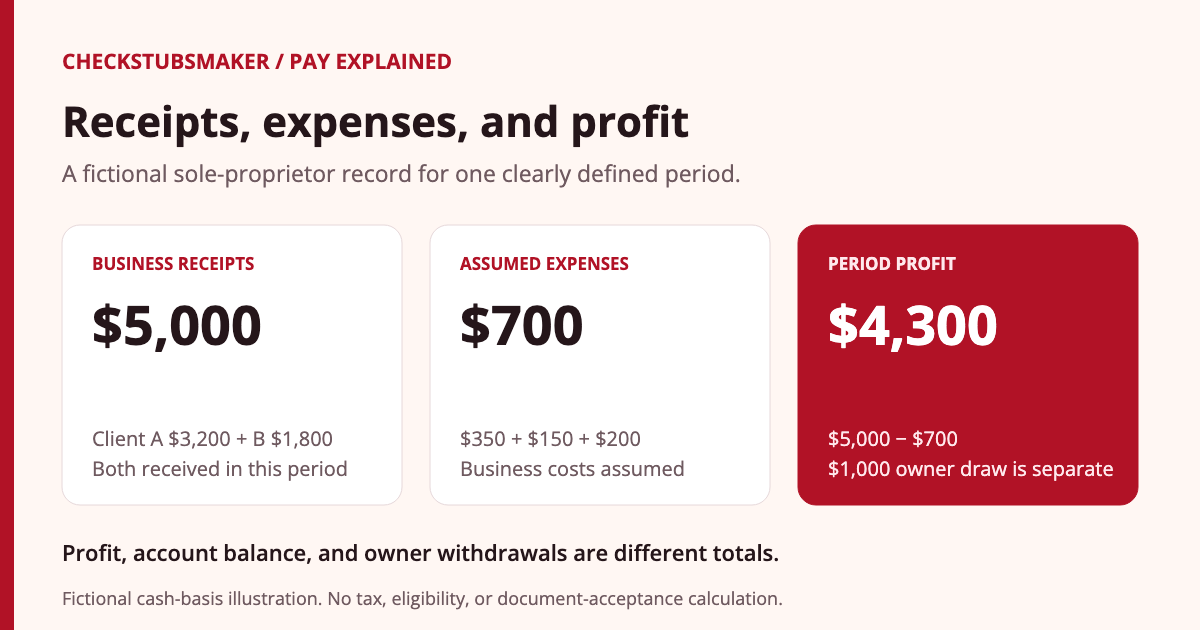
The receipt total is $3,200 + $1,800 = $5,000. Expenses total $350 + $150 + $200 = $700. Profit under these assumptions is $4,300, even though the owner withdrew only $1,000.
Why is an owner withdrawal different from an expense?
IRS Publication 334 explains that a sole proprietor cannot deduct their own salary or personal withdrawals as employee pay and is not an employee of the proprietorship. That rule should not be generalized to every entity or payroll arrangement.
The IRS personal-expense FAQ distinguishes personal spending from ordinary and necessary business expenses and recommends separating business and personal accounts.
Bank balance is another separate number. If the example’s account began with $2,000, received $5,000, paid $700 expenses, and paid the $1,000 withdrawal, its ending balance would be $5,300. That balance includes opening funds; it is not the month’s $4,300 profit.
How do you reconcile the ledger with supporting documents?
- Total each category. Recalculate receipts, costs, and any separate withdrawals or transfers.
- Match payments. Link each entry to the actual receipt, invoice, or account record.
- Check duplicates. Do not count the same client payment once from an invoice and again from its bank credit.
- Explain differences. Investigate fees, refunds, timing, split transactions, and amounts belonging to another period.
- Preserve corrections. Keep the original reference and explain any adjusted entry.
The IRS supporting-records guide identifies documents such as invoices, receipts, deposit information, and payment records as support for book entries. A ledger total does not replace those records.
Our bank-record comparison explains why an account credit alone does not establish a complete income calculation.
Can you use the ledger as proof of income?
Ask the receiving organization whether it accepts a ledger and what it requires with it. Clarify the period, accounting basis, expense definition, supporting records, and whether the report should reflect actual activity or an estimate.
A useful request is: “Do you accept a self-employment ledger for [purpose], and which dates, supporting documents, expense rules, and certification do you require?” Do not assume one program’s definition or format controls another application.
Keep the report accurate and identify its preparer. Do not present an unaudited personal ledger as an independent accountant’s certification or employer-issued payroll record.
Frequently asked questions
Must a ledger use accounting software?
No particular software is inherent in the definition. The record needs accurate detail and must meet the intended use.
Is revenue the same as profit?
No. In the simplified example, receipts are $5,000 and profit after the assumed $700 expenses is $4,300.
Does an owner withdrawal reduce sole-proprietor profit?
Do not treat a personal withdrawal as employee pay or a business expense merely because money leaves the account.
Can I count both the invoice and its payment as two receipts?
Avoid duplicating one transaction. Use the applicable method and reconcile the underlying records.
Does a completed ledger guarantee acceptance?
No. The recipient determines the required records and review process.
Prepared by the CheckStubsMaker Editorial Team using primary IRS and HealthCare.gov sources and original arithmetic examples. See our editorial policy. Actual reporting and tax treatment depend on the business, accounting method, and applicable requirements.