A pay stub explains how an employer calculated a payment; a bank statement records activity in a financial account. Compare the pay stub’s final payment assigned to an account with the corresponding bank credit—not with gross wages. A lender or other reviewer may request both documents because they answer different questions. The recipient decides which records it accepts.
For U.S. readers · Sources checked October 29, 2026 · The reconciliation below is fictional. It illustrates document matching, not mortgage eligibility or a tax calculation.
A payroll deposit of $1,620 does not explain an employee’s hourly rate, withholding, or retirement contribution. A pay stub showing $2,400 gross does not establish that $2,400 reached checking. Reading the two records together connects the calculation with the account activity.
What is the difference between a pay stub and a bank statement?
A pay stub, also called an earnings statement, describes a payroll calculation for a particular payment. Consumer.gov’s paycheck guide explains that the stub shows earnings and amounts taken out for taxes and benefits.
A bank statement organizes transactions and balances for an account over its statement period. A payroll credit is one transaction within that account record. The credit alone does not provide the employer’s full earnings-and-deductions calculation.
| Question | Pay stub | Bank statement |
|---|---|---|
| How was this pay calculated? | Earnings, deductions, and payment details | Does not replace the payroll breakdown |
| Which period does the record cover? | Pay period and payment date | Account statement opening and closing dates |
| What reached this account? | May identify the destination and assigned amount | Records the account credit and transaction date |
| What happened to other account funds? | Does not track bank spending or transfers | Records account activity and balances |
Layouts vary. Start with the field labels on your actual records rather than expecting every payroll system or bank to use identical wording.
Why might a lender ask for pay stubs and bank statements?
Income details and account assets are different parts of a financial review. For example, Fannie Mae’s educational mortgage checklist lists pay stubs under income documentation and bank-account statements under asset statements.
The CFPB’s application-packet guide likewise lists both types of record and says requirements depend on the lender and circumstances. These are mortgage examples, not a rule that every landlord, lender, or benefit program must accept a particular document.
There is also a distinction between requesting a mortgage Loan Estimate and later verification. The CFPB explains that documents cannot be required as a condition for providing a Loan Estimate; additional verification may follow after you indicate that you want to proceed. Its guidance includes exceptions for products outside that disclosure process.
Ask the reviewer for the required dates, accounts, format, and completeness rules. Do not assume a transaction screenshot satisfies a request for a full statement.
How do you match a pay stub to a bank deposit?
- Identify the correct payment. Use the pay date, employer, and current-period amounts. Do not start with a YTD total.
- Find the payment destination. Check whether the net amount was divided between accounts, a payroll card, or another method.
- Read the bank transaction. Compare its amount, description, and date with the assigned payroll payment.
- Check the statement window. A transaction outside the closing date will need the appropriate later record.
- Document the connection. Keep a short note linking the pay date, payroll amount, and matching transaction.
Our pay-period versus pay-date guide helps identify the relevant date. For the payroll calculation itself, see gross versus net pay.
Why can a checking deposit be smaller than net pay?
Assume a fictional pay stub has $2,400 gross wages and $480 total employee withholding and deductions. There are no reimbursements, noncash entries, or other adjustments. Net pay is $2,400 − $480 = $1,920.
The employee directs $300 to savings and the remaining $1,620 to checking. Those two destinations explain the full $1,920. The checking statement alone shows only the portion sent to checking.
| Record or calculation | Meaning | Amount |
|---|---|---|
| Gross wages | Starting payroll earnings | $2,400.00 |
| Employee deductions | Assumed total, not a tax estimate | −$480.00 |
| Net pay | Amount distributed by payroll | $1,920.00 |
| Savings credit | First payment destination | $300.00 |
| Checking credit | Second payment destination | $1,620.00 |
| Combined credits | $300 + $1,620 matches net pay | $1,920.00 |
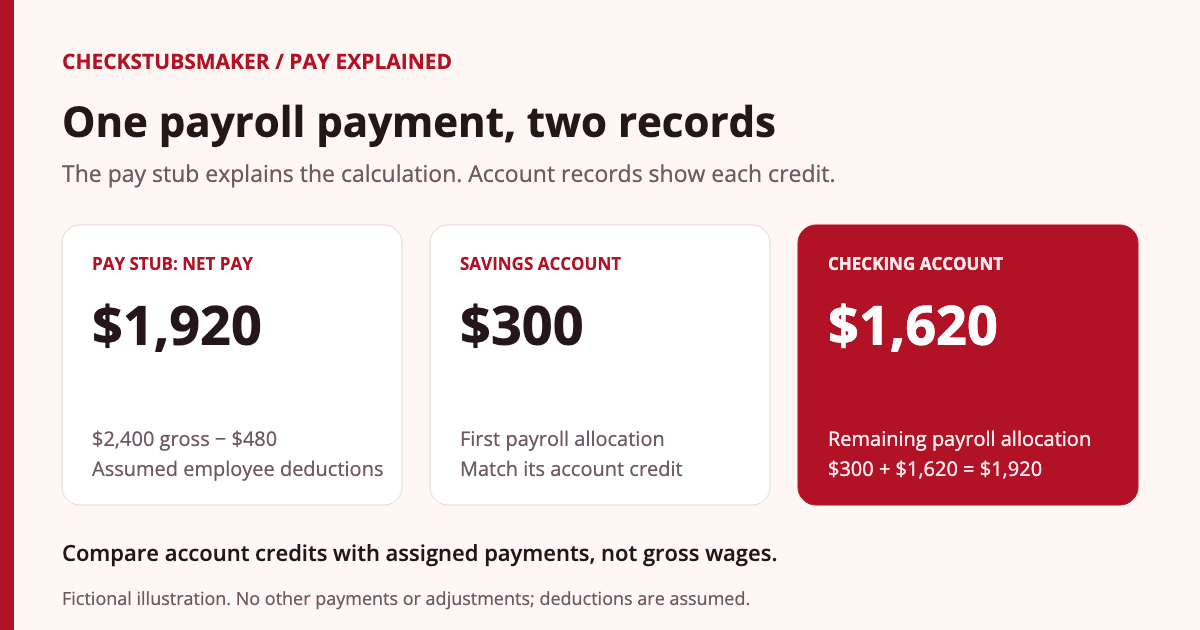
Do not add the checking credit to the pay stub’s net amount as if they were separate income. In this example, they are overlapping records of the same payment. See our direct-deposit reconciliation guide for related checks.
What should you check when the amounts do not match?
First write down the exact difference. A $300 difference in the example points to the savings allocation. A different amount requires a different explanation; do not force a match by ignoring it.
Check for a separate reimbursement, an off-cycle payment, a reversal, an account allocation, or a payment delivered by another method. Treat these as questions to investigate, not assumptions about what happened. A combined wages-and-reimbursement payment can require component-level reading.
If payroll says the payment was sent, ask for the destination, effective payment date, amount, and available transaction reference. If the bank record is unclear, contact the bank through its established support channel. Keep both explanations so the records can be reconciled.
For an incorrect earnings or deduction entry, request an official pay-stub correction. Changing a downloaded file does not correct the employer’s payroll record.
Can a bank statement replace a missing pay stub?
It can document an account transaction, but it cannot reconstruct all of the missing payroll fields. Ask the recipient whether it accepts that record, an employer verification, or another alternative for the particular purpose.
Request the missing stub from payroll or the employer’s authorized portal. Identify the payment dates you need and whether a corrected version exists. Former employees can follow our previous-employer retrieval guide.
If the missing document is the bank statement, use the bank’s statement download or request an official copy. Preserve the original record and the complete requested date range.
How should you prepare the documents for a reviewer?
Use a simple document list: requested record, covered dates, filename, and whether it is complete. For the fictional example, note that two accounts receive the payroll payment; ask whether both account records are needed.
The CFPB packet guide advises including every page of requested multi-page documents. Confirm any allowed redaction before removing information a reviewer needs. Use the recipient’s verified submission channel and keep a copy of what you provided.
A useful clarification request is: “Do you need the complete bank statement, the employer-issued pay stub, or both, and which payment dates and accounts should they cover?” This resolves the document question without guessing at acceptance.
Frequently asked questions
Is a bank statement a pay stub?
No. It records account activity rather than the employer’s complete payroll calculation.
Should my payroll deposit equal gross pay?
Compare the payment assigned to that account. Gross wages are before employee deductions and may differ from the final payment.
Why does one bank account show less than net pay?
Check whether payroll divided the payment between multiple destinations. Reconcile every allocation.
Can I submit a transaction screenshot instead of a statement?
Ask the recipient. A single transaction view may omit dates, balances, or pages required for its review.
Does providing both documents guarantee loan approval?
No. Document acceptance and the financing decision depend on the lender, product, and actual circumstances.
Prepared by the CheckStubsMaker Editorial Team using the primary sources linked above and an original reconciliation example. See our editorial policy for sourcing and corrections. This guide explains records and does not determine a recipient’s document requirements.