FICA stands for Federal Insurance Contributions Act. On a U.S. employee pay stub, it refers to the Social Security and Medicare payroll taxes withheld from covered wages. The ordinary employee rates are 6.2% for Social Security and 1.45% for Medicare. Together, they equal 7.65% when the same wages are subject to both taxes, the Social Security limit has not been reached, and Additional Medicare Tax does not apply.
For U.S. employee pay statements · Sources checked October 12, 2026 · All paycheck examples are fictional.
FICA may appear as one label or as separate Social Security and Medicare lines. To check it, you need more than the total amount deposited into your bank account: you need the wages used for each tax, the employee deduction amounts, and the relevant year-to-date figures.
What does FICA mean on a pay stub?
FICA covers two payroll taxes: Social Security and Medicare. IRS Topic 751 explains those components and their separate rates. Social Security is also called OASDI, short for Old-Age, Survivors, and Disability Insurance, as described by the Social Security Administration.
Your payroll system may use an abbreviation rather than the full name. Start with the employer’s code key or ask payroll which line represents which tax. Do not assume every entry with “federal” in its label is FICA.
| Entry to identify | What it represents | What to check |
|---|---|---|
| Social Security or OASDI | The Social Security component of FICA | Social Security taxable wages and the annual limit |
| Medicare | The ordinary Medicare component of FICA | Medicare taxable wages and any additional withholding |
| Federal income tax | A separate employee tax withholding | The payroll calculation and withholding elections |
| Employer contribution | An amount paid by the employer | Whether it is displayed as information rather than an employee deduction |
Reading the employee and employer columns separately prevents double counting. For the complete path from earnings to take-home pay, see our guide to gross pay versus net pay.
What are the FICA rates and limits for 2026?
| Tax | Employee rate | Wage limit or withholding trigger |
|---|---|---|
| Social Security | 6.2% | $184,500 annual Social Security wage base |
| Ordinary Medicare | 1.45% | No annual wage-base ceiling |
| Additional Medicare | 0.9% on the applicable excess | An employer begins withholding on Medicare wages it pays above $200,000 in the calendar year |
The IRS’s 2026 Employer’s Tax Guide sets out the payroll-tax rules. SSA’s 2026 fact sheet confirms the Social Security wage base and the absence of a Medicare wage ceiling. Use limits for the year the wages were paid when checking an older statement.
The employer ordinarily pays its own 6.2% Social Security and 1.45% Medicare shares. Those amounts are separate from the employee’s deduction. Additional Medicare withholding has no employer match.
How do you calculate FICA on a $2,000 paycheck?
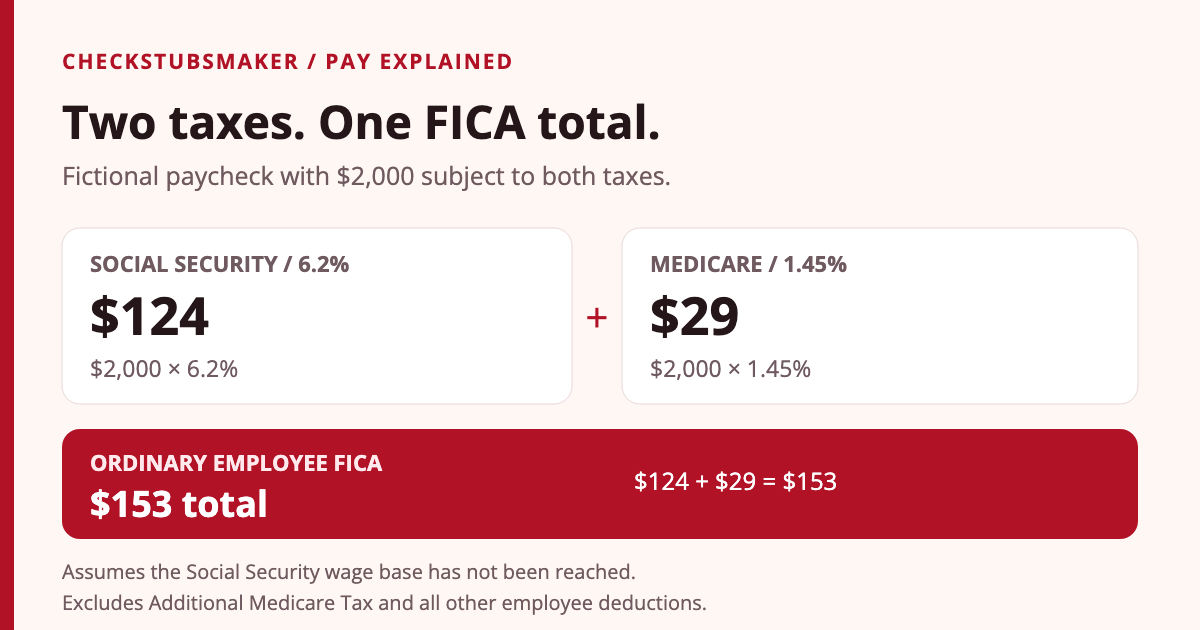
Assume a fictional employee receives $2,000 in wages subject to both Social Security and Medicare. The employee remains below the Social Security wage base after this payment, and Additional Medicare withholding does not apply.
| Calculation | Amount |
|---|---|
| Social Security: $2,000 × 6.2% | $124.00 |
| Medicare: $2,000 × 1.45% | $29.00 |
| Combined employee FICA: $124 + $29 | $153.00 |
For this example, $2,000 × 7.65% produces the same $153 result. Subtracting only these two deductions leaves $1,847, but that is not necessarily the paycheck’s net pay. Federal income tax, state or local taxes, retirement contributions, benefits, or other employee deductions may also apply.
If the statement also displays $153 in ordinary employer contributions for this payment, do not subtract that second $153 from employee pay. Identify which entries belong to the employee deductions before reconciling the statement.
Should you calculate FICA from gross pay or taxable wages?
Use the wages subject to each tax. Gross earnings, federal income-tax wages, Social Security wages, and Medicare wages can differ. A quick percentage calculation against gross pay can therefore be misleading.
For example, suppose the fictional employee’s $2,000 gross wages include a $100 traditional pre-tax 401(k) contribution, with no other adjustments. Federal income-tax wages can be $1,900 while Social Security and Medicare wages remain $2,000. The ordinary FICA calculation would still be $124 plus $29 in this simplified case.
IRS Topic 401 explains that amounts withheld under certain salary-reduction arrangements can be excluded from wages subject to income tax while remaining subject to Social Security and Medicare taxes. “Pre-tax” does not establish the treatment for every payroll tax. Ask payroll about the specific deduction if the taxable-wage columns are unclear.
Why might Social Security withholding become smaller or stop?
For 2026, Social Security tax applies only up to the $184,500 wage base. The SSA’s contribution and benefit base page lists the corresponding maximum employee contribution of $11,439, calculated as $184,500 × 6.2%. Ordinary Medicare continues on covered wages after that point.
A paycheck that crosses the wage base
Suppose the employee has already received $184,000 in Social Security wages from the same employer during 2026 and then receives another $1,000 in otherwise covered wages. This simplified example has no payroll adjustments and no Additional Medicare withholding.
- Remaining Social Security wage base: $184,500 − $184,000 = $500.
- Social Security on this payment: $500 × 6.2% = $31.
- Ordinary Medicare on this payment: $1,000 × 1.45% = $14.50.
- Combined employee deductions: $31 + $14.50 = $45.50.
Applying 7.65% to the entire $1,000 would give $76.50, which would overstate these deductions by $31 in this example. The smaller deduction has a visible explanation in the year-to-date Social Security wages. It is not evidence that the gross paycheck increased.
Why might Medicare withholding increase later in the year?
An employer must begin withholding an extra 0.9% on the Medicare wages it pays above $200,000 in the calendar year. This employer threshold applies regardless of filing status; the IRS’s Additional Medicare Tax FAQ explains the distinction between withholding and the tax ultimately owed.
For a fictional employee with $199,000 in Medicare wages already paid by that employer, a new $9,000 payment takes the total to $208,000. Of the new payment, $8,000 falls above the withholding threshold. Additional withholding is therefore $8,000 × 0.9% = $72, alongside ordinary Medicare of $9,000 × 1.45% = $130.50. Combined Medicare withholding for that payment is $202.50.
The final Additional Medicare Tax threshold is $250,000 for married filing jointly, $125,000 for married filing separately, and $200,000 for other filing statuses. Consequently, employer withholding does not, by itself, establish your final liability. Use the IRS guidance and the appropriate return instructions to reconcile it.
How can you check a FICA deduction that looks wrong?
Work through the statement in a consistent order rather than dividing the bank deposit by an assumed tax rate:
- Confirm the year and payment. Use the annual limits for that year and current-period values from the same paycheck.
- Identify the employee tax lines. Separate Social Security, Medicare, federal income tax, and employer-paid entries.
- Find the relevant wage amounts. Ask for Social Security and Medicare taxable wages if the statement does not show them.
- Review year-to-date wages. Check whether this payment crosses the Social Security wage base or the employer’s Additional Medicare withholding threshold.
- Compare with the previous statement. Note bonuses, changed earnings, corrections, or changed deduction treatment.
- Ask payroll about any remaining difference. Supply the pay date, tax label, taxable wages, and deduction amount you want explained. Keep the original records.
The CFPB’s pay-stub guide shows the distinction between current and year-to-date amounts. A YTD total is cumulative; it should not be compared directly with the tax on a single current payment.
What if you had more than one employer?
Keep the statements and Forms W-2 from all jobs. IRS Topic 608 distinguishes excess Social Security withholding across multiple employers from an overcollection by one employer. Depending on the circumstances, excess across multiple employers may be claimed as a credit on the income-tax return; an error by one employer should first be addressed with that employer. Do not combine the situations or assume that a deduction from a new job is automatically incorrect.
Frequently asked questions
Is FICA the same as federal income tax?
No. Social Security and Medicare are payroll taxes with their own wage rules and rates. Federal income-tax withholding is a separate paycheck entry. Include each employee deduction once when calculating take-home pay.
Is FICA always exactly 7.65% of gross pay?
No. That shortcut works only when the same wages are subject to both ordinary taxes, the Social Security wage base has not been reached, and Additional Medicare withholding does not apply. Taxable-wage differences and payroll adjustments can also affect a comparison.
Can a Form W-4 change stop ordinary FICA withholding?
Form W-4 is used for federal income-tax withholding. It does not let an employee choose whether covered wages are subject to ordinary Social Security and Medicare taxes. Ask payroll about the applicable coverage rules if a tax line is missing.
Does changing from semimonthly to biweekly change FICA rates?
The payment frequency does not set the ordinary rates. Different paycheck amounts can produce different deduction amounts, and the timing of a threshold crossing may change. Our biweekly versus semimonthly guide explains the change in payment size and dates.
Should you enter the employer’s FICA share when creating a pay stub?
Enter employee deductions and employer contributions in the fields intended for them, using accurate payroll records. An employer-paid amount shown for information should not be added to employee deductions. Review the document against the actual earnings and payment records.
Sources and editorial notes
This guide uses IRS payroll-tax guidance and SSA’s published 2026 amounts, with CFPB support for reading pay-statement fields. The examples assume ordinary covered employee wages and explicitly state the limits used. Special coverage rules, self-employment tax, and railroad retirement taxes are outside these example calculations.
Published by the CheckStubsMaker Editorial Team. This guide explains pay-stub entries and does not calculate an individual’s tax return. Read our editorial policy for sourcing and corrections.