EFT usually means electronic funds transfer. An “EFT No.” on a pay stub may be a payroll payment reference, but it is not automatically the bank’s ACH trace number. Ask payroll what the field identifies. To investigate a missing deposit, match the amount, intended pay date, destination, and bank-usable reference with the actual payment status.
For U.S. payroll readers · Sources checked November 11, 2026 · Payroll labels and banking records differ. No real account or trace number appears in the fictional example.
A payment reference helps connect records. It does not, by itself, prove the money is available to spend or explain the wages and deductions used to calculate it.
What does EFT mean in payroll?
The CFPB’s Regulation E text includes direct deposits among electronic fund transfers involving consumer accounts. EFT is a broader term than a particular payroll reference or payment-network identifier.
The CFPB describes ACH as a network used for electronic transfers between banks and credit unions, including payroll direct deposit. Seeing EFT on an earnings statement does not tell you every technical detail of how that employer sent the payment.
For obtaining the statement itself, see direct-deposit pay stubs. The document and the electronic payment are related records with different purposes.
Is the EFT number the same as an ACH trace number?
Do not assume so. A payroll system may display an internal payment, advice, or reference identifier. Ask the issuer whether the displayed value is internal or is a bank-usable ACH trace for the specific entry.
Nacha’s ACH file guide identifies the trace-number field in its PPD and CCD entry layout as 15 numeric characters, assigned by the originating financial institution. That technical field should not be confused with every number labeled EFT on a payroll screen.
A number’s length alone does not establish its purpose or prove successful settlement. Obtain the explanation from payroll or the payment provider and ask your financial institution which reference it can use.
Which numbers and dates should you distinguish?
| Field | Question it helps answer | What not to assume |
|---|---|---|
| Payroll payment or advice reference | Which payment record did the employer create? | That it is an ACH trace |
| ACH trace confirmed by sender | Which ACH entry should the bank investigate? | That the number alone proves funds are available |
| Employee ID | Which employee does payroll identify? | That it identifies a bank transfer |
| Pay period | Which earnings dates are covered? | That it is the bank posting date |
| Pay date and bank transaction status | When was payment intended and what does the bank show? | That a generated statement confirms settlement |
If the statement is marked non-negotiable, our non-negotiable pay-stub guide explains why that advice is not itself a paper check to cash.
Example: one net-pay amount, two deposit allocations
Assume a fictional employee’s statement has $1,800 net pay, allocated as $1,500 to checking and $300 to savings. There are no other payment methods, corrections, or deductions in this example. The account allocations add to the stated net amount.
| Payroll allocation | Amount | What to match |
|---|---|---|
| Checking | $1,500 | Corresponding checking-account credit |
| Savings | $300 | Corresponding savings-account credit |
| Total | $1,800 | The statement’s net payment total |
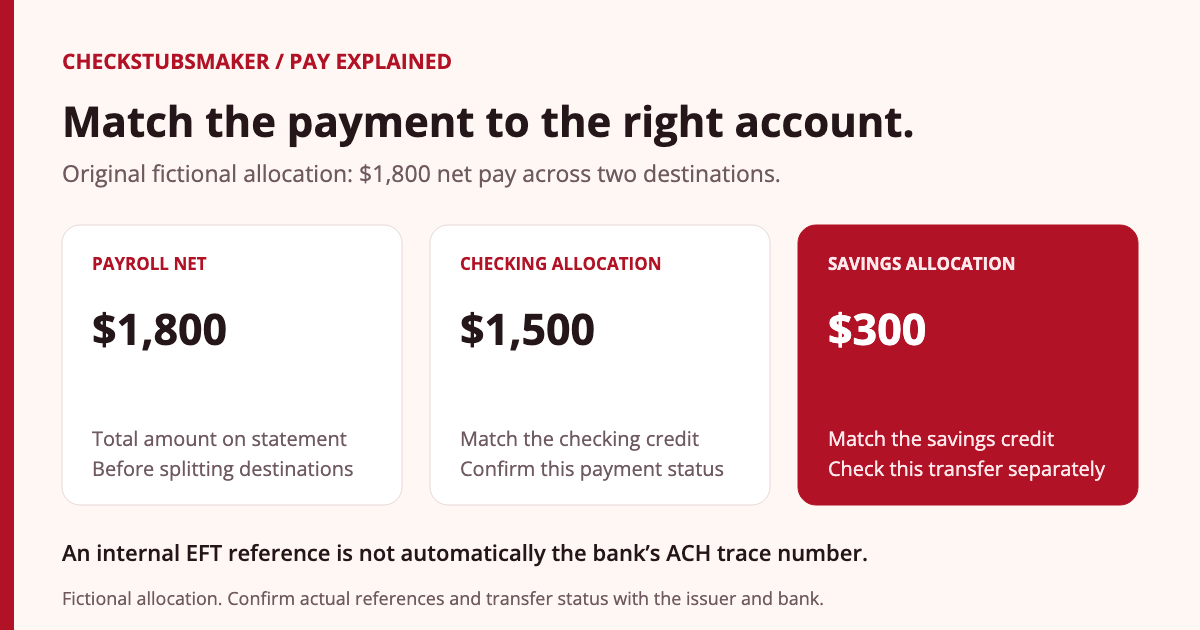
If the checking credit is visible but the savings credit is not, the first credit does not establish that the second arrived. Tell payroll exactly which allocation is unresolved and ask for the relevant payment status and reference.
Likewise, do not compare the $1,500 checking credit alone with $1,800 total net pay and immediately label $300 as a payroll deduction. It is an allocated payment in these assumed facts. Confirm the actual setup and both accounts.
For other differences between earnings and deposits, see pay stubs versus bank statements.
What should you do if the deposit is missing?
- Check the actual statement’s net amount, pay date, and destination allocations.
- Review the intended bank account’s transaction status, including any pending, returned, or posted entry shown.
- Ask payroll whether the payment was submitted and what status or return information it has.
- Ask for the bank-usable trace or other reference for the unresolved payment, clarifying any internal EFT number.
- Contact the bank or credit union through a trusted channel with the amount, expected date, sender, and confirmed reference.
- Keep the responses, case references, and any corrected payment records together.
The CFPB’s direct-deposit availability guidance ties availability to when the institution receives the deposit and advises asking about the account’s policy. A pay stub’s creation date does not establish bank receipt.
Do not treat a general timing estimate as a reason to ignore an unresolved expected payday. Confirm the actual circumstances with the issuer and institution. If a replacement payment is needed, have the employer coordinate the original and replacement so records remain clear.
Should you share the reference publicly?
Keep payroll and banking details within the authorized support process. A public screenshot can reveal names, pay, account fragments, and other identifying information together.
Use contact details obtained independently from the employer or institution. Do not give an unknown person passwords or one-time sign-in codes to “trace” a payment. For document submission, see sharing and redaction.
Frequently asked questions
Does EFT mean an extra tax or deduction?
The label usually concerns electronic payment. Confirm the field and do not classify a reference number as a deduction.
Is every EFT number a 15-digit ACH trace?
No. The issuer may use an internal reference. Ask which value the bank can use.
Can I cash a pay stub that lists an EFT number?
A payment reference does not turn an earnings statement into a negotiable check.
Does a trace number guarantee the deposit reached me?
No. Confirm the status of the actual transfer and the receiving account.
What if only one split deposit is missing?
Identify that allocation separately and ask payroll and the relevant institution to investigate the corresponding payment.
Prepared by the CheckStubsMaker Editorial Team from primary CFPB and Nacha guidance and an original split-payment example. See our editorial policy. No individual bank settlement or dispute outcome is determined.