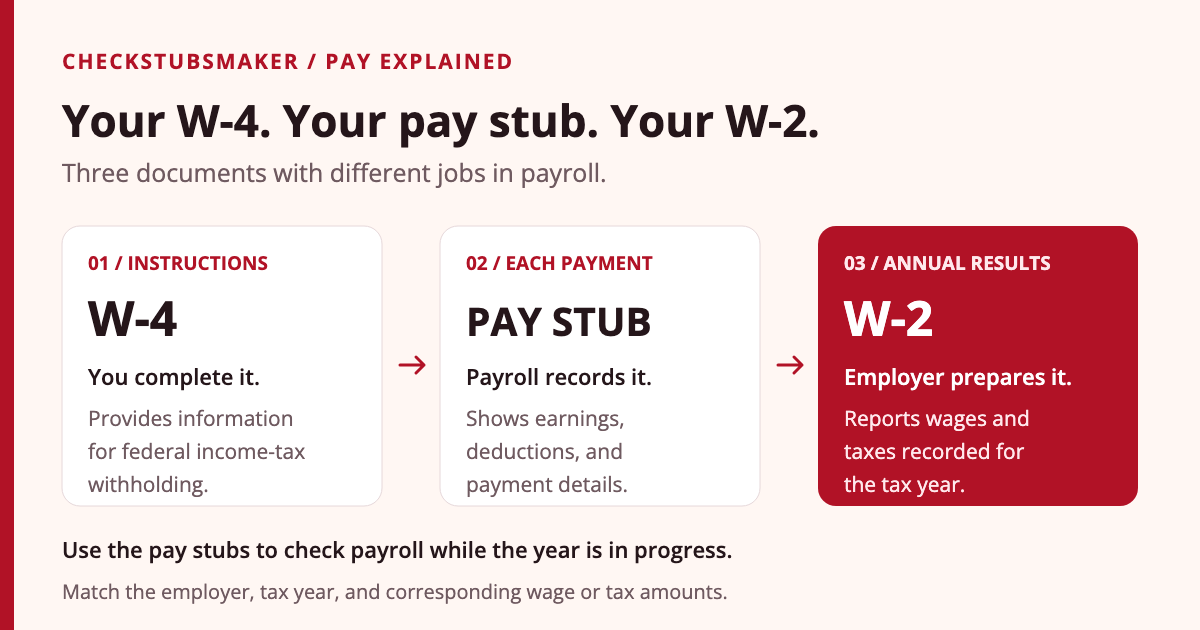
Form W-4 gives your employer information used to calculate federal income-tax withholding. Form W-2 reports the wages and taxes recorded for the year. A pay stub connects them: it shows earnings and deductions for a payment, often alongside year-to-date totals. Complete the W-4 to guide withholding, review pay stubs to check payroll, and use the employer-issued W-2 to review annual wage and tax information.
For U.S. employees · Sources checked October 13, 2026 · The calculations below are fictional examples.
The names are similar, but the documents answer different questions. A W-4 concerns how withholding should be calculated. A W-2 concerns what was paid and withheld. The pay stub helps you see those payroll results while the year is still in progress.
What is the difference between a W-4 and a W-2?
The IRS’s Form W-4 page explains its withholding purpose. The Form W-2 page describes the employer’s wage-reporting document. Add your pay stub to the comparison to see where each fits in the payroll process.
| Question | W-4 | W-2 | Pay stub |
|---|---|---|---|
| Who prepares it? | The employee provides withholding information | The employer reports wage and tax results | The payroll process produces a payment statement |
| What does it describe? | Inputs for federal income-tax withholding | Annual reported wages and taxes | Earnings and deductions for a payment |
| When is it useful? | Starting work or reviewing withholding | Reviewing annual reporting and preparing a tax return | Checking payroll during the year |
| What should you check? | Current, accurate withholding information | Employer, tax year, wage boxes, and withheld taxes | Pay dates, current figures, and YTD totals |
The CFPB’s pay-stub guide distinguishes current payment amounts from year-to-date totals. A single paycheck’s federal withholding is not the same measure as the annual federal withholding on a W-2.
What does Form W-4 change on your paycheck?
The W-4 supplies information about filing status, multiple jobs, credits, other income, deductions, and additional withholding. Payroll uses those inputs to calculate federal income tax. IRS Topic 753 explains the information employers use.
A revised W-4 can change take-home pay by changing that withholding amount. It does not, by itself, change the employee’s salary, hourly rate, or hours worked. Ordinary Social Security and Medicare deductions have separate wage rules, explained in our FICA guide.
Review your withholding when relevant personal or financial circumstances change. The IRS Tax Withholding Estimator can help assess federal withholding using current information. Use the current form and its instructions rather than an old worksheet built around withholding allowances.
How can a W-4 change reduce net pay without reducing gross pay?
Consider a fictional paycheck with $2,400 gross earnings, $300 in other employee deductions, and $180 in federal income-tax withholding. Assume payroll implements a valid W-4 request for $20 of additional federal withholding per paycheck, and every other input stays unchanged.
| Paycheck item | Before | After |
|---|---|---|
| Gross earnings | $2,400 | $2,400 |
| Other employee deductions | $300 | $300 |
| Federal income-tax withholding | $180 | $200 |
| Net pay | $1,920 | $1,900 |
The $20 lower net payment is explained by the extra $20 withheld. Gross earnings remain $2,400. The $180 and $300 are assumed inputs for this example, not tax amounts calculated from a particular filing status or benefit election.
Compare the first pay stub affected by the new W-4 with the previous one. Check the federal income-tax line and the effective payment date rather than assuming every deduction should change. Our gross versus net guide shows how to reconcile a full statement.
What does Form W-2 tell you at the end of the year?
The W-2 reports wage and tax information for a tax year. Confirm the year and employer first, then compare each box with the corresponding payroll total. The 2026 W-2 instructions distinguish federal wages in box 1, federal income tax withheld in box 2, Social Security wages and tax in boxes 3 and 4, and Medicare wages and tax in boxes 5 and 6.
Wage amounts and tax amounts are different measures. Box 2 is federal income tax actually withheld during the year; it is not a promise that the final tax return will show exactly that amount of tax due. Do not add wage boxes together as if they describe separate paychecks.
When should you receive the W-2 for 2026 wages?
The standard deadline in the 2026 instructions is February 1, 2027 for employers to furnish the employee copies. That is the deadline for the statement covering 2026 wages. Check that the tax year on the form matches the payroll records you are reviewing.
Why can W-2 box 1 be lower than gross earnings?
Different payroll taxes can use different wage amounts. For example, a traditional pre-tax 401(k) employee contribution generally reduces wages subject to federal income tax while remaining in wages subject to Social Security and Medicare. IRS Topic 424 explains that treatment.
Assume a fictional employee receives $62,400 in ordinary covered gross wages during the year and contributes $3,120 to a traditional pre-tax 401(k). There are no other wage adjustments, benefits, tips, or compensation changes, and wages remain below the Social Security wage base.
| Record or calculation | Amount |
|---|---|
| Gross wages paid | $62,400 |
| Traditional pre-tax employee 401(k) | $3,120 |
| Box 1 federal wages: $62,400 − $3,120 | $59,280 |
| Box 3 Social Security wages | $62,400 |
| Box 5 Medicare wages | $62,400 |
These amounts can be correct at the same time. Each wage figure relates to a particular tax. To check the cash paid, use the payment records and net-pay amounts. Roth contributions and other payroll items can have different treatment, so identify the actual deduction type before using this comparison.
Taxable noncash benefits can also affect wage reporting without increasing cash pay. Our imputed-income guide explains that distinction. When estimating the year’s pay, also separate an annual pay rate from amounts already paid, as described in our annual-income guide.
How should you compare a W-2 with your pay stubs?
- Match the employer and tax year. Keep records from separate jobs distinct while reconciling each employer’s statement.
- Use complete annual records. Check the final relevant YTD statement and any separate payments or corrections that affect the year.
- Compare corresponding tax lines. Match federal income tax to federal income tax, Social Security to Social Security, and Medicare to Medicare.
- Identify wage adjustments. Review traditional pre-tax contributions, taxable benefits, and other items that explain differences from gross earnings.
- Check deductions once. Avoid subtracting a contribution again from a wage figure that already excludes it.
- Ask payroll about an unexplained difference. Identify the W-2 box, payroll total, tax year, and amount you cannot reconcile.
A W-4 can help explain why a withholding pattern changed, but it is not a ledger of the money actually withheld. Use the payment records to investigate the amounts. If you received separate overtime or benefit adjustments, include those records in the review.
What should you do if a W-2 is missing or incorrect?
Contact the employer or payroll department and request the form or an explanation of the disputed amount. If a reporting error is confirmed, ask about the appropriate corrected statement. Changing your current W-4 does not, by itself, correct an earlier W-2.
IRS Topic 154 describes the process for missing or incorrect wage statements and the circumstances in which Form 4852 may be used as a substitute. Follow that process and its current instructions. A recreated pay stub is not an employer-issued W-2, and a final pay stub alone may miss later corrections.
Frequently asked questions
Do I fill out both a W-4 and a W-2?
You provide W-4 withholding information to the employer. The employer prepares the W-2 wage and tax statement. Review the W-2 for accuracy and contact payroll about errors.
Does a new W-4 change wages already reported on an earlier W-2?
No. A new withholding instruction and a correction to an earlier annual statement are separate actions. Ask payroll about the effective date of a W-4 change and the process for correcting a reporting error.
Should I review my W-4 every year?
The IRS recommends considering a new W-4 each year and when personal or financial circumstances change. A claim of exemption from federal income-tax withholding has separate annual renewal rules; use the current IRS instructions if that applies.
Does a pay stub replace either form?
It records payroll activity, while the W-4 supplies withholding inputs and the W-2 reports annual results. Use the document required for the particular task. For a missing W-2, follow the IRS substitute-form process rather than treating a pay stub as the issued form.
Which information should I use when creating a pay stub?
Use accurate payment-period earnings, employee deductions, and payment dates from the actual payroll records. W-4 entries describe withholding inputs; annual W-2 totals should not be entered as if they were amounts for one paycheck. Reconcile the completed statement with the source records.
Sources and editorial notes
This guide uses IRS form pages, current payroll-reporting instructions, withholding guidance, and retirement-plan guidance, with CFPB support for reading pay-stub fields. The examples are original illustrations and do not calculate an individual’s tax liability or recommend personal W-4 elections.
Published by the CheckStubsMaker Editorial Team. Read our editorial policy for sourcing and corrections.