An eligible HSA owner can contribute through an available payroll arrangement or directly to the HSA custodian. The contribution route affects payroll treatment and tax reporting, but it does not create separate annual limits. Identify employee payroll contributions, employer funding, and personal bank contributions separately, then reconcile them for the correct tax year.
For U.S. HSA owners · Sources checked November 14, 2026 · Federal contribution and reporting education. The example assumes full-year 2026 eligibility for self-only coverage and no catch-up contribution, rollover, transfer, or correction.
A pay stub showing $100 for HSA and $25 for HSA employer funding does not necessarily mean $125 came out of the employee’s wages. A transfer made from the employee’s bank account is another source again. Separating who provided the money from how the IRS classifies it prevents double counting.
Which HSA entries should you keep separate?
Confirm that the payroll code identifies a health savings account, not a health FSA, insurance premium, or another benefit. The employer’s legend should distinguish your deduction from its own contribution. Our deduction-code guide explains those headings.
| Source | Where to trace it | What to confirm |
|---|---|---|
| Employee payroll contribution | Pay stub, election, custodian posting | Whether it uses a qualifying cafeteria plan or after-tax treatment |
| Employer contribution | Employer benefit record and custodian posting | Funding amount, timing, and contribution year |
| Personal direct contribution | Bank confirmation and custodian receipt | Selected tax year and classification as a new contribution |
| Transfer or rollover | Custodian transfer documents | Whether it is a transfer/rollover rather than new annual funding |
Do not assume every bank movement into an HSA is a new deductible contribution. The IRS HSA guidance in Publication 969 distinguishes contributions from rollovers and trustee-to-trustee transfers. Ask the custodian to identify the actual transaction type.
How do payroll contributions differ from direct personal contributions?
Under a qualifying section 125 cafeteria-plan arrangement, eligible HSA salary reductions can receive federal payroll-tax exclusions. IRS Publication 15-B for 2026 explains HSA exclusions and cafeteria-plan treatment. A generic HSA deduction label does not prove the arrangement qualifies.
A personal contribution from a bank account uses money outside that salary-reduction process. An eligible deductible contribution can be claimed through the federal return’s HSA reporting. It does not retroactively turn the bank transfer into a pre-tax payroll deduction.
Most importantly, do not claim a second personal deduction for money already treated as an employer contribution through a cafeteria plan. The Form 8889 instructions place employee cafeteria-plan salary reductions in the employer-contribution category rather than the personal-contribution line.
This comparison concerns federal treatment. It does not calculate a personal refund, decide every state result, or establish which contribution route your employer offers. Ask payroll about the active arrangement before changing an election.
What are the 2026 HSA contribution limits?
Revenue Procedure 2025-19 sets the 2026 basic annual limits at $4,400 for self-only coverage and $8,750 for family coverage. These are tax-year-specific amounts, not an automatic entitlement for every account owner.
Publication 15-B also describes the $1,000 additional contribution for a qualifying individual age 55 or older. Eligibility months, coverage changes, Medicare enrollment, family rules, and special provisions can affect the permitted total. Confirm your own limit before treating the published maximum as unused room.
Use current coverage rules as well as current dollar limits. The IRS’s HSA eligibility update explains that qualifying Exchange bronze and catastrophic plans are treated as HSA-compatible beginning January 1, 2026, even if they do not meet the ordinary HDHP definition. Other eligibility requirements still need review.
Contributions from you and your employer generally share the applicable annual contribution limit. Opening another HSA or moving from payroll to bank funding does not create another full allowance. This is why payroll YTD alone may not show the whole year’s funding.
Example: combining payroll, employer, and bank contributions
Assume a fictional employee is eligible for all 12 months of 2026 with self-only HSA-compatible coverage, is under 55, and has no other contribution source or adjustment. All amounts below are made during 2026 for 2026. The employee uses a qualifying cafeteria-plan payroll arrangement.
| Source | Calculation or assumption | 2026 funding |
|---|---|---|
| Employee cafeteria-plan salary reductions | 24 deductions × $100 | $2,400.00 |
| Separate employer funding | Given annual contribution | $600.00 |
| Personal bank contributions | Given direct contribution | $800.00 |
| Combined annual contributions | $2,400 + $600 + $800 | $3,800.00 |
| Room under the assumed basic limit | $4,400 − $3,800 | $600.00 |
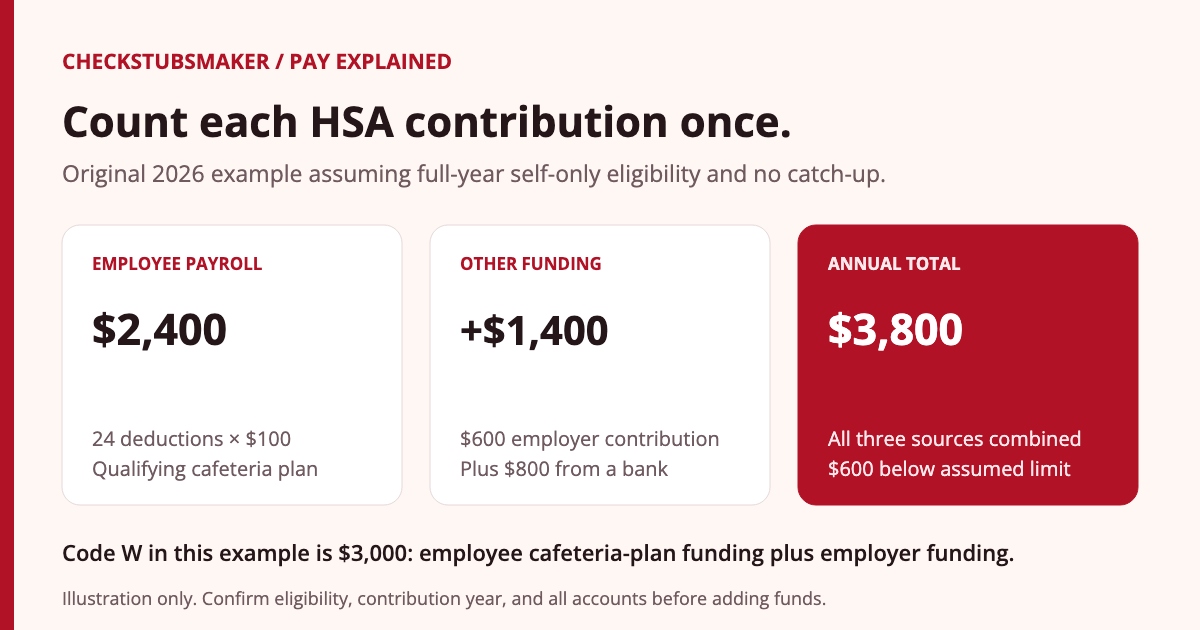
If the employee looked only at the $2,400 payroll deduction total, they might incorrectly calculate $2,000 remaining. That ignores $600 from the employer and $800 from the bank. The correct remaining amount under the stated assumptions is $600.
The $3,800 is also not necessarily the HSA’s available balance. Earlier-year funds, distributions, fees, investment activity, and posting dates can change the balance. An annual contribution election is not a promise that the entire amount is already deposited. Keep contribution records and account activity distinct.
Why can W-2 code W include money taken from your own pay?
The 2026 W-2 instructions use box 12 code W for employer HSA contributions, including employee contributions through a section 125 cafeteria plan. “Employer contributions” in this reporting category therefore includes more than the company’s separately funded benefit.
In the original example, the expected code W amount is $3,000: $2,400 employee cafeteria-plan funding plus $600 employer funding. The employee should not then add another $2,400 as a separate personal contribution on top of that reported amount.
The $800 personal bank contribution is tracked separately for the applicable Form 8889 reporting. A permitted deduction is not an $800 tax refund. Follow the instructions for the actual return year and account for any employer contributions designated for another tax year.
For the role of the annual wage form, see W-4 versus W-2. For differences among wage bases, see taxable wages on a pay stub.
How do you reconcile the records before contributing more?
- Confirm eligibility, coverage category, age-related provisions, and the tax year.
- Add employee payroll funding and separate employer funding without combining the same amount twice.
- Include personal contributions made outside payroll and funding from other employers or accounts.
- Identify transfers, rollovers, refunds, and corrections separately.
- Match custodian receipts and payroll records, then investigate missing or misclassified postings.
For contributions made after year-end, confirm the selected contribution year and applicable deadline with the custodian. Do not assume the bank transaction’s calendar year and contribution tax year always match. Use Publication 969 and the return-year instructions for the relevant timing rules.
A useful payroll request is: “Please reconcile my HSA employee deductions and employer contributions with custodian postings, the contribution year, and the amount reported under code W.” Ask the custodian about an account posting or year designation. Request official corrections where needed; editing the pay stub does not change either system.
Frequently asked questions
Can I fund an HSA directly without a payroll deduction?
An eligible account owner can make a direct contribution through the custodian’s process. Eligibility, total limits, and the contribution year still matter.
Does my employer’s contribution count toward my limit?
Generally yes. Combine the applicable contribution sources instead of giving each source a separate annual allowance.
Can I deduct employee cafeteria-plan contributions again on my return?
Do not claim a second personal deduction. The Form 8889 instructions treat these payroll contributions as employer contributions.
Does code W show only money supplied by the company?
No. It also includes employee contributions made through a section 125 cafeteria plan.
Does an HSA contribution total equal my account balance?
Not necessarily. Contributions, earlier funds, distributions, fees, investments, and posting timing are different parts of the account history.
Prepared by the CheckStubsMaker Editorial Team using primary IRS publications, reporting instructions, and an original funding example. See our editorial policy. This guide does not determine an individual contribution limit or recommend a contribution amount.