Taxable wages on a pay stub are the earnings included in a particular tax calculation after the applicable additions, exclusions, and limits. Federal income-tax wages, Social Security wages, and Medicare wages can differ on the same payment. Identify the tax named beside the figure before comparing it with gross pay, tax withheld, or your bank deposit.
For U.S. employees · Sources checked October 21, 2026 · All paycheck examples below are fictional. Annual limits are identified by tax year.
A statement showing $3,000 gross, $2,750 federal taxable wages, and $2,900 Medicare wages can be consistent. Those figures describe different calculations. You need the earnings lines, benefit treatment, and contribution details to explain the difference.
What does “taxable wages” mean on a pay stub?
It is a wage base, not the amount of tax taken out. Payroll applies the relevant withholding rules to that base. A label such as “FIT taxable,” “SS wages,” or “Medicare wages” identifies which calculation the number belongs to. A generic “taxable gross” label needs the employer’s explanation.
The IRS W-2 instructions distinguish annual wages in box 1, Social Security wages in box 3, and Medicare wages and tips in box 5. The corresponding payroll categories also serve different purposes before those annual forms are prepared.
| Field | What it describes | What it does not establish |
|---|---|---|
| Gross earnings | Earnings before employee deductions, as presented by payroll | The wage base for every tax |
| Federal income-tax wages | Wages included in that federal withholding calculation | The final income tax owed on a return |
| Social Security wages | Covered wages subject to Social Security treatment and the applicable cap | The Medicare wage base |
| Medicare wages | Wages included in the Medicare calculation | A measure of take-home pay |
| Tax withheld | The employee tax amount withheld from this payment | The underlying wage base |
Keep employer tax costs separate from employee deductions. Our FICA guide explains the Social Security and Medicare labels, and our gross versus net guide follows the cash-pay calculation.
How can one paycheck have different taxable-wage amounts?
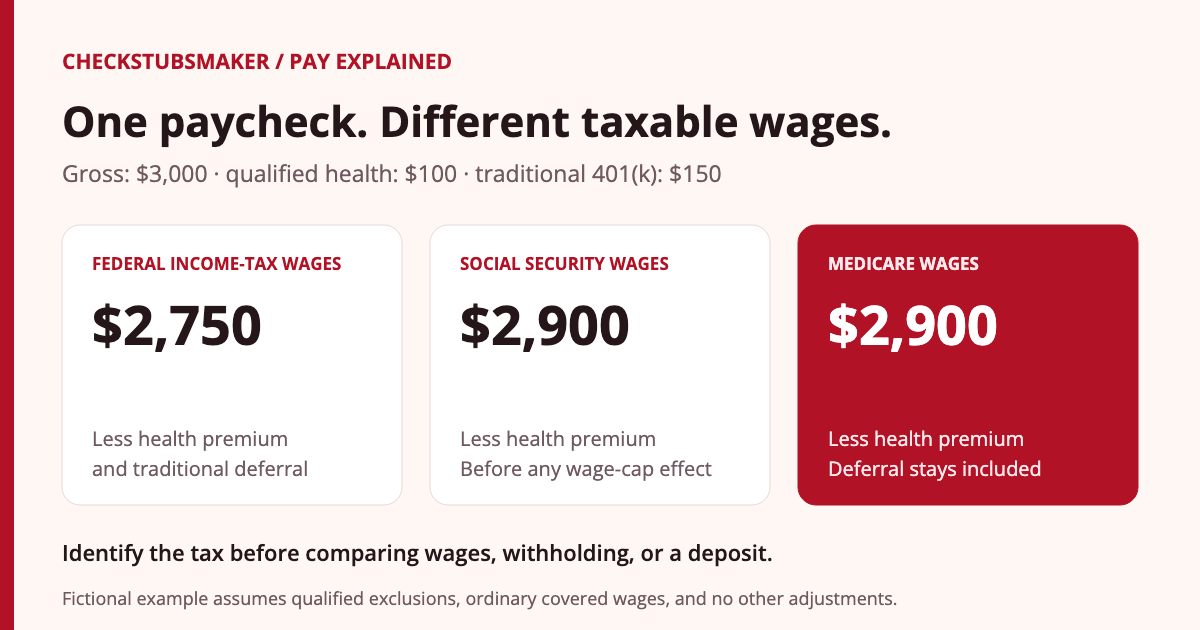
Assume a fictional employee receives $3,000 in cash gross earnings. The employee contributes $150 to a traditional pre-tax 401(k) and pays $100 for qualified employee health coverage through a compliant section 125 cafeteria plan. Assume the health deduction is excluded from all three federal wage bases, the employee is eligible for that treatment, and there are no other additions or deductions affecting wages.
Also assume the employee has not reached the Social Security wage cap. These assumptions matter: the phrase “health insurance” alone does not establish that every premium receives this treatment.
| Wage base | Calculation | Amount |
|---|---|---|
| Federal income-tax wages | $3,000 − $150 − $100 | $2,750 |
| Social Security wages | $3,000 − $100 | $2,900 |
| Medicare wages | $3,000 − $100 | $2,900 |
The IRS contribution-withholding FAQ explains why traditional employee deferrals generally reduce federal income-tax wages while remaining subject to Social Security and Medicare. IRS Publication 15-B describes the qualified health-benefit exclusions and cafeteria-plan rules.
The $150 difference between $2,750 and $2,900 comes from the traditional deferral in this example. The employee’s net pay requires further information about tax withholding and any remaining deductions. None of the three wage bases is automatically the deposit amount.
Does every payroll deduction reduce taxable wages?
No. Classify each deduction by its actual tax treatment. An after-tax deduction may reduce the cash you receive without reducing the wages used to calculate a particular tax.
For example, replace the $150 traditional deferral above with an employee Roth 401(k) deferral. Under the same remaining assumptions, federal income-tax wages would be $2,900. The $100 qualified health exclusion still applies, while the employee Roth deferral does not produce the traditional federal wage reduction.
The retirement contribution is still $150 in either version. The tax treatment differs. Our 401(k) guide explains employee traditional and Roth entries, including the distinction between a contribution and an employer match.
Ask payroll which tax bases each deduction affects. Do not subtract every deduction from gross pay and call the result “taxable wages.” That shortcut can incorrectly remove taxes already withheld, after-tax premiums, loan repayments, or other cash deductions from a wage calculation.
Can taxable wages include money that was not paid in cash?
Yes. Publication 15-B explains that fringe benefits are taxable unless an exclusion applies. A taxable noncash benefit can therefore increase relevant wages without adding the same amount to the bank deposit.
That is one reason a quick comparison of cash earnings and taxable wages can look confusing. Find any benefit, imputed-income, or offset entries and ask what they represent. The employer’s benefit documentation matters more than the code’s abbreviated name.
Keep the two questions separate: what value was added to wages, and what amount was paid in cash? Our imputed-income guide explains how those entries can affect a statement. Do not assume the same exclusion or calculation applies to every benefit.
Why can Social Security wages stop increasing while Medicare wages continue?
The SSA’s contribution-and-benefit-base table lists a $184,500 Social Security wage cap for 2026. Use the limit for the payment year; the table also publishes other years.
For a separate cap illustration, assume this employer has already recorded $183,000 of covered Social Security wages for the employee in 2026. A new payment has $2,900 of wages that would otherwise be subject to Social Security. The remaining room is $184,500 − $183,000 = $1,500. Only that $1,500 remains subject to the Social Security wage cap on this payment.
IRS Publication 15 explains that Medicare has no annual wage-base cap. Under these assumptions, the $2,900 Medicare amount continues even when the Social Security amount is limited. Additional Medicare withholding has separate rules; reaching the Social Security cap does not resolve those rules.
This illustration assumes one employer and ordinary covered wages, without special adjustments. Multiple-employer situations need separate review. Ask which year-to-date figure and wage cap payroll used before concluding a tax line was omitted.
How do current taxable wages relate to YTD totals and the W-2?
The current column describes one payment; YTD generally accumulates the employer’s recorded amounts for the year. Compare the same tax category and include reversals, separate checks, and later corrections.
For example, ten identical uncapped payments under the first example produce $27,500 of federal income-tax wages and $29,000 of Medicare wages. Those totals differ by $1,500 because ten $150 traditional deferrals remain included in Medicare wages.
Do not add the current amount to a YTD figure that already includes it. Also check the payment year rather than only the work dates. Our YTD guide and pay-date guide explain those checks.
What should you ask payroll when taxable wages look wrong?
- Identify the field. Name the tax and whether the amount is current or YTD.
- List the earnings. Include separate payments and any taxable benefit additions.
- Classify each deduction. Confirm which tax bases it reduces.
- Check limits and corrections. Review the payment year, Social Security cap, and reversals.
- Request a reconciliation. Ask payroll to show gross earnings plus taxable additions minus applicable exclusions for each disputed wage base.
A focused request could say: “For the payment dated [date], please explain how $[gross] became $[federal wages] and $[Medicare wages], including each benefit or deduction used.” Save the original statement and written explanation.
Frequently asked questions
Are taxable wages the same as my annual taxable income?
No. Payroll wage bases are inputs to tax reporting. A tax return can include other income, adjustments, and deductions beyond this employer’s wages.
Does “pre-tax” mean exempt from every tax?
No. Ask which taxes the exclusion affects. Traditional employee 401(k) deferrals illustrate why federal income-tax and FICA treatment can differ.
Should taxable wages equal my bank deposit?
No. The deposit reflects the payment after applicable deductions and adjustments. Read wages and net payment as separate fields.
Can Medicare wages be higher than federal wages?
Yes. The first example shows how a traditional employee deferral can create that difference without a payroll error.
Should I use gross pay to replace a missing W-2?
Follow the IRS missing-form process and verify each wage category. Our last-pay-stub filing guide explains the records and substitute-form steps.
Prepared by the CheckStubsMaker Editorial Team using the primary sources linked above and original examples. See our editorial policy for sourcing and correction standards. Actual exclusions and wage calculations depend on the benefit, employee, tax year, and applicable rules.