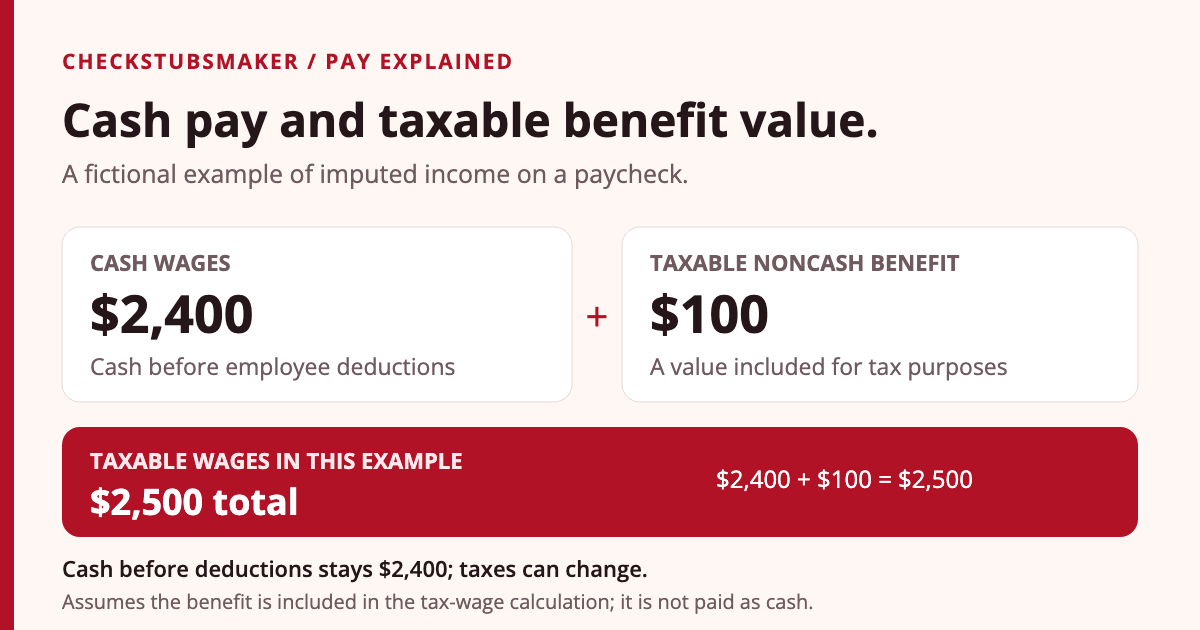
On a pay stub, imputed income generally means the taxable value of a noncash benefit your employer provides. It can increase the wages used to calculate taxes without adding the same amount to your cash paycheck. For example, $2,400 in cash wages plus a $100 taxable noncash benefit can produce $2,500 in taxable wages while the cash available before employee deductions remains $2,400.
For U.S. employee pay statements · Sources checked October 12, 2026 · All examples are fictional and state their tax assumptions.
An unfamiliar benefit entry can make a paycheck look larger on paper while the bank deposit becomes smaller. To understand it, separate three things: the cash you earned, the benefit’s taxable value, and the taxes withheld. A noncash entry and an employee benefit premium can also be different items, even when they relate to the same benefit.
What does imputed income mean on a pay stub?
An employer can provide compensation through a benefit or service as well as through cash wages. Where a noncash benefit is taxable, its value may be included in payroll’s taxable-wage calculation. The IRS discusses taxable fringe benefits and their treatment in its 2026 Employer’s Tax Guide.
The pay stub’s exact label depends on the payroll system and benefit. Ask for the code explanation instead of treating every benefit-related line as a cash payment or a new charge. These three amounts have different jobs:
| Entry | What it represents | Question to ask |
|---|---|---|
| Cash wages | Salary, hourly pay, or other cash earnings | How much cash was earned before deductions? |
| Imputed income | A noncash benefit value included for tax purposes | Which benefit and valuation produced this amount? |
| Employee benefit premium | An amount the employee pays toward coverage | What payment is actually being taken from cash wages? |
Some benefits qualify for exclusions, so the employer’s cost is not automatically taxable income. The IRS’s 2026 fringe-benefit guide explains the rules by benefit type. The classification and valuation matter more than the abbreviation on the statement.
How can imputed income change a paycheck without adding cash?
Assume a fictional employee earns $2,400 in cash wages. Payroll also records a $100 taxable value for personal use of an employer-provided vehicle. That $100 is an assumed value from the employer’s records; this example does not calculate vehicle mileage, lease value, or eligibility for a valuation method.
For this example, all $2,500 is subject to ordinary employee Social Security and Medicare taxes, the employee remains below the Social Security wage base, and Additional Medicare withholding does not apply. Federal income-tax withholding is assumed to be $180. There are no other employee deductions or adjustments.
| Statement line | Amount | How to read it |
|---|---|---|
| Cash wages | $2,400.00 | Cash earned before employee deductions |
| Taxable noncash vehicle benefit | +$100.00 | Added for the example’s taxable-wage calculation |
| Taxable-wage subtotal | $2,500.00 | Cash wages plus the taxable benefit value |
| Noncash offset | −$100.00 | Removes the benefit value from the cash payment calculation |
| Employee Social Security | −$155.00 | $2,500 × 6.2% |
| Employee Medicare | −$36.25 | $2,500 × 1.45% |
| Federal income-tax withholding | −$180.00 | Assumed input, not a personalized tax calculation |
| Net cash payment | $2,028.75 | $2,500 − $100 − $155 − $36.25 − $180 |
You can check the cash result another way: $2,400 cash wages − $371.25 employee taxes = $2,028.75. The taxable-wage subtotal of $2,500 is not an amount of cash waiting to be deposited.
If the same fictional cash wages had no noncash benefit, ordinary employee FICA would be $183.60 rather than $191.25. Holding the assumed $180 income-tax withholding and every other item unchanged, net cash would be $2,036.40. The benefit therefore reduces cash by $7.65 in this comparison. Actual income-tax withholding can also change, so this is not a universal prediction of the net-pay difference.
Our guide to FICA on a pay stub explains the ordinary rates and why wage limits can change that calculation.
Why does imputed income appear with a matching deduction?
In the display illustrated above, payroll includes the $100 value in an earnings subtotal for tax calculation, then uses a matching noncash offset so it is not paid out as cash. That offset serves a different purpose from the actual employee taxes or a premium collected for coverage.
Do not subtract the offset twice. If you start with $2,500, the noncash $100 must be removed to reach the $2,400 cash base. If you start directly with $2,400 cash wages, subtracting the $100 again would understate the payment by $100. Both starting points should reconcile when the lines are classified correctly.
Payroll systems can instead show the benefit in a separate taxable-benefits section without the same visible offset. Ask which display your statement uses. If payroll also provides a cash allowance or another cash earning, identify that separately rather than assuming the noncash value itself is being paid.
How does group-term life insurance create imputed income?
For ordinary employer-carried group-term life insurance, the IRS generally excludes the first $50,000 of coverage. The taxable item for coverage above that amount is the imputed cost of the excess protection, not the full insurance coverage amount. The IRS’s group-term life insurance guidance explains the distinction and the Social Security/Medicare treatment.
A fictional monthly cost example
Assume an ordinary non-key employee has $80,000 of qualifying employer-carried coverage for a full month, is age 50 on the last day of the tax year, and makes no after-tax payment toward the insurance. The plan meets the conditions for the ordinary exclusion. Table 2-2 in Publication 15-B lists a monthly cost of $0.23 per $1,000 of protection for ages 50–54.
- Coverage above the exclusion: $80,000 − $50,000 = $30,000.
- Number of $1,000 units: $30,000 ÷ $1,000 = 30.
- Monthly imputed cost: 30 × $0.23 = $6.90.
The $6.90 is the illustrative monthly benefit value, not $30,000 in cash wages and not a $30,000 deduction. Employee payments, coverage dates, age, and plan conditions can change the calculation. Do not use this example as a substitute for the employer’s actual insurance worksheet.
Are all imputed-income entries taxed and reported the same way?
No. The benefit type and applicable exclusions determine the treatment. Federal taxable wages, Social Security wages, Medicare wages, and cash gross earnings can be different. The simple vehicle example assumes equal taxable amounts; it does not establish the treatment of every benefit.
IRS Publication 505 explains that the value of certain noncash benefits is part of pay for tax purposes. It also notes that an employer can elect not to withhold income tax on the value of personal use of a provided vehicle. A missing extra income-tax deduction does not, by itself, mean that the value is nontaxable.
For group-term life insurance, the 2026 Form W-2 instructions require the taxable cost of excess coverage to appear in box 12 with code C, as well as the applicable wage boxes. The reporting rules and withholding rules are separate, so review the specific benefit rather than applying one withholding pattern to all noncash entries.
Why might the entry appear only on some paychecks?
Recording frequency can differ from cash payday frequency. Publication 15 permits certain taxable noncash benefits to be treated as paid by the pay period, quarter, or another basis, subject to annual timing rules. Ask payroll what benefit period a new entry covers and whether it includes an adjustment.
A monthly benefit amount is also not automatically an amount for each biweekly check. Our pay-frequency guide explains why twice a month and every two weeks have different payment counts.
What should you check if the imputed-income amount looks wrong?
- Identify the benefit. Request the earnings-code description and the coverage or use period.
- Request the valuation. Ask which rule, coverage amount, age, usage record, or employee payment produced the value.
- Separate cash and noncash entries. Identify cash earnings, taxable benefit values, noncash offsets, actual premiums, and employee taxes.
- Check the tax-wage columns. Confirm which taxes apply to the specific benefit and how the year-to-date totals changed.
- Reconcile the cash payment. Start from one consistent cash or earnings subtotal and count each deduction or offset once.
- Ask payroll about any unresolved difference. Provide the pay date, benefit code, current amount, prior amount, and the part of the calculation you cannot match.
Keep the original pay statements and benefit records. Our gross versus net guide provides a broader paycheck-reconciliation example. If you are projecting income, distinguish taxable benefit values from cash available for spending when using the annual-income guide.
Frequently asked questions
Does imputed income mean I received extra cash?
Not necessarily. A noncash benefit can be included in taxable wages without an equivalent cash payment. Check the cash earnings and payment allocations separately.
Is the matching noncash offset a fee charged by my employer?
It can be a payroll display adjustment that removes an already-included noncash value from the cash calculation. Verify the code’s purpose; an actual employee premium or another cash deduction is a separate entry.
Why did taxable wages increase when my salary did not?
A newly recorded benefit, changed coverage, changed use, or a benefit adjustment may explain the increase. Compare the benefit valuation and cash salary independently.
Are imputed income and an employee insurance premium the same amount?
They measure different things. One is a value included for tax purposes; the other is an employee payment for coverage. The insurance example uses an IRS table value, which need not equal the employer’s premium or an employee’s deduction.
How should imputed income be entered when creating a pay stub?
Use the actual payroll valuation and correct benefit treatment from the source records. Enter cash wages, taxable noncash values, offsets, and employee deductions in their intended fields. Reconcile the completed statement with the real cash payment and tax-wage totals.
Sources and editorial notes
This guide uses current IRS publications for taxable fringe benefits, withholding, life-insurance valuation, and W-2 reporting. The paycheck figures and insurance example are original illustrations with stated assumptions. The guide does not determine a particular benefit’s eligibility for an exclusion or calculate an individual’s tax liability.
Published by the CheckStubsMaker Editorial Team. Read our editorial policy for sourcing and corrections.