Retro pay on a pay stub means a payroll adjustment for an earlier period. Often, it is the extra gross wages due when a raise takes effect before payroll starts using the new rate. Check the effective date, affected hours, old and new rates, and any overtime adjustment. The retro amount is separate from current-period earnings and may be reduced by withholding and other applicable deductions.
For U.S. employees · Sources checked October 18, 2026 · All rates, hours, and dollar amounts below are fictional examples.
A paycheck can include work from the current pay period and a correction for work paid earlier. Reading those two pieces separately helps you check the increase without counting the original wages twice. Start with the gross adjustment, then follow it through the rest of the statement.
What does “retro” mean on a pay stub?
“Retro” is short for retroactive. In payroll, it points to a change connected with an earlier period. A statement might use a label such as retro pay, retroactive earnings, or a company-specific adjustment code. Confirm the meaning in the payroll legend rather than relying on the abbreviation alone.
Oracle’s payroll documentation describes retroactive processing as recalculating earlier results after a change is entered. Its examples include late timecards and backdated salary changes. The system compares the recalculation with the original result and creates adjustment entries for a later payroll.
For a backdated raise, three dates matter: when the higher rate became effective, which work dates were previously paid at the old rate, and when the additional wages are paid. A raise announcement date alone does not tell you how many hours belong in the calculation.
Keep the employer’s written rate confirmation and the original statements. A short label on the latest stub may not contain the full calculation history.
How do you calculate retro pay for an hourly raise?
For ordinary straight-time hours affected by one rate increase, calculate the difference between the correct gross wages and the wages already paid. The shortcut is:
Retro gross pay = (new hourly rate − old hourly rate) × affected straight-time hours.
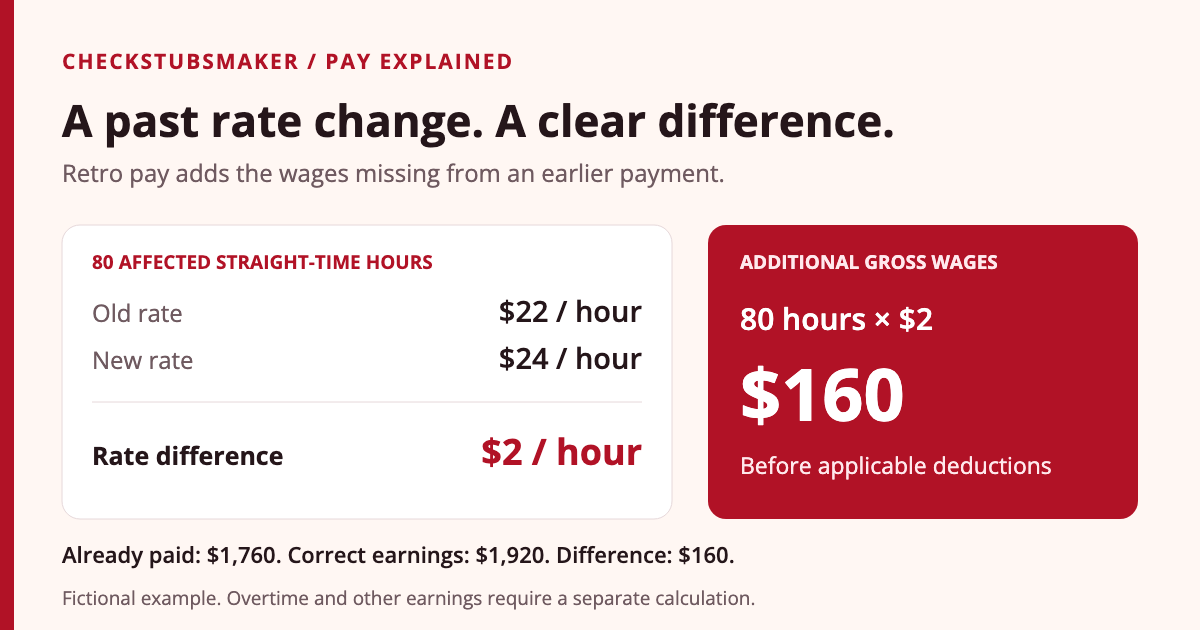
Assume an employee’s rate increased from $22 to $24, effective at the start of an earlier pay period. All 80 hours in that period were ordinary straight-time hours, with no overtime, premiums, leave, bonuses, or other earnings. Payroll already paid all 80 hours at $22.
| Calculation | Formula | Gross amount |
|---|---|---|
| Already paid | 80 × $22 | $1,760 |
| Correct earnings | 80 × $24 | $1,920 |
| Additional wages due | $1,920 − $1,760 | $160 |
The additional gross amount is $160, also calculated as 80 × $2. Adding another $1,920 would count the original $1,760 again. The adjustment closes the difference between the two earnings amounts.
If the new rate starts halfway through a period, include only the affected hours. If several rates or effective dates apply, split the calculation into separate rows before adding the differences. Use actual time records; the normal number of hours in a pay schedule does not establish the hours worked.
Does retro pay include an overtime adjustment?
It can. 29 CFR 778.303 explains that a retroactive pay increase raises the regular rate for the affected period, including the overtime calculation. Review each affected workweek.
Consider a separate fictional employee covered by the FLSA’s ordinary weekly overtime rule. The employee worked 45 hours in one workweek. The rate was originally $20 and is increased retroactively to $22. Assume that rate is also the regular rate, with no other earnings or adjustments.
| Hours | Originally paid | Correct pay | Difference |
|---|---|---|---|
| 40 straight-time hours | 40 × $20 = $800 | 40 × $22 = $880 | $80 |
| 5 overtime hours | 5 × $30 = $150 | 5 × $33 = $165 | $15 |
| Workweek total | $950 | $1,045 | $95 |
The additional gross wages are $95. Multiplying all 45 hours by the $2 increase gives only $90. That approach misses the extra $5 overtime premium in this example. Alternatively, 45 × $2 plus 5 × $1 produces the same $95 total.
The DOL’s regular-rate fact sheet explains why the regular rate can include more than base hourly wages. Bonuses or other includable earnings can change the calculation. A lump-sum retroactive increase may require allocation across earlier hours under section 778.303; do not apply the simple hourly shortcut to every award.
Our overtime pay-stub guide explains common earnings displays. Applicable state rules or agreements may also affect the amount owed.
How does retro pay appear beside current earnings?
Return to the first employee’s $22-to-$24 raise. Assume the next regular payment covers a different 80 straight-time hours, all at the new $24 rate, and also includes the earlier $160 adjustment. There are no other earnings.
| Earnings component | What it pays for | Gross amount |
|---|---|---|
| Current regular earnings | New period: 80 × $24 | $1,920 |
| Retroactive earnings | Earlier period: 80 × $2 difference | $160 |
| Total gross earnings | Current wages plus adjustment | $2,080 |
The $2,080 is gross pay before employee taxes and other applicable deductions. It does not mean the employee worked 160 hours in the new period. The two 80-hour figures refer to different work periods.
When checking your statement, separate these fields:
- Earnings code: which entry contains the correction?
- Hours and rate: are they current work details, historical reference details, or the rate difference?
- Current amount: how much adjustment is included in this payment?
- YTD amount: is this a cumulative total rather than another payment?
- Pay date: when is this payment issued?
If an entry shows only dollars, request a breakdown of the hours and periods behind it. Our YTD guide helps distinguish running totals from current amounts, and our gross versus net guide explains the next stage of the paycheck calculation.
Is retro pay taxed differently?
Retroactive wage increases generally remain wages. IRS Publication 15 (2026) includes them in supplemental wages and explains that withholding depends on how payments are identified and processed. A separately identified payment may qualify for the optional 22% federal withholding method under specified conditions; other methods can apply. The label alone does not establish the method.
Social Security and Medicare rules also apply. A federal withholding percentage is not the employee’s final income-tax rate. Compare the earnings and deduction lines before comparing a bank deposit with the pay stub.
Publication 15 treats back pay, including retroactive wage increases, as ordinary wages in the year paid. An increase paid this year for last year’s work therefore does not automatically belong on last year’s wage statement. Ask payroll about any separate reporting correction.
Is retro pay the same as back pay?
The terms overlap, and payroll labels do not create a universal legal distinction. Retro pay often describes a recalculation, including a backdated raise. The Department of Labor’s back-pay overview describes making up the difference between wages paid and wages that should have been paid as a remedy for wage violations.
It is therefore too narrow to say back pay only means an entirely missing paycheck. A partial underpayment can also be involved. Equally, a retro entry does not by itself prove a legal violation. Establish what changed, which earnings were affected, and whether the difference has been fully paid.
What should you do if retro pay is missing or seems wrong?
- Confirm the effective date. Find the written raise, agreement, or correction notice.
- Collect the affected records. Save original pay stubs and time records, including each workweek’s overtime.
- Build a comparison. List old rate, correct rate, affected hours, original gross wages, and corrected gross wages.
- Check adjustments already paid. Review separate payments and earlier correction lines to avoid requesting the same difference twice.
- Ask for the payroll breakdown. Request the covered dates, calculation, overtime treatment, deduction explanation, and expected payment date.
- Keep the response. Save the explanation alongside the statement showing the correction.
A focused request could say: “My rate changed from $22 to $24 effective [date]. Please confirm which hours the retro entry covers, the gross difference, any overtime recalculation, and the payment date.” Replace the fictional details with your records.
A processing cutoff does not, by itself, establish the legal payment deadline. If wages remain unpaid, consult the relevant state labor agency or the DOL Wage and Hour Division about applicable rules. For older statements, see how to request pay stubs from a previous employer.
Frequently asked questions
Is retro pay a bonus?
A backdated raise adjustment pays a wage difference for earlier work. A bonus can have a different purpose. Confirm the actual earnings type; a payroll system’s retroactive process can handle several kinds of changes.
Does a retro line mean I received a new permanent raise?
The line shows an adjustment. Check the written rate notice and current regular-earnings rate to confirm whether your ongoing rate changed and when the change applies.
Should the retro amount equal the increase in my deposit?
Compare gross retro earnings first. Withholding, other applicable deductions, and changes in current earnings can make the deposit increase different from the gross adjustment.
Can one retro payment cover several pay periods?
Yes. Request a period-by-period calculation, especially if rates or hours changed. Add the separate wage differences after checking that no period or prior payment is counted twice.
Can I use the hourly formula for a salary adjustment?
Use a calculation matching the salary arrangement and effective dates. Do not substitute assumed hourly totals. Ask payroll how it allocated the salary difference and handled any applicable overtime.
Prepared by the CheckStubsMaker Editorial Team using the primary sources linked above and original fictional examples. See our editorial policy for sourcing and correction standards. Actual pay calculations depend on the employee’s records, compensation arrangement, and applicable law.