A 401(k) line on a pay stub usually records a retirement-plan contribution taken from your pay. Check whether it is a traditional pre-tax deferral, an employee Roth deferral, or a separate employer contribution. Your deduction reduces cash available for take-home pay; an employer match is a different source of retirement funding. Read the current and year-to-date columns separately and confirm the plan’s own contribution rules.
For U.S. employees · Sources checked October 20, 2026 · All pay amounts, percentages, and matching formulas below are fictional examples.
A statement showing “401K $144” and “401K ER $72” does not necessarily mean $216 was deducted from your paycheck. Those entries may describe contributions from two different people: you and your employer. Identifying the source is the first step in checking the calculation.
What do 401K, Roth, EE, and ER mean on a pay stub?
Payroll labels vary. A “401K” entry might identify your regular elective deferral, while a separate Roth entry distinguishes an after-tax employee contribution. “EE” often means employee and “ER” often means employer, but the payroll legend controls the meaning of a particular code.
The IRS participant overview explains that a 401(k) allows employees to defer part of their wages into a retirement plan. Check your enrollment confirmation and summary plan description to identify the contribution type you elected.
| Possible label | What to investigate | Useful comparison |
|---|---|---|
| 401K or pre-tax 401(k) | An employee traditional elective deferral | Your elected percentage or dollar amount |
| Roth 401K | An employee designated Roth deferral | The Roth election and deduction section |
| 401K EE | An employee contribution | Employee deductions included in net-pay calculation |
| 401K ER or match | An employer contribution | The plan’s matching formula and employer totals |
| 401(k) loan | A repayment under a plan loan | The loan schedule, rather than the deferral election |
Do not combine every retirement-related code into one contribution total. Ask payroll to distinguish a loan repayment, correction, employee deferral, and employer funding. Our deduction-code guide explains how to read unfamiliar labels.
How do traditional and Roth 401(k) contributions affect payroll taxes?
The IRS contribution-withholding FAQ distinguishes employee pre-tax and Roth salary deferrals. A traditional pre-tax deferral generally reduces wages subject to federal income-tax withholding. An employee Roth deferral generally does not. Both generally remain included in Social Security and Medicare wages.
| Question | Traditional pre-tax | Employee Roth |
|---|---|---|
| Deducted from employee cash pay? | Yes | Yes |
| Generally reduces current federal income-tax wages? | Yes | No |
| Generally reduces Social Security and Medicare wages? | No | No |
| Uses part of the shared employee elective-deferral limit? | Yes | Yes |
The IRS designated Roth FAQ explains that a Roth account is a separate account within an eligible employer plan. A Roth 401(k) contribution is not the same transaction as depositing money into a personal Roth IRA.
These comparisons describe employee deferrals. Other contribution types and state treatment can differ. The examples below assume an ordinary non-Roth employer match. Check the plan and its reporting explanation if a separate employer contribution is designated Roth.
How do you calculate the 401(k) deduction on one paycheck?
For a percentage election, multiply the compensation eligible under the plan by the elected percentage. Do not assume every earnings category is included. Bonuses, commissions, overtime, or other pay require checking the plan’s definition of compensation and your election.
Assume a fictional employee has $2,400 of gross pay, all eligible for the plan, and elects a 6% traditional pre-tax deferral. There are no other benefits, adjustments, or exclusions affecting the wage-base comparison.
Employee deferral = $2,400 × 6% = $144.
Under those assumptions, the federal income-tax wage amount is $2,400 − $144 = $2,256. The $144 traditional deferral does not reduce the $2,400 Social Security and Medicare wage base in this example. Actual withholding also depends on the applicable tax rules and the rest of the payroll record.
If the same employee instead elects a 6% employee Roth deferral, the contribution is still $144, but federal income-tax wages remain $2,400 under these assumptions. That is a comparison of wage bases—not a calculation of either paycheck’s final net pay.
A $144 traditional deferral also does not mean $144 less federal tax. It reduces the amount used in the relevant income-tax calculation. Our gross versus net guide and FICA guide explain those different stages.
How does an employer match appear beside your contribution?
An employer match is funding contributed by the employer under the plan’s formula. The IRS matching-contribution guide directs participants to their plan documents for eligibility and matching conditions. A displayed match should not automatically be added to employee deductions.
Continue the fictional $2,400 example. Assume the plan matches 50% of employee deferrals up to 6% of eligible compensation, calculates the match for this payroll, and the employee satisfies all eligibility conditions. The employer contribution is an ordinary non-Roth match.
| Funding source | Calculation | Amount |
|---|---|---|
| Employee deferral | $2,400 × 6% | $144 |
| Employer match | $144 × 50% | $72 |
| Combined contribution amount | $144 + $72 | $216 |
Only $144 is the employee deduction in this example. The additional $72 is employer funding. The combined $216 is not another take-home payment and is not the employee’s net pay.
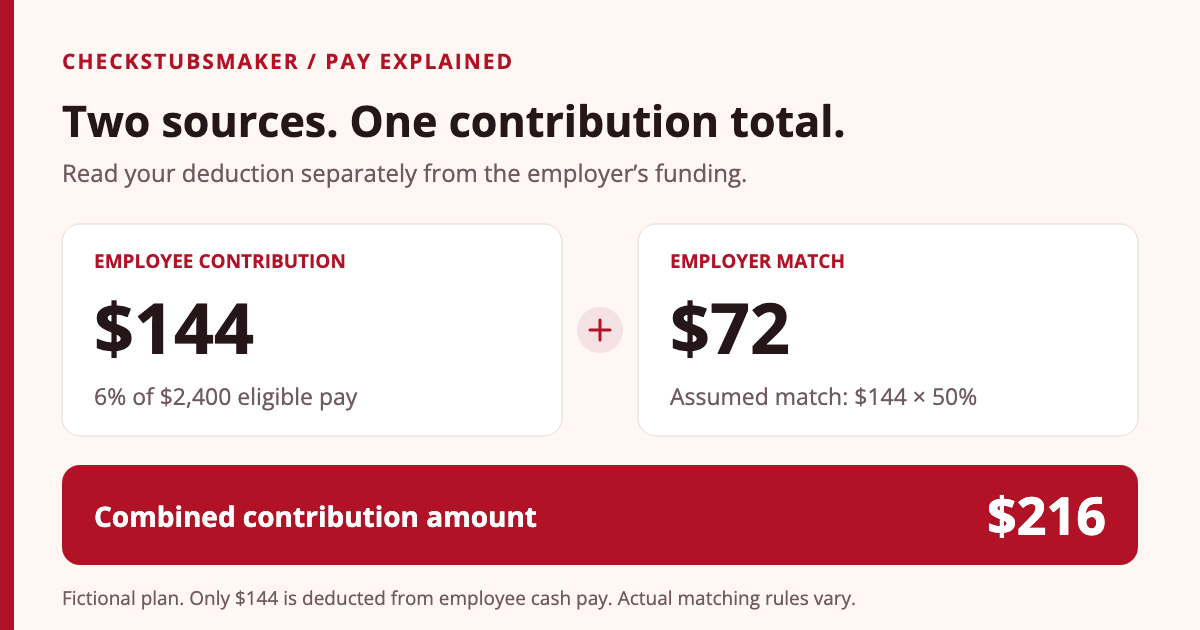
Read “50% up to 6%” carefully: it does not mean the employer adds 6% of pay in this example. At the assumed employee election, the match equals 3% of eligible pay. Other plans use different formulas or contribution schedules.
Why does the YTD contribution differ from the retirement account balance?
A payroll YTD column is a running total of recorded contributions. An investment account balance can also reflect employer deposits, investment gains or losses, fees, transfers, distributions, and timing differences.
For example, ten employee deductions of $144 total $1,440. Ten matching entries of $72 total $720. Even if both amounts have reached the account, their $2,160 combined total is not a prediction of the current investment balance.
Compare the same source, period, and transaction type. Do not add the latest current deduction to a YTD figure that already includes it. Our YTD guide shows how to avoid that double count.
The DOL’s fiduciary-responsibility guidance discusses timely deposits of employee contributions. A payroll entry and a retirement-account transaction are separate records. Ask the plan administrator to reconcile missing deposits rather than assuming a pay-stub deduction proves the funds have arrived.
What should you know about annual limits and vesting?
For 2026, the IRS lists a $24,500 basic employee elective-deferral limit for traditional and safe harbor 401(k) plans. Traditional and employee Roth deferrals share the applicable limit. Catch-up eligibility, plan restrictions, and other limits can change an individual’s permitted amount; SIMPLE arrangements have different rules.
Employer matching contributions are not charged against that basic employee deferral limit, but a separate overall contribution limit applies. A job change can require coordination because the applicable employee limit generally aggregates deferrals across plans. Do not assume a new employer’s payroll knows the earlier employer’s totals.
Vesting means ownership. Your employee contributions are always fully vested. Employer contributions may follow a vesting schedule, depending on the plan. A match displayed on a statement therefore does not, by itself, establish that every employer-funded dollar is fully vested.
What should you check if the deduction or match looks wrong?
- Find the election. Confirm traditional versus Roth, percentage versus fixed dollars, and its effective date.
- Confirm eligible compensation. Ask which earnings categories the plan includes.
- Recalculate the employee amount. Apply the election to the correct compensation base.
- Separate employer funding. Check the matching formula, eligibility, and allocation schedule.
- Compare matching periods. Align current and YTD payroll records with the retirement account’s contribution history.
- Ask for a written reconciliation. Identify the pay dates, disputed amounts, and any correction or deposit still needed.
A useful request is: “My election is [type and amount], effective [date]. Please confirm the eligible compensation used, employee deduction, employer-match calculation, and deposit record for [pay date].” Keep the response with the original statement.
Frequently asked questions
Is 401(k) an employer tax?
An employee 401(k) deferral is a retirement contribution elected through the plan. It is different from tax withholding. A separate employer contribution should be identified separately.
Does a pre-tax 401(k) deduction reduce my gross earnings?
Gross earnings can remain unchanged while federal taxable wages are lower. Read the field labels rather than treating gross pay, taxable wages, and net pay as interchangeable.
Why is my match missing from this paycheck?
Check eligibility and the plan’s calculation and deposit schedule. Ask whether the match is reported elsewhere or allocated on a different schedule before concluding it was omitted.
Does “after-tax” always mean Roth?
No. Plans can distinguish designated Roth deferrals from other after-tax contributions. Confirm the exact contribution type with the administrator.
Is a loan repayment another elective deferral?
The IRS loan FAQ distinguishes repayments from plan contributions. Keep them separate when reconciling your deferral election. Ask the administrator to identify each transaction using the plan’s records and loan schedule.
Prepared by the CheckStubsMaker Editorial Team using the primary sources linked above and original fictional examples. See our editorial policy for sourcing and correction standards. This guide explains payroll records; actual contribution and tax treatment depends on the plan and applicable rules.