Overtime on a pay stub may appear as a separate earnings line with hours, a rate, and an amount, or as an extra premium added after straight-time pay for all hours. Under the general federal rule for covered, nonexempt employees, hours worked over 40 in one workweek must be paid at least 1.5 times the regular rate. For a simple $24 regular rate, five overtime hours produce $180 in full overtime earnings, including a $60 premium above straight time.
For U.S. employee pay statements · Sources checked October 12, 2026 · Examples are fictional and use the general federal weekly overtime rule.
A line marked “OT” can mean different things depending on how payroll displays the earnings. The most useful first check is whether the amount includes the full payment for the overtime hours or only the extra premium. Once you identify the display method, you can reconcile the hours and gross pay without counting the same earnings twice.
What does overtime look like on a pay stub?
Look in the earnings section, then read the employer’s explanation of its codes. An overtime label alone is not enough to establish the amount due. You also need the covered work dates, the hours, the rate calculation, and any adjustments.
| Field | What to identify | Why it matters |
|---|---|---|
| Pay-period dates | The work dates included in the statement | The paycheck can cover more than one workweek |
| Earnings code | Whether the entry is full overtime pay or an added premium | The two display methods use different amounts |
| Hours | Hours assigned to each earnings line | Hours used in a premium calculation can also appear in the straight-time line |
| Rate | The rate or premium used for that line | A premium-only rate can be half the regular rate |
| Current earnings | Money included in this payment | Current earnings are different from cumulative YTD totals |
The Department of Labor’s overtime overview explains the general federal rule and notes that some special arrangements and state requirements differ. The examples below assume an employee covered by the ordinary 40-hour workweek rule, with no higher applicable overtime requirement.
How do you calculate overtime for a 45-hour workweek?
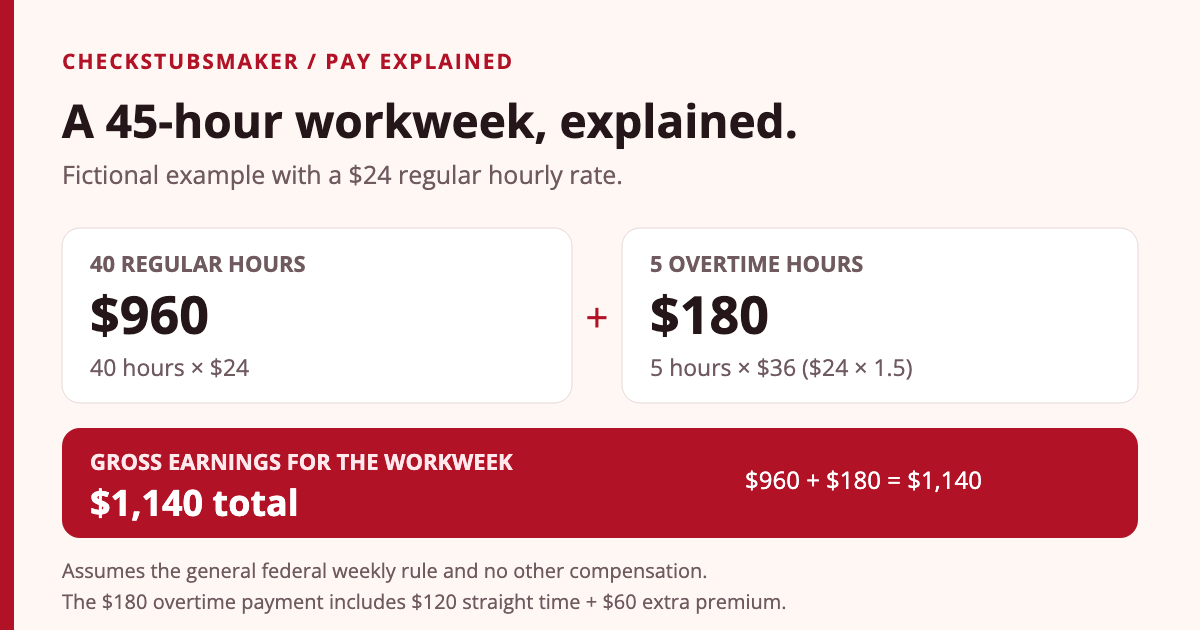
Assume a fictional employee works 45 hours in one workweek at a single $24 hourly rate. There are no bonuses, shift differentials, commissions, or other amounts that change the regular rate. The overtime rate is $24 × 1.5 = $36 per hour.
Full overtime earnings = overtime hours × overtime rate.
| Earnings line | Hours | Rate | Amount |
|---|---|---|---|
| Regular pay | 40 | $24 | $960 |
| Overtime pay | 5 | $36 | $180 |
| Gross earnings for the workweek | 45 worked | $1,140 |
The calculation has two parts: 40 × $24 = $960, and 5 × $36 = $180. Adding them gives $1,140 in gross earnings. Taxes and other employee deductions are still separate, as our gross pay versus net pay guide explains.
Why might the overtime line show $60 instead of $180?
Some statements first show straight-time pay for every hour worked, then add the extra half-time premium for the overtime hours. In that display, the straight-time portion of the five overtime hours has already been included.
Extra overtime premium = overtime hours × regular rate × 0.5.
| Earnings line | Hours used | Rate | Amount |
|---|---|---|---|
| Straight-time pay for all hours | 45 | $24 | $1,080 |
| Extra overtime premium | 5 | $12 | $60 |
| Gross earnings for the workweek | 45 worked | $1,140 |
Both methods reach the same gross total. The five hours used on the premium line are a subset of the 45 hours already shown; they are not five more hours worked. Adding the 45 and 5 as if they were separate work time would incorrectly suggest 50 hours.
Similarly, $1,080 in straight-time earnings plus another $180 in full overtime earnings would total $1,260. That combines two display methods and counts the overtime hours’ $120 straight-time portion twice. Ask payroll what a line includes before treating a smaller premium entry as missing wages.
Can a biweekly paycheck hide overtime in the total hours?
The pay period and the overtime workweek are different. 29 CFR 778.104 states that each workweek stands alone and that hours cannot be averaged across two or more weeks. A biweekly pay date does not change that general rule.
Continue the fictional example with 45 hours in week one and 35 hours in week two, both at the same $24 regular rate:
- Week one: $960 regular pay + $180 overtime pay = $1,140.
- Week two: 35 × $24 = $840, with no weekly overtime in this example.
- Both weeks combined: 80 hours worked and $1,980 gross earnings.
Paying all 80 hours at $24 would produce $1,920 and omit the $60 premium for week one. Although the two-week average is 40 hours, that average does not erase the first week’s overtime. Compare the weekly time records with the earnings lines.
Our biweekly versus semimonthly guide explains how payment schedules relate to the dates on the statement. A calendar period can include portions of workweeks, so request the weekly breakdown if it is not visible.
Is the overtime rate always 1.5 times your base hourly rate?
The general federal calculation uses the regular rate, which can differ from the base rate displayed on a pay stub. The Department of Labor’s Fact Sheet 56A explains which compensation is included and excluded. Some additional payments affect the calculation.
The $24 examples work because the employee has one hourly rate and no other compensation changing the regular rate. If you also receive an incentive payment, work at different rates, or see an overtime adjustment after a bonus, ask payroll for the workweek’s regular-rate calculation. A different rate needs an explanation; it should not be judged using the base rate alone.
Does “no tax on overtime” mean the entire OT line is tax-free?
No. The IRS’s 2026 Employer’s Tax Guide says overtime remains subject to federal income-tax withholding and generally to Social Security and Medicare taxes. An eligible deduction does not automatically remove all paycheck taxes. See our guide to FICA on a pay stub for those separate tax lines.
The IRS’s updated August 2026 qualified-overtime FAQ distinguishes the FLSA-required premium above the regular rate from total overtime earnings. In the simple example, the full overtime payment is $180, but the additional half-time premium is $60. Whether the employee can deduct qualified compensation depends on the IRS eligibility rules and limits.
For tax year 2026, the FAQ says employers report qualified overtime compensation on Form W-2 in box 12, code TT. That annual reported amount is not necessarily the amount ultimately deductible. Keep the pay statements and use the current IRS instructions when reconciling the tax form.
What should you check if overtime is missing or looks incorrect?
- Match the work dates. Compare the pay-period dates with the time record and the employer’s established workweek.
- Separate hours worked from other paid entries. Identify leave, corrections, and premium-calculation hours before adding the total.
- Identify the display method. Determine whether straight time already includes the overtime hours.
- Check the regular-rate calculation. Review the rates and any additional compensation that may affect them.
- Reconcile gross earnings first. Add the earnings lines before considering taxes, benefits, or bank deposits.
- Ask payroll about unresolved differences. Provide the workweek dates, recorded hours, earnings code, rate, and amount you need explained. Keep a copy of the original statement and time record.
The Department of Labor’s hours-worked guidance helps explain what counts as work time under the FLSA. If the disagreement concerns those rules or eligibility rather than arithmetic, review the applicable guidance and contact the appropriate labor office.
For annual planning, avoid multiplying one unusually overtime-heavy paycheck by every pay period in the year. Our guide to annual income from a pay stub explains how to use year-to-date earnings and realistic assumptions about future pay.
Frequently asked questions
Why does my OT rate look like half my normal rate?
It may be a premium-only line. Check whether straight-time earnings already pay for every hour worked. In the example, $12 is the extra premium on top of $24 already paid, reaching $36 for each overtime hour.
Can I just total two weeks to see whether I worked overtime?
Use the separate workweeks for the general federal weekly test. A two-week total of 80 hours can include 45 in one week and 35 in the other, with five overtime hours in the first week.
Is overtime included in gross pay or net pay?
Overtime earnings are included in gross pay. Net pay is what remains after employee taxes and other deductions. The overtime earnings line alone does not establish how much extra money will reach your bank account.
Does working on Saturday automatically make the hours overtime?
Under the general federal rule, Saturday by itself does not determine overtime. The workweek’s hours matter. A higher applicable state requirement, employer policy, or agreement can provide additional premium pay.
What should I enter when creating a pay stub with overtime?
Use the actual work dates, hours, regular-rate information, and earnings from the payroll records. Identify whether the overtime field expects full overtime earnings or only an added premium, and reconcile the result with the source records.
Sources and editorial notes
This guide uses Department of Labor guidance and the federal workweek regulation for the overtime explanation, and current IRS guidance for the short tax-reporting section. The calculations and illustration are original examples. They do not cover every exemption, state rule, industry arrangement, or alternative overtime method.
Published by the CheckStubsMaker Editorial Team. This article explains how to read and check pay-stub earnings; individual wage disputes and tax eligibility depend on the applicable facts and rules. Read our editorial policy for sourcing and corrections.