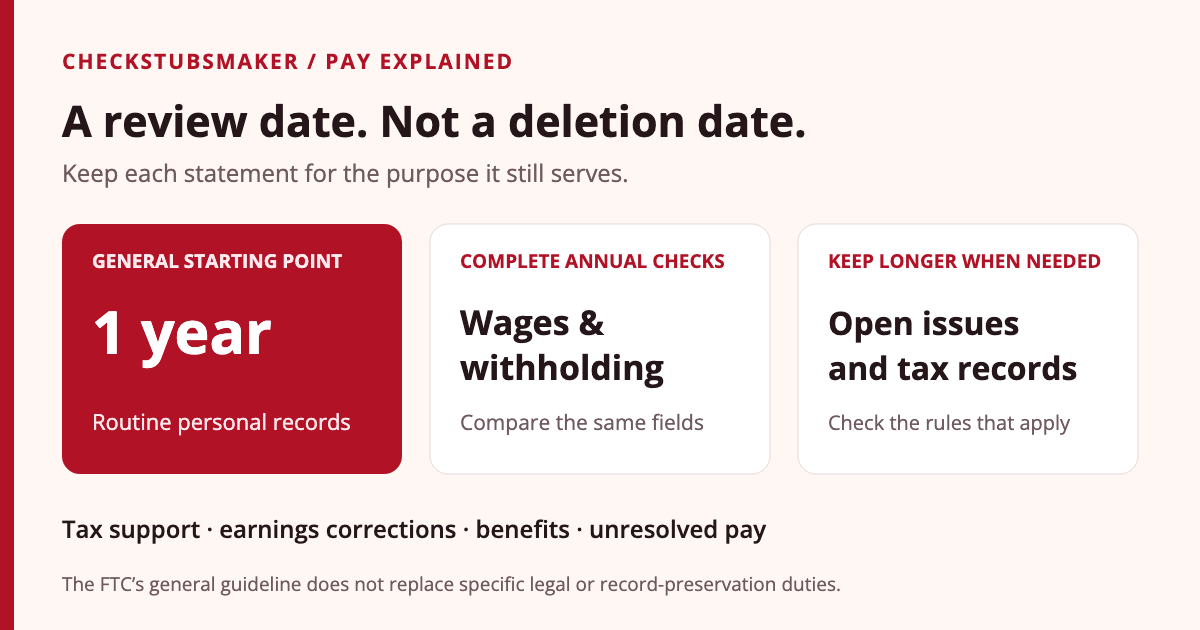
For routine personal recordkeeping, keep pay stubs for at least a year and through your annual wage checks. Keep them longer when they support tax-return information, a benefit claim, a retirement contribution, or an unresolved pay issue. The FTC’s one-year guideline is a useful starting point, not a universal legal destruction date. Employer payroll-retention duties are separate from an employee’s decision about personal copies.
For U.S. readers · Sources checked October 20, 2026 · All earnings and record examples below are fictional.
The right question is not only how old a statement is. Ask what it still proves. A two-year-old pay stub connected with an unresolved wage correction may be more important than a recent duplicate you have already saved securely.
Is keeping pay stubs for one year enough?
The FTC’s document-retention guidance puts pay stubs in its one-year category. It separately recommends keeping tax returns and tax-related documents for at least three years, with longer periods in some cases.
Use those categories together. A routine statement may be ready for review after a year, while a statement that substantiates a tax item or an ongoing claim belongs with that longer-lived file. Do not discard all payroll documents automatically on January 1 or as soon as the latest W-2 arrives.
| Situation | Retention approach | Check before disposal |
|---|---|---|
| Routine statement, no open issue | Use at least a year as the general starting point | Annual wage comparison and other needs are complete |
| Supports a tax-return item | Keep with the relevant tax records | The applicable retention period has ended |
| Pay, benefit, or contribution dispute | Preserve while the matter remains relevant | The issue and any further record needs are resolved |
| Needed for a pending application | Keep the requested documents and submission record | The recipient’s requirements and any follow-up needs |
This is a decision guide, not a complete legal retention schedule. A pending audit, investigation, court matter, or specific agency instruction can require a different approach. Preserve records relevant to an open matter and ask the responsible adviser or agency before destroying them.
What should you compare before discarding older pay stubs?
Compare the employer, calendar year, payment dates, wage categories, and withholding totals. Your last statement may show useful YTD totals, but it is not automatically identical to every W-2 box. Check for separate payments, year-end corrections, and differences between gross and taxable wages.
For a fictional example, assume an employee receives 26 payments of $2,000 during one calendar year. The employee contributes $100 from each payment to a traditional pre-tax 401(k). There are no other benefits, taxable additions, corrections, or wage-base adjustments, and all wages fall below the Social Security wage cap.
| Annual item | Calculation | Amount |
|---|---|---|
| Gross earnings paid | 26 × $2,000 | $52,000 |
| Employee pre-tax deferrals | 26 × $100 | $2,600 |
| Federal income-tax wages | $52,000 − $2,600 | $49,400 |
| Social Security and Medicare wages | No reduction for these deferrals | $52,000 |
The IRS retirement-contribution FAQ explains the different wage treatment. In this example, $52,000 payroll gross and $49,400 federal taxable wages can both be correct. The retained deduction records explain the $2,600 difference.
Compare like with like before treating a mismatch as an error. Our 401(k) guide explains the contribution line, and our YTD guide explains running totals. Keep the statements and payroll’s explanation if a difference remains unresolved.
When should pay stubs stay with tax records?
IRS Topic 305 explains that records supporting income, deductions, or credits generally need to remain available through the relevant limitations period. The ordinary assessment period is generally three years from filing; a return filed early is generally treated as filed on its due date.
The IRS retention overview lists important exceptions. Certain substantial income omissions can involve six years; an unfiled or fraudulent return has no ordinary assessment limit. Refund claims and other situations can also use different periods. A blanket “shred everything after three years” rule misses these distinctions.
Keep a statement with the tax file when you used it to substantiate reported information, reconcile a correction, or explain a wage or withholding amount. Record why it was retained so a later review does not mistake it for an unnecessary duplicate.
The clock is not simply three years from the pay date. A statement supporting an annual return is connected to that return and its applicable rules. If the circumstances are unusual, confirm the retention period with the preparer or the IRS guidance before deleting the evidence.
Why might you need pay stubs after the tax check?
The Social Security Administration’s earnings-correction guide lists wage stubs or pay slips among evidence that can help establish missing earnings. Review your earnings record and preserve supporting documents if a discrepancy needs investigation.
SSA also explains that recent earnings may not yet appear. A current-year or recent prior-year posting gap is not automatically proof of an employer reporting error. Follow the agency’s guidance and compare the correct earnings category rather than assuming all payroll gross should appear as Social Security earnings.
Other reasons to keep particular statements include:
- A missing retirement contribution or employer match being reconciled with the plan.
- A disputed overtime calculation or corrected hourly rate.
- An earlier retroactive pay adjustment with supporting correspondence.
- A benefit-reporting requirement or income-verification request that remains open.
Keep the relevant time records, notices, corrected statements, and written responses alongside the pay stubs. A single earnings summary may not explain which week contained disputed hours or when a deduction changed.
How long must employers keep payroll records?
Employer requirements are a different question. The DOL’s FLSA recordkeeping fact sheet describes at least three years for payroll records and two years for records used to calculate wages, such as timecards and wage-rate tables.
IRS Topic 305 also describes retaining employment-tax records for at least four years after the tax becomes due or is paid, whichever is later. The IRS employment-tax recordkeeping page identifies records to preserve and longer requirements for specified credit documentation.
These federal baselines do not replace state requirements or other applicable obligations. They also do not promise that an employer will provide an employee with unlimited portal access for the same number of years. Save your own copies and request missing statements promptly.
How should you organize digital and paper copies?
Use a folder for each employer and calendar year, with the payment date in each filename. For example: “2026-10-23_EmployerA_pay-stub.pdf.” Include the employer name or another clear identifier when several jobs have the same payday.
Before relying on a download, open it and confirm that every page, earnings line, deduction, and date is readable. A portal bookmark or cropped screenshot may omit the details you later need. Keep the full original document and save explanations as separate files.
A simple folder can contain:
- Original statements, including separate and correction payments.
- The relevant W-2 and any corrected W-2.
- Time records or contribution histories needed for a specific issue.
- A short note explaining unresolved differences and where the correspondence is stored.
Protect access with a strong account password and available two-factor authentication. Keep a protected backup and test that it opens. Download permitted copies before leaving a job or changing payroll systems; access and storage policies can change.
For missing records, our previous-employer guide explains how to make a focused request. Our date-reading guide helps distinguish the earnings window from the payment date used in your files.
What should you check before shredding or deleting a statement?
- Check the age and purpose. Has the routine retention period passed, and is there another reason to keep it?
- Complete annual comparisons. Investigate unexplained wage, withholding, and contribution differences.
- Check for open matters. Preserve documents tied to tax questions, benefit reviews, applications, or disputes.
- Verify the retained copy. If keeping a digital version, confirm it is complete, accessible, and backed up.
- Dispose securely when appropriate. The FTC recommends shredding personal financial documents when it is time to discard them.
Review shared folders, old email attachments, and backups when managing digital duplicates. Follow the storage service or device’s instructions, and do not assume deleting one shortcut removes every copy.
Frequently asked questions
Can I throw away every pay stub when my W-2 arrives?
Complete the comparison first, then check tax-supporting and other record needs. An unresolved correction or claim can justify keeping particular statements longer.
Is one year a legal rule for every employee?
No. It is a general consumer-retention guideline. The document’s purpose and applicable requirements can call for a longer period.
Do electronic pay stubs need to be printed?
A readable, protected electronic copy can serve routine personal storage needs. Confirm any original-document or submission requirements for the particular matter before disposing of paper.
Should I keep only the final stub of the year?
A final YTD summary may help, but earlier statements can explain individual hours, rates, deductions, or corrections. Keep those needed to resolve or substantiate an issue.
Does leaving a job make the old statements unnecessary?
No. Keep the records for their remaining purposes and download available copies before access changes. A job change does not resolve a missing payment or reporting difference.
Prepared by the CheckStubsMaker Editorial Team using the primary sources linked above and original examples. See our editorial policy for sourcing and correction standards. Specific tax, employment, and record-preservation obligations depend on the circumstances and applicable rules.