Your last pay stub can help estimate missing wage information, but it is not the routine replacement for Form W-2. First request the missing or corrected W-2 from your employer. If it remains unavailable, follow the IRS missing-form process and Form 4852 instructions. Use the correct year-to-date wage and withholding categories, explain your estimates, and check any deduction-specific reporting requirements.
For U.S. federal individual income-tax filing · Sources checked October 20, 2026 · All earnings examples below are fictional. Use instructions for the tax year being filed.
A final statement is useful evidence. It can show cumulative earnings and amounts withheld when an annual form is missing. But a bank deposit, gross-pay total, and taxable-wage amount answer different questions. Preparing a return requires identifying the right information rather than copying one large number.
Why is the last pay stub different from a W-2?
A pay stub explains a payroll calculation, often with current and YTD columns. A W-2 is the employer’s annual wage-and-tax statement. It has separate fields for different wage bases, taxes withheld, and other reportable items. Our W-4 versus W-2 guide explains the annual form’s role.
The IRS W-2 instructions use wages paid during the calendar year. The statement from your final workday is not necessarily the final payment record for that year. Later payments or corrections can change the annual totals.
Before using a statement as evidence, confirm the employer, tax year, pay date, and whether it includes all payments. A year-end bonus paid separately or a correction issued after the regular payroll may require another record.
Do not substitute take-home pay for wages. Net pay reflects taxes, benefits, contributions, and potentially other adjustments. Our gross versus net guide explains why the bank credit cannot supply all the required tax information.
What should you do if your W-2 is missing or wrong?
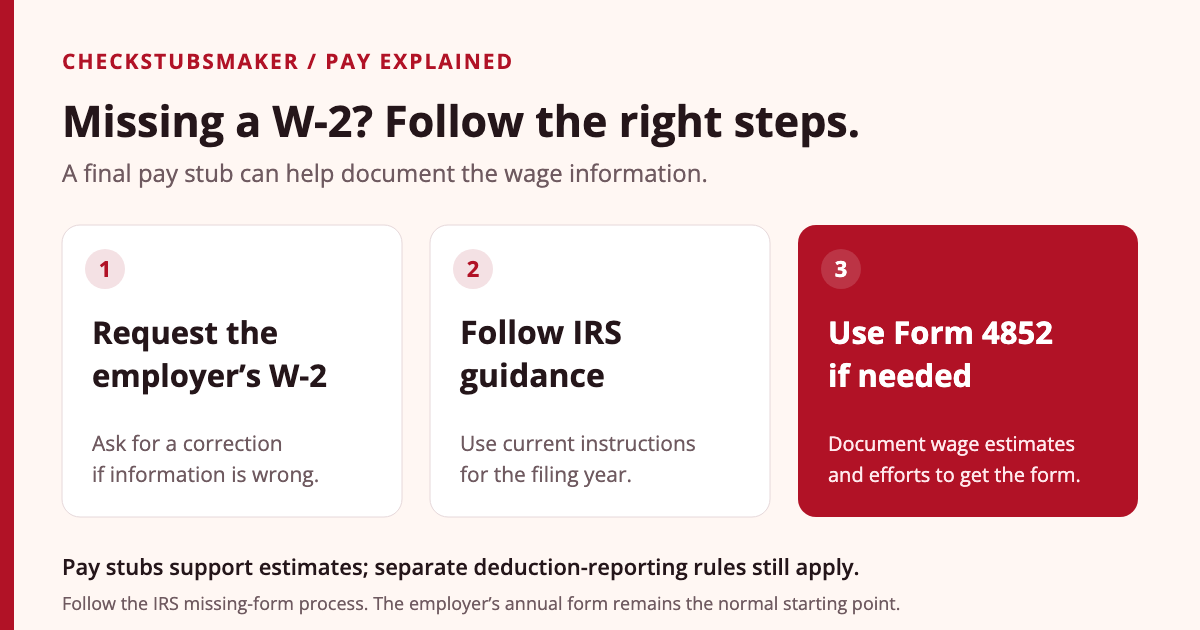
The IRS missing-W-2 guide gives a sequence:
- Contact the employer. Ask when the form is coming or request correction of inaccurate information. Confirm the delivery address and check the authorized payroll portal.
- Follow up with the IRS when appropriate. If you contacted the employer and still lack the form by the end of February, the IRS directs you to contact it for help. Use the current instructions on the linked official page.
- Use the substitute process if necessary. If the form still does not arrive in time to file, the IRS explains using paycheck records to estimate wages and completing Form 4852 with the return.
Form 4852 and its instructions require explaining how the amounts were determined and the efforts made to obtain the missing or corrected form. Keep a dated log of requests and responses. Do not create an employer-issued W-2 yourself or silently alter a payroll document.
If you changed jobs, deal with each employer’s missing information separately. A complete record from the new job does not replace the previous employer’s wages. Our previous-employer guide can help you gather supporting statements.
Which pay-stub information should you gather?
Start with the final available YTD statement, then check it against other records. Separate each employer and year. Do not add several YTD totals together: earlier payments are already included in a later cumulative figure.
| Information | What to verify | Common mistake |
|---|---|---|
| Federal taxable wages | The correct annual wage category and adjustments | Copying gross earnings or net pay |
| Social Security and Medicare wages | Each wage base separately | Assuming both equal federal income-tax wages |
| Income tax withheld | Federal, state, and local amounts separately | Combining all taxes as federal withholding |
| Employee payroll taxes | Social Security and Medicare withholding | Including the employer’s share |
| Employer and employment details | Correct identity, address, and relevant dates | Using another employer’s information |
Form 4852 separates these categories. If a needed field is absent, ask payroll for an earnings summary or a documented explanation. Guessing a missing tax amount from the net deposit can produce an unsupported result.
The IRS wage-transcript guide describes wage-and-income transcripts showing information reported to the IRS. Availability depends on reporting and processing; information for the year currently being processed may be incomplete. It also does not include state or local information from Form W-2.
Use a transcript for the information it actually contains. An absent entry does not establish that wages were zero, and a transcript is not necessarily a complete copy of the employer’s form.
Why might gross pay differ from the wage amount needed?
Assume a fictional employee receives $60,000 in gross wages from one employer during the calendar year and makes $3,000 of traditional pre-tax 401(k) deferrals. There are no other taxable benefits, tips, adjustments, or exclusions. Wages are below the Social Security cap.
| Annual category | Calculation | Amount |
|---|---|---|
| Gross wages | Total earnings paid | $60,000 |
| Traditional employee deferrals | Documented pre-tax contributions | $3,000 |
| Federal income-tax wages | $60,000 − $3,000 | $57,000 |
| Social Security and Medicare wages | No reduction for these deferrals | $60,000 |
The IRS contribution-withholding FAQ explains this treatment. A $60,000 gross figure does not automatically belong in every wage field. An employee Roth deferral would have different federal income-tax treatment.
This is a wage-base illustration, not a completed tax return or Form 4852. It does not calculate withholding, deductions claimed on a return, credits, tax due, or a refund. Check actual records rather than applying the example to all benefit types. Our 401(k) guide explains the underlying payroll entry.
Can Form 4852 establish an overtime or tip deduction?
Do not assume it establishes every deduction. In FS-2026-13, questions 22 and 23, the IRS explains the 2026 reporting requirement for qualified overtime compensation. An omitted or understated amount requires the employer’s corrected W-2 reporting; an amount reported on Form 4852 cannot be used to determine the deductible qualified overtime amount.
The IRS missing-or-incorrect-W-2 FAQ also says qualified tips reported on Form 4852 cannot determine the deductible qualified-tip amount. It identifies a separate Form 4137 route for qualified tips not reported to the employer.
These are specific reporting rules. They do not mean ordinary wage income disappears when a form is missing. Use the guidance for the tax year and the particular deduction; do not transfer a prior year’s transition rule to a later return. Our overtime guide explains the payroll calculation separately.
What if the filing deadline is approaching?
Missing paperwork does not automatically postpone a filing obligation. Review the substitute-form instructions and, when more preparation time is needed, the IRS extension guidance. An extension request generally must be made by the applicable filing deadline.
An extension to file generally does not extend the time to pay. Estimate and pay amounts required by the applicable payment deadline. Disaster relief, overseas situations, and other special rules can affect dates, so confirm the instructions that apply rather than relying on a generic calendar reminder.
For state returns, check the state revenue agency’s missing-wage-form and extension instructions. Federal substitute-form acceptance does not establish every state’s documentation requirements.
What happens if the W-2 arrives after you file?
Compare it with what was reported. The IRS missing-form guidance explains amending a return when the correct information differs. Form 4852 instructions identify Form 1040-X for the correction.
Keep the filed substitute form, supporting statements, calculation notes, requests to payroll, and any later W-2 or W-2c. Record the source of each estimate so a reviewer can follow it without reconstructing the entire payroll history.
The IRS W-2 FAQ advises keeping Form 4852 until you begin receiving Social Security benefits in case the earnings record is questioned. That is a specific reason to keep this document beyond a routine pay-stub storage review. See our pay-stub retention guide for organizing supporting records.
A final review should confirm:
- All employers and relevant wage payments were considered.
- Current and YTD amounts were not added together incorrectly.
- Federal, state, local, Social Security, and Medicare categories stayed separate.
- The estimate method and employer-contact efforts were documented.
- Any deduction-specific reporting requirement was checked for the filing year.
Frequently asked questions
Can I file early just because my final stub is available?
Follow the W-2 and missing-form process. Availability of a final pay stub alone does not make it the routine substitute for the employer’s annual form.
Can a bank statement replace the wage information?
A deposit generally shows the payment received, without all the separate wage bases and withholding categories. Gather payroll records rather than treating the deposit as taxable wages.
Can I add all my pay stubs’ YTD amounts?
No. Each later YTD amount already includes earlier amounts within that employer’s running total. Use matching records and investigate separate or corrected payments. See our YTD guide.
Will filing with Form 4852 guarantee a quick refund?
No. The IRS explains that verification can delay processing when a substitute form is used. It does not guarantee a refund or processing date.
What if the pay period ends in December but payment is in January?
Check the actual payment year and relevant wage-reporting rules. The work-period end alone does not determine the year. Our pay-period versus pay-date guide explains the distinction.
Prepared by the CheckStubsMaker Editorial Team using the primary IRS sources linked above and original fictional examples. See our editorial policy for sourcing and correction standards. This guide explains records and general procedures; individual filing requirements depend on the tax year and circumstances.