CA SDI on a pay stub usually identifies California State Disability Insurance contributions withheld from covered employee wages. For 2026, the state SDI withholding rate is 1.3%, with no annual SDI taxable wage limit. Confirm the employer’s code, the payment year, coverage, and wages subject to SDI before checking the amount. SDI is separate from California personal income-tax withholding and federal payroll taxes.
For employees reviewing California payroll · Sources checked November 16, 2026 · The stated rate is for 2026 state SDI coverage. Approved voluntary plans and employment exceptions require their own review. Examples assume ordinary covered wages and no corrections.
A small state disability deduction can be easy to overlook until it changes or continues after another payroll tax stops. Start by identifying the program. A federal Social Security wage cap, an income-tax election, and California SDI rules should not be treated as the same calculation.
What does California SDI help fund?
The California EDD payroll-tax overview explains that SDI supports Disability Insurance and Paid Family Leave benefits. It distinguishes employee SDI withholding from other state payroll programs.
Read the exact label and section. An employer might abbreviate its state disability entry differently. Ask whether a similar-looking code identifies state SDI, an approved voluntary plan, an employer cost, or another insurance benefit.
A contribution shown on the stub is not itself a benefit payment or a personal savings-account balance. Applying for benefits and establishing eligibility are separate tasks. Our short-term disability guide also explains why a premium or contribution entry should not be confused with an approved insurance claim.
What rate and wage limit apply in 2026?
EDD’s 2026 California Payroll Taxes chart lists an employee SDI rate of 1.3%, or 0.013, and no SDI wage limit. Its note identifies the removal of the annual SDI wage limit effective January 1, 2024.
For a straightforward covered payment, the calculation is SDI-subject wages × 0.013. Use the wages subject to this specific program, not automatically gross earnings, federal taxable wages, net pay, or a bank deposit.
Confirm the year before applying the percentage. A rate found in an older article or an old pay statement may belong to another year. For a different payment year, consult EDD’s rates and withholding page rather than carrying the 2026 percentage forward automatically.
No annual SDI wage ceiling does not mean every employment arrangement is covered. First establish the applicable coverage, then review the subject wages and any exclusions or adjustments.
Example: checking $39 of SDI on a $3,000 wage payment
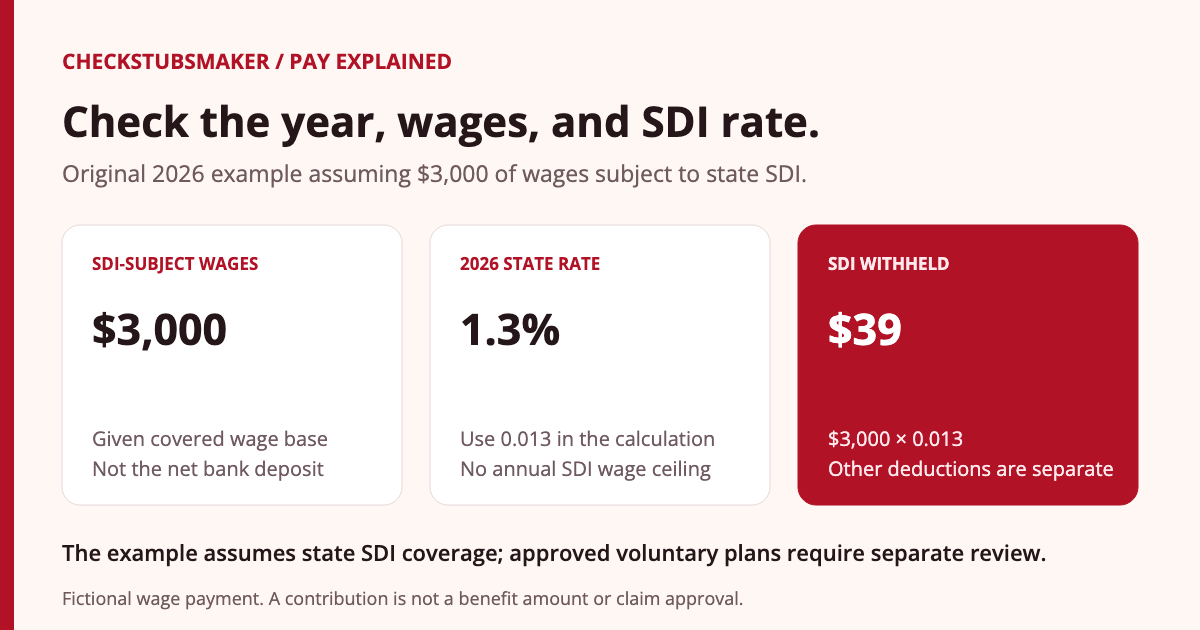
Assume a fictional 2026 paycheck has $3,000 cash gross wages, all of which are subject to state SDI. Assume no pre-tax exclusions, imputed income, prior-period corrections, or voluntary-plan substitution. The SDI calculation is $3,000 × 0.013 = $39.
To show the cash reconciliation, also assume $650 total other employee deductions. That $650 is supplied for illustration and is not calculated from tax tables or benefit elections.
| Line | Calculation or assumption | Amount |
|---|---|---|
| Cash wages subject to SDI | Given covered wages | $3,000.00 |
| Employee California SDI | $3,000 × 1.3% | −$39.00 |
| Other employee deductions | Assumed combined amount | −$650.00 |
| Net payment | $3,000 − $39 − $650 | $2,311.00 |
Do not subtract the $39 again if a displayed total-deductions amount already includes it. Likewise, do not multiply the $2,311 net payment by 1.3% to test SDI. That uses the wrong wage base under the stated assumptions.
For a running-total check, assume the previous SDI YTD was $273, the current contribution is $39, and no intervening payroll or correction occurred. The updated SDI YTD would be $312. It is a contribution total, not $312 newly withheld on this paycheck. See YTD on a pay stub.
Is SDI the same as California income tax, UI, or ETT?
No. EDD distinguishes four state payroll-tax categories. Identify the employee and employer columns before adding deductions.
| Program | Usual payer in EDD’s overview | Reading distinction |
|---|---|---|
| State Disability Insurance (SDI) | Employee withholding | Disability and Paid Family Leave program contribution |
| Personal Income Tax (PIT) | Employee withholding | State income-tax withholding, separate from SDI |
| Unemployment Insurance (UI) | Employer contribution | Not another employee SDI deduction |
| Employment Training Tax (ETT) | Employer contribution | Company obligation, separate from employee withholding |
Federal income tax, Social Security, and Medicare have separate rules again. A change or limit in one tax does not establish that another contribution should stop. Do not borrow another program’s wage limit when reviewing SDI.
Our paycheck tax-line guide explains the broader categories, and Social Security wages and OASDI covers the separate federal wage base.
Why might a similar deduction say VP or VPDI?
EDD’s voluntary-plan explanation describes an approved private disability and family-leave arrangement as an alternative to the state program. If a statement uses a VP-related label, ask payroll which approved plan and contribution rules apply.
Do not decide that a VP amount is wrong solely because it differs from the state SDI example. Confirm the actual code, coverage, plan terms, and contribution basis. A private insurance premium with an unrelated label should not automatically be treated as an EDD-approved voluntary plan either.
For remote work, multiple-state work, or a change of employment, ask payroll to explain the coverage determination it uses. An address printed on a statement is not a complete coverage analysis. Provide the actual work and payment facts when requesting a review.
How do you investigate an unexpected SDI amount?
- Confirm the code and whether the amount is current or YTD.
- Identify the payment year and the state or voluntary coverage arrangement.
- Request the wages subject to the contribution and the rate applied.
- Check bonuses, taxable additions, reversals, and other payroll changes.
- Ask for an employer explanation or correction and retain the supporting record.
A focused request is: “Please explain the [SDI label] amount on my [pay date] statement, including coverage, subject wages, rate, and any adjustment. Please reconcile the current amount with the YTD total.” EDD’s taxable-wage calculation guide provides the official program context.
If the payroll entry is wrong, use the correction process. If the question concerns a benefit claim, use EDD’s or the named plan’s claim process; changing a pay-stub number does not establish benefit eligibility.
Frequently asked questions
What is California’s state SDI rate for 2026?
The 2026 state SDI withholding rate is 1.3% of wages subject to the program.
Is there an annual state SDI wage cap in 2026?
No. EDD’s 2026 chart lists no SDI taxable wage limit. Coverage and subject-wage rules still apply.
Is SDI the same as California personal income tax?
No. They are separate employee withholding categories with different calculations.
Does an SDI deduction guarantee a benefit payment?
No. Payroll contributions, claim eligibility, and claim approval are separate questions.
Should an approved voluntary-plan deduction always equal this example?
Do not assume that. Confirm the actual plan, code, contribution basis, and applicable requirements.
Prepared by the CheckStubsMaker Editorial Team using primary California EDD sources and an original payroll example. See our editorial policy. Rates are explicitly labeled for 2026.