A U.S. paycheck may withhold federal income tax, employee Social Security and Medicare taxes, and applicable state or local taxes and employee program contributions. The exact lines depend on covered wages, elections, location, and other rules. Benefits and retirement contributions are separate deductions; employer-paid taxes such as FUTA should not be counted as employee withholding.
For U.S. employees · Sources checked November 11, 2026 · This is a tax-line overview, not a personalized paycheck estimator. The example calculates employee Social Security and Medicare under stated assumptions; income-tax amounts and benefits are supplied fictional inputs.
Start by separating the earnings section, employee taxes, other employee deductions, and employer informational amounts. Adding every number printed on a statement can double count deductions or subtract costs the employer pays.
Which federal taxes commonly come out of employee wages?
| Tax | Possible statement label | Key distinction |
|---|---|---|
| Federal income tax withholding | FIT, FITW, federal withholding | An income-tax prepayment based on applicable payroll rules and W-4 information |
| Employee Social Security | Social Security, OASDI, FICA SS | Applies to covered Social Security wages up to the annual wage base |
| Employee Medicare | Medicare, FICA Medicare | Applies to covered Medicare wages; Additional Medicare rules can also apply |
The IRS employment-tax overview explains that federal income-tax withholding uses Form W-4 and the appropriate withholding method. It is not one universal percentage of every employee’s gross pay.
IRS Topic 751 identifies the standard employee Social Security rate as 6.2% and Medicare rate as 1.45%. It also explains the Social Security wage base and Additional Medicare withholding. Confirm the year and applicable covered wages before testing an actual line.
For details, see FITW, Social Security wages and OASDI, and Medicare wages.
What state or local taxes might appear?
Applicable state income-tax withholding and local taxes depend on the relevant jurisdiction and circumstances. Do not assume a coworker’s tax list applies to you, particularly when residence or work locations differ.
As one scoped example, Pennsylvania’s local withholding FAQ describes local earned-income-tax administration using residence and work-location information. Its rules should not be applied to every state or locality.
Employee program contributions may also appear. California EDD’s payroll-tax overview, for example, distinguishes employee-withheld SDI and personal income tax from employer-paid unemployment insurance and employment training tax. That is a California illustration, not a nationwide tax list.
Ask payroll which agency and program a code belongs to. Verify jurisdiction-specific questions with the relevant tax or program authority. Our EIT explanation covers one common local-tax label.
Are all deductions taxes?
No. An insurance premium, retirement contribution, or other employee deduction can reduce take-home pay without being a payroll tax. Whether a benefit is pre-tax or post-tax also affects how you interpret wage fields.
The amount labeled gross earnings may differ from the wages used for a particular tax. Do not assume every deduction reduces every tax base. See taxable wages and deduction codes.
Keep current-period and year-to-date columns separate. A cumulative amount is not an extra deduction from the current check.
Example: separate employee taxes, benefits, and net pay
Assume a fictional ordinary paycheck has $2,000 cash gross wages, all covered for Social Security and Medicare. The employee remains below the Social Security annual wage base and has no Additional Medicare withholding in this period. Assume no pre-tax deductions, imputed income, reimbursements, credits, or corrections.
For illustration only, supply $120 federal income-tax withholding, $50 state withholding, and $10 local withholding. These three amounts are not calculated from a real Form W-4 or any jurisdiction’s tax tables. Also assume a $100 post-tax benefit deduction and no state program contribution in this fictional case.
| Item | Calculation or assumption | Amount |
|---|---|---|
| Gross wages | Given | $2,000.00 |
| Employee Social Security | $2,000 × 6.2% | −$124.00 |
| Employee Medicare | $2,000 × 1.45% | −$29.00 |
| Federal income tax | Assumed input | −$120.00 |
| State income tax | Assumed input | −$50.00 |
| Local income tax | Assumed input | −$10.00 |
| Total employee taxes | $124 + $29 + $120 + $50 + $10 | $333.00 |
| Post-tax benefit | Assumed input | −$100.00 |
| Net pay | $2,000 − $333 − $100 | $1,567.00 |
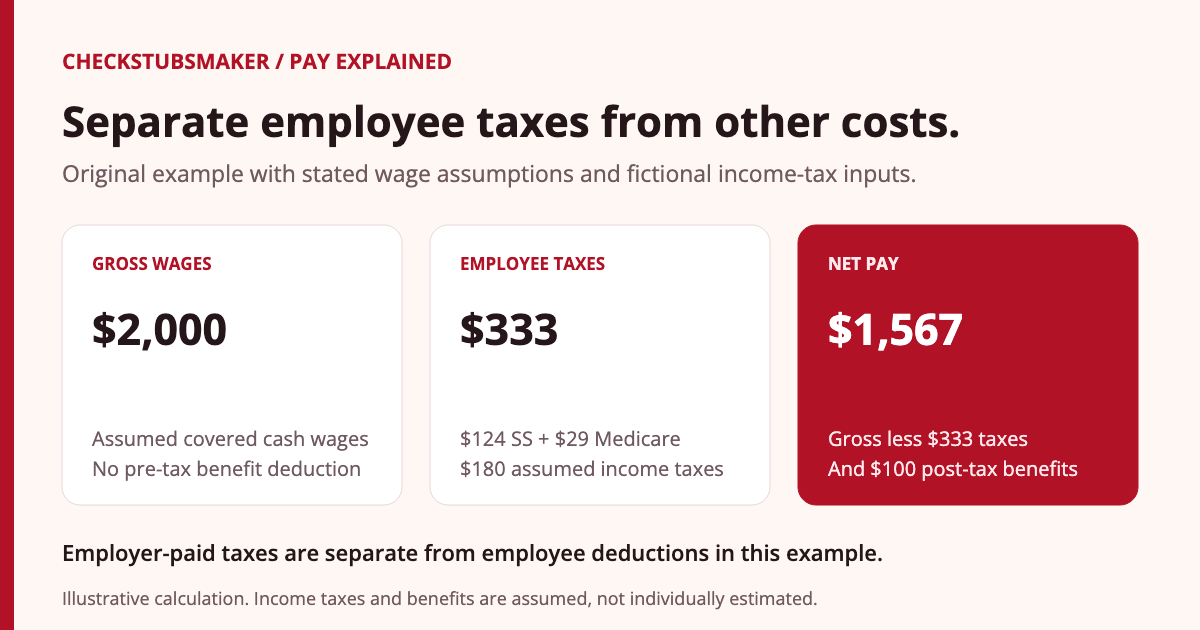
The employee’s total deductions are $433, of which $333 are taxes and $100 is a benefit deduction. No employer matching tax is subtracted from the employee’s $2,000 gross in this reconciliation.
To express those amounts as shares of gross, use our deduction-percentage guide. A percentage describing this check does not determine an annual tax bracket or final liability.
Which employer taxes should you avoid subtracting again?
The IRS distinguishes employee withholding from employer tax obligations. Employers generally pay their own Social Security and Medicare shares, and FUTA is paid from employer funds rather than withheld from employees.
If a statement displays employer taxes in an informational area, do not add them to the employee deduction total simply because they are visible. Confirm which entries actually reduce net pay. See FUTA on a pay stub for the federal unemployment distinction.
How do you review an unexpected tax amount?
- Identify the exact code and current-period amount.
- Match it to the relevant taxable-wage field.
- Check pay changes, bonuses, adjustments, W-4 changes, and applicable wage limits.
- Confirm residence and work-location information for jurisdictional items.
- Ask payroll for the calculation or code explanation and retain any correction.
The IRS withholding page provides an estimator for reviewing federal income-tax withholding. A small or zero line alone does not establish an error; see no federal withholding. For a confirmed discrepancy, follow the correction process.
Frequently asked questions
Does every employee have every tax listed here?
No. Covered wages, applicable rules, location, elections, and other circumstances affect the actual lines.
Is my health-insurance deduction an income tax?
No. Benefits and taxes are separate categories even when both reduce take-home pay.
Should I add employer FICA to my employee taxes?
Do not subtract the employer’s own share from employee gross in a take-home-pay reconciliation.
Why can taxable wages differ from gross earnings?
Different tax rules and benefit treatment can affect the wage base for a specific tax.
Does a paycheck’s withholding equal my final annual income tax?
No. Withholding is part of the annual payment and filing picture. Review actual records and applicable tax rules.
Prepared by the CheckStubsMaker Editorial Team from primary IRS, California EDD, and Pennsylvania guidance and an original reconciliation. See our editorial policy. This guide does not determine an individual tax bill.