In an employee-benefit context, STD usually means short-term disability. On a pay stub it may identify an insurance premium, a disability payment, or a related employer-benefit entry. Read the column heading and confirm the employer’s code. Paying a premium is different from receiving benefits, and the letters STD alone do not establish coverage, claim approval, or tax treatment.
For U.S. employees · Sources checked November 3, 2026 · Benefit definitions, payroll codes, claim terms, and tax treatment depend on the actual arrangement. The premium example is fictional.
A line under deductions generally asks a different question from a line under earnings. Start there, then compare the amount with your enrollment and the relevant plan documents.
What does STD mean on a pay stub?
Short-term disability is an income-replacement benefit for an eligible period of disability under a plan’s terms. For example, the University of Minnesota’s STD page describes its own optional coverage and its payroll contributions. Its details apply to that university’s arrangement, not every employer.
Locate the exact label and heading before interpreting the number. Our payroll-code guide explains why the employer’s legend matters.
| Entry context | Possible purpose | What to request |
|---|---|---|
| Employee deduction | Your premium contribution | Rate, frequency, and pre-tax or after-tax classification |
| Earnings or payment | A disability-related payment or adjustment | Benefit period, payer, gross amount, and withholding |
| Employer benefit or imputed value | Employer cost or a taxable noncash value | Code definition and effect on wages and net pay |
| YTD amount | A running total for the named entry | History of premiums, payments, or adjustments included |
As a concrete example of code variation, the Arc of Washington County’s payroll legend defines STDIMP as the taxable value of employer-paid short-term disability coverage. That employer-specific entry is not the same as an insurance claim payment. See our imputed-income guide for the noncash-value distinction.
Does a premium deduction prove that benefits are payable?
No. Ask for the enrollment confirmation, effective date, certificate or plan terms, and claim instructions. The university’s published plan illustrates that eligibility, the definition of disability, benefit commencement, and claim approval are separate considerations.
Use your own documents to answer these questions:
- When did coverage become effective?
- Which earnings does the plan use to determine a benefit?
- Is there a waiting or elimination period?
- What is the benefit limit and maximum duration?
- How do other payments or a return to work affect benefits?
- Which administrator decides the claim?
Those questions do not imply that every plan has the same answers. Do not use another employer’s percentage, waiting period, or maximum as a quote for your coverage.
How can you check the STD premium and YTD total?
Assume a fictional employee contribution of $12 per deduction-bearing paycheck, collected on 26 checks in a full year. The annual amount would be $12 × 26 = $312. Dividing that annual amount by 12 gives a $26 monthly average; it does not mean every calendar month contains $26 of deductions.
For a YTD check, assume 12 earlier $12 deductions, no refunds, no missed collections, and no other adjustments.
| Item | Calculation | Amount |
|---|---|---|
| Prior YTD premiums | 12 deductions × $12 | $144.00 |
| Current premium | One additional deduction | $12.00 |
| New YTD premiums | $144 + $12 | $156.00 |
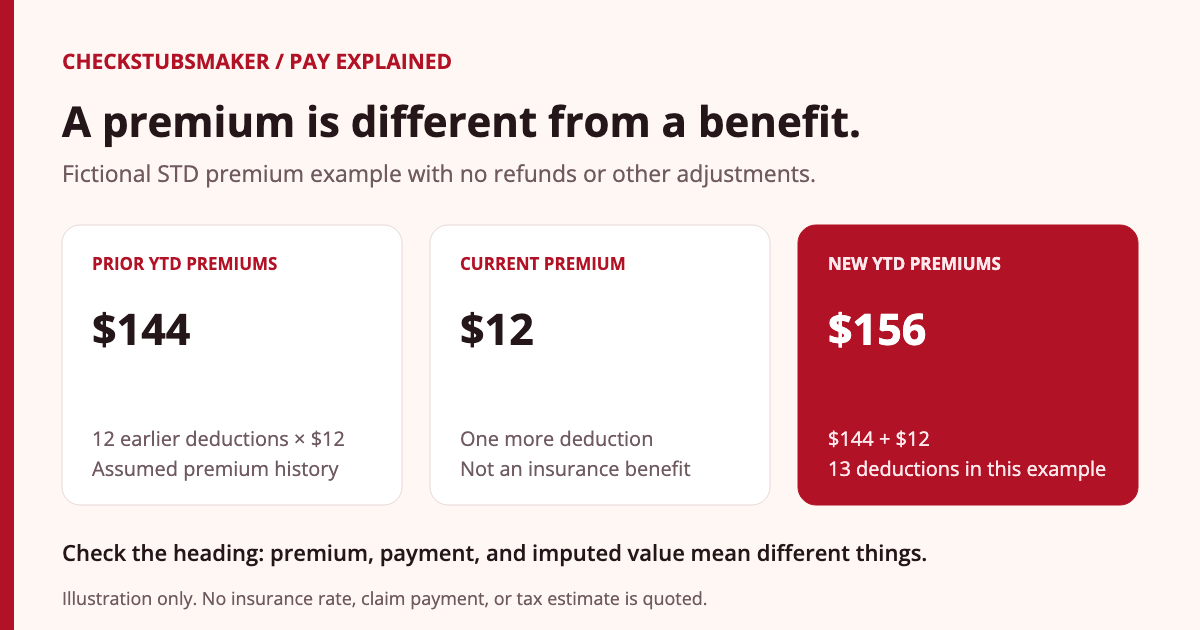
If the actual total differs, ask about credits, catch-up collections, coverage changes, or a different deduction schedule. Our YTD guide explains the period-versus-running-total comparison.
How should you read an STD benefit payment?
Keep the benefit statement separate from the premium record. Identify the payment’s covered dates, gross benefit, adjustments, withholding, and amount delivered. Confirm whether the payer is the employer, an insurer, or another administrator.
A disability payment may not follow the same reporting or payment process as your regular wages. Ask which statement explains it and which party will provide the relevant year-end reporting. Do not add an insurer payment to payroll income twice merely because both records mention the same benefit.
Use the bank-statement comparison to match the amount actually delivered with the relevant statement. A premium deduction does not reconcile a benefit deposit.
Are STD benefits taxable?
The funding and tax treatment of premiums matter. IRS Publication 525 explains that disability-related payments under employer-funded accident or health arrangements can be taxable, while benefits attributable to an employee’s after-tax contributions generally receive different treatment. Pre-tax cafeteria-plan contributions are treated differently from after-tax employee payments.
IRS Publication 15-A for 2026 addresses sick-pay reporting, employee contributions, and applicable payroll-tax rules. Mixed funding can require a specific allocation; a single recent deduction does not necessarily establish the taxable share of a claim.
Ask the payer or payroll team how the actual benefit was classified. A line’s pre-tax status, federal income-tax treatment, withholding, and state treatment are related but separate questions. This guide does not calculate them for an individual claim.
Is STD the same as sick leave, FMLA, or LTD?
No. STD concerns an income-replacement arrangement. Accrued sick leave or PTO concerns an employer’s leave balance and payment policy. Review the rules for coordinating them rather than assuming both pay in full for the same period.
The Department of Labor’s FMLA fact sheet describes unpaid, job-protected leave for eligible employees of covered employers. An STD insurance entry does not, by itself, establish FMLA eligibility or approval.
Long-term disability is another coverage arrangement. Our LTD guide covers that label. Ask benefits how the actual plans coordinate; do not assume a fixed transition date from their names.
What should you ask about an unfamiliar STD entry?
Use a focused request: “My [pay date] statement shows [exact STD label] of [amount] under [heading]. Please confirm whether this is a premium, benefit payment, employer contribution, or imputed value, and explain its period, tax classification, and YTD effect.”
For a coverage question, contact benefits or the plan administrator. For a statement calculation, contact payroll. For a claim payment, ask the named payer. Keep the original record and the written explanation. If an error is confirmed, request the appropriate correction rather than changing the statement yourself.
Frequently asked questions
Does STD always mean a deduction?
No. Check the heading and employer code; it can appear in different benefit or payment contexts.
Is the premium the amount I receive if a claim is approved?
No. The premium buys coverage; the plan’s terms determine any payable benefit.
Does an STD deduction prove a claim has been approved?
No. Enrollment and claim approval are separate matters.
Are all STD benefits tax-free?
No. Premium funding and the applicable tax rules matter. Ask how the actual payment was classified.
Does an STD line automatically protect my job?
No. Insurance benefits and leave or job-protection rights require separate review.
Prepared by the CheckStubsMaker Editorial Team using primary plan, payroll, and government sources with an original premium example. See our editorial policy. This guide does not determine claim eligibility, coverage, medical disability, or individual tax treatment.