To find a paycheck deduction as a percentage of gross pay, divide the deduction by gross pay for the same period, then multiply by 100. For total deductions, first add only the employee amounts actually reducing pay. A tax-only percentage, an all-deductions percentage, and a marginal income-tax bracket answer different questions.
For U.S. employees · Sources checked November 11, 2026 · All dollar amounts in the examples are assumed. These calculations describe a statement; they do not determine the legally correct withholding or annual tax liability.
A percentage is useful only when its numerator and denominator are clear. “Twenty-four percent came out” can include insurance and retirement contributions as well as taxes.
What is the formula for the percentage taken out?
Percentage = selected deduction amount ÷ matching gross pay × 100. Use current-period figures together or year-to-date figures together. Do not divide one paycheck’s deduction by the annual cumulative gross.
- Identify the period and the gross-pay field.
- Choose one employee deduction, employee taxes only, or all employee deductions.
- Add the chosen amounts once, avoiding a duplicate total line.
- Divide that sum by gross pay and multiply by 100.
- Label the result and round at the end, retaining the original cents.
The CFPB pay-stub guide distinguishes gross income, deductions, net income, and year-to-date totals. Those labels help you select consistent fields.
Example: how much is tax and how much is everything else?
Assume one fictional paycheck has $2,500 gross wages, $400 total employee taxes, and $200 other employee deductions. There are no reimbursements, noncash earnings, reversals, or other adjustments. The net amount is $1,900.
| Measure | Calculation | Result |
|---|---|---|
| Employee taxes only | $400 ÷ $2,500 × 100 | 16% |
| Other employee deductions | $200 ÷ $2,500 × 100 | 8% |
| All employee deductions | $600 ÷ $2,500 × 100 | 24% |
| Net pay | $1,900 ÷ $2,500 × 100 | 76% |
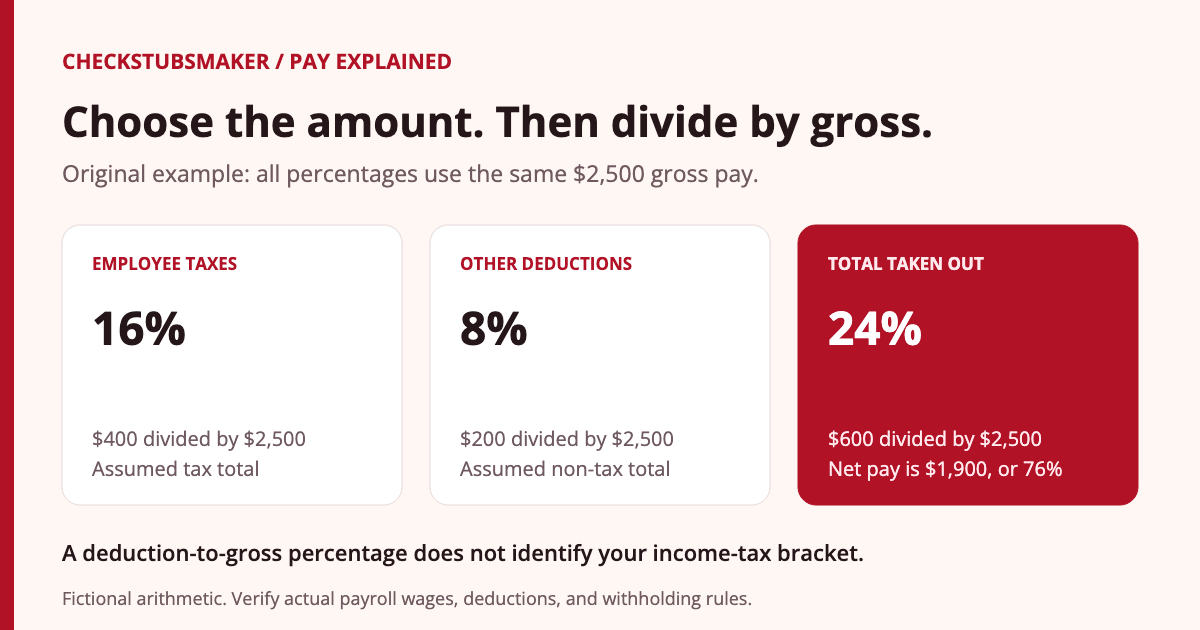
The 24% result includes the 16% tax share plus the 8% other-deduction share. Calling all 24% “income tax” would misdescribe the statement. Also, the $400 combines assumed employee taxes; it is not necessarily federal income-tax withholding alone.
Check the dollar reconciliation first: $2,500 − $400 − $200 = $1,900. For statements with other kinds of entries, see gross versus net pay before assuming gross minus the displayed net is entirely deductions.
Should you divide by gross pay or taxable wages?
For the share of your total gross pay taken out, use gross pay. For testing a specific payroll tax calculation, you may need that tax’s applicable wage base and rules. Those are separate tasks.
Pre-tax benefits, exclusions, or wage limits can make taxable wage fields different from total gross. Our taxable-wage explanation shows why the labels matter.
Do not include employer-paid tax or benefit amounts merely because they appear on the statement. The IRS employment-tax overview distinguishes employer and employee responsibilities; for example, FUTA is paid by the employer. Only count an amount in an employee deduction total if it actually reduces that employee’s pay.
If gross pay is zero, division by gross does not produce a meaningful percentage. For negative or correction statements, resolve what is being reversed before comparing percentages with ordinary checks.
How do you compare several paychecks correctly?
Add the relevant deductions across the selected checks, add their matching gross pay, and divide the totals. A simple average of percentages gives each paycheck equal weight even when the checks differ in size.
For example, assume a separate pair of fictional checks: $100 deductions on $1,000 gross and $400 deductions on $2,000 gross. The combined share is $500 ÷ $3,000 × 100 = about 16.67%. Averaging 10% and 20% would give 15%, which does not describe the combined dollars.
Use the same deduction categories throughout the comparison. A period with a benefit catch-up or an extra withholding request may reasonably differ. Keep dates, gross, chosen deductions, and the resulting ratio in a small worksheet.
Is the paycheck percentage your income-tax rate?
No. A deduction-to-gross ratio describes the selected payroll amounts. It does not establish your annual effective income-tax rate, and a combined tax share may include several taxes.
The IRS explains federal income-tax brackets as layers: reaching a higher bracket does not apply that higher rate to all your income. A marginal bracket is therefore different from the observed percentage taken from one paycheck.
IRS withholding guidance explains that federal income-tax withholding depends on earnings and Form W-4 information. To review projected federal withholding, use the current IRS estimator and actual records rather than replacing the payroll method with a flat ratio.
What should you check if the percentage looks wrong?
Confirm current versus year-to-date columns, taxable wages, one-time deductions, additional withholding, and employer informational lines. Compare the original dollar entries with the prior statement.
Ask payroll which code changed and how it was calculated. Keep a copy of the original and any correction. Our deduction-code guide and error-correction guide provide a starting checklist.
Frequently asked questions
Can I divide taxes by net pay instead?
You can calculate that ratio, but it is taxes as a share of net pay. Label it clearly; it will not equal taxes as a share of gross.
Does a 24% deduction share mean I am in the 24% bracket?
No. The ratio can include several taxes and benefit deductions and does not identify a marginal bracket.
Should employer matching contributions be included?
Exclude amounts that do not reduce your pay from an employee-deduction calculation.
Can I mix year-to-date tax with current gross?
That mixes periods. Use matching current or cumulative amounts.
Does the percentage prove withholding is correct?
No. It is a descriptive check. Correctness depends on the relevant wages, elections, rules, and payroll method.
Prepared by the CheckStubsMaker Editorial Team using primary CFPB and IRS guidance and original arithmetic. See our editorial policy. No individual withholding change is recommended.