“Float” on a pay stub may refer to a floating holiday, but confirm the code with payroll. A floating-holiday entry can show paid leave used, a leave balance, or an adjustment. Hours remaining are not automatically extra wages paid in that paycheck. The employer’s policy, any applicable agreement, and governing law determine the benefit’s actual terms.
For U.S. employees · Sources checked November 11, 2026 · Payroll abbreviations are not universal. The original example uses a fictional policy and assumed rate, separate from the named employer example.
Read the column heading before interpreting the number. Eight hours in a leave-balance area means something different from eight paid hours in an earnings row.
What is a floating holiday?
A floating holiday generally allows an eligible employee some choice about when to use a holiday benefit, under the specific plan’s rules. It may sit in a separate bank from vacation or sick leave. The label alone does not tell you the grant amount, eligible dates, approval process, or payout rights.
As one employer-specific illustration, the University of Michigan’s floating-holiday FAQ describes an eligible employee choosing a personal holiday and identifies its time-reporting code as HFT. It also sets its own eligibility and scheduling restrictions.
That is an example of one institution’s system, not a universal code dictionary. If your statement says FLOAT, FH, or another abbreviation, ask for the issuer’s exact definition before drawing a conclusion.
Is the number a leave balance or pay for leave taken?
| Field type | Possible meaning | What to verify |
|---|---|---|
| Granted or accrued hours | Time added to the benefit bank | Policy period and eligibility |
| Used hours | Approved leave charged to the bank | Dates and approved time record |
| Remaining balance | Time left under the plan | Whether pending requests are already reflected |
| Earnings amount | Money paid for leave included in this payroll | Hours, rate, and whether included in gross |
| Adjustment | Correction or another change | Reason, effective period, and sign |
Some systems display the leave bank on a timesheet or HR page rather than the pay statement. Missing balance information on one screen does not establish that no benefit exists. Check the authorized system and ask payroll where to find the official balance.
For related entries, see PTO on a pay stub and sick-leave fields. Do not assume the banks share identical rules.
Example: leave used, remaining hours, and paid earnings
Assume a fictional employer’s policy provides an employee with a 16-hour floating-holiday bank and permits an approved eight-hour day. The employee uses eight hours, with no other accruals, adjustments, or pending deductions from the bank. The remaining balance is eight hours.
Separately, assume payroll pays the eight used leave hours at $25 per hour. In the same workweek, the employee actually works 32 regular hours at $25. No other earnings are included.
| Measure | Calculation | Result |
|---|---|---|
| Remaining leave bank | 16 available hours − 8 used | 8 hours remaining |
| Pay for leave used | 8 hours × $25 | $200 gross earnings |
| Pay for actual regular work | 32 hours × $25 | $800 gross earnings |
| Total gross earnings | $800 regular + $200 leave | $1,000 before deductions |
| Hours paid in the example | 32 work + 8 leave | 40 paid; 32 actually worked |
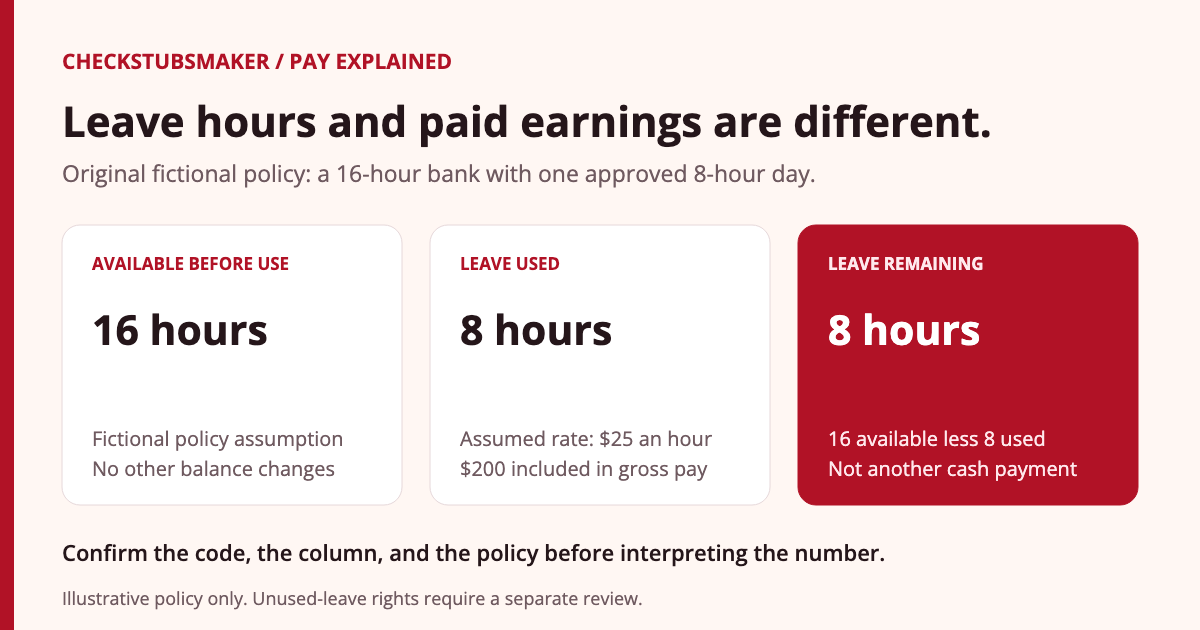
Do not add another $200 to gross merely because eight hours remain in the bank. The example pays for hours used. It does not establish the cash value or payout entitlement of unused leave.
Do floating-holiday hours count toward overtime?
The DOL Hours Worked Advisor explains that paid time off when no work is performed need not be counted as hours worked for FLSA overtime purposes. State rules, agreements, and employer practices may require additional review.
In the example, 40 hours were paid but only 32 were actually worked. The paid-hours total alone does not establish federal overtime. Conversely, work performed on a day initially scheduled as leave must be recorded accurately; a holiday label should not hide actual work.
Review the workweek’s time records rather than just the pay-period total. Our hours guide explains common distinctions.
Does unused floating-holiday time carry over or pay out?
Do not infer either result from the word “floating.” Ask about eligibility, grant date, permitted increments, approval, expiration, carryover, transfers, and separation from employment. Applicable law can affect what a policy may require.
The DOL holiday-pay overview explains that the FLSA generally does not require pay for holiday time not worked, while certain government-contract requirements can differ. This is not a nationwide answer about every leave benefit or state payout rule.
The Michigan FAQ, for example, describes a single-block benefit with specific non-carryover and non-payout provisions. Do not apply those institution-specific provisions to another employer or jurisdiction.
What should you ask payroll if the entry looks wrong?
Provide the statement date, exact code, column, number, approved leave dates, and timekeeping record. Ask whether the figure is a grant, usage, remaining balance, earnings, or correction.
If approved leave was cancelled because you worked, identify the actual hours and ask how both timekeeping and leave records should be updated. Keep the original record and any corrected statement. See pay-stub corrections.
Frequently asked questions
Does FLOAT always mean floating holiday?
No. Confirm the employer’s code definition and the column where it appears.
Is a remaining leave balance part of my net pay?
A balance alone does not establish a payment. Check the earnings and net-pay calculation.
Must every employer offer floating holidays?
There is no universal entitlement established by the label. Check applicable law, agreements, and the employer’s plan.
Can every floating holiday be split into half days?
Usage increments vary. Follow the specific policy and approval process.
Does an eight-hour balance prove eight hours are payable when I leave?
No. Separation rights depend on the benefit’s terms and applicable law, not only the displayed balance.
Prepared by the CheckStubsMaker Editorial Team using primary labor and employer guidance and an original example. See our editorial policy. This guide does not determine an individual leave entitlement.