Sick leave on a pay stub can refer to a time balance, leave used, or wages paid for approved leave. Read the heading and units before using the number. A 20-hour balance is not a $20 payment, and using eight hours of leave is different from receiving eight additional hours of cash earnings on top of the same salary.
For U.S. employees · Sources checked November 10, 2026 · Accrual, eligibility, permitted use, payment rates, display requirements, and payout rules vary. The example assumes the employer has confirmed the leave treatment and applicable pay rate.
Start by identifying whether the statement shows available time or payment activity. Then compare it with the leave request, time record, and employer’s leave policy.
What does the sick-leave number represent?
| Possible field | Typical unit | Question to ask |
|---|---|---|
| Available sick leave | Hours or days | How much can be used under the applicable rules? |
| Earned or accrued | Hours or days | What was added during this period? |
| Used sick leave | Hours or days | Which approved absence was charged? |
| Sick-pay earnings | Money, sometimes with hours and rate | What payment was included in payroll? |
| YTD activity | Check the label | Is this accumulated usage, earnings, or another total? |
Ask payroll to define an unfamiliar abbreviation. Do not infer the meaning from a positive or negative sign alone. A reduction in an hours bank is not automatically a deduction from cash pay.
Our PTO guide and hours guide explain related balance and earnings fields.
How do you check the leave balance?
Use the opening balance, confirmed additions, usage, and adjustments for the same period. Identify whether the plan accrues leave over time, grants it in advance, or uses another lawful arrangement.
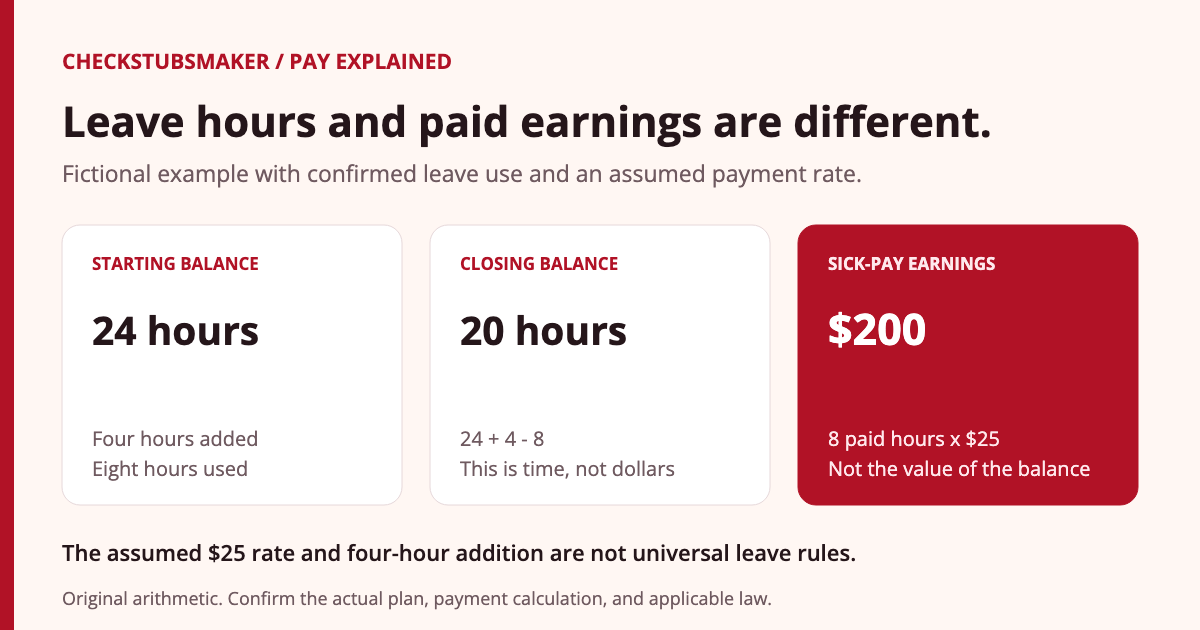
For an original fictional example, assume 24 hours available before payroll, four hours added, eight hours used, and no other changes. The closing balance is 24 + 4 − 8 = 20 hours.
This arithmetic does not determine the required accrual rate or legal entitlement. A real balance can also involve a carryover, cap, correction, or effective-date difference. Ask which entries apply instead of assuming every plan uses the example’s four-hour addition.
How do you check payment for leave used?
Continue the example by assuming payroll confirms that the eight used hours are paid at an applicable $25 hourly rate. Sick-pay earnings for that line are 8 × $25 = $200 gross.
| Calculation | Result | Meaning |
|---|---|---|
| 24 + 4 − 8 hours | 20 hours | Assumed remaining leave balance |
| 8 paid hours × $25 | $200 gross | Assumed current sick-pay earnings |
Do not automatically add the $200 to a salary that already includes the same paid time. Review whether the employer separates regular and leave earnings for display or actually makes an additional payment.
The applicable leave-pay rate also needs confirmation. It is not always established by copying a headline hourly rate from another section. California’s Labor Commissioner FAQ, for example, describes specific calculation methods for covered workers. Those are California rules, not a nationwide formula.
Check taxes and other deductions separately. This example does not calculate total gross wages or net pay; see gross versus net pay.
Which sick-leave rules apply?
The Department of Labor’s general sick-leave overview describes the absence of a broad federal paid-sick-leave requirement. That does not mean every worker lacks a paid-leave right.
State or local law, an employment agreement, and special federal coverage can matter. The DOL separately explains paid-sick-leave requirements for covered federal contractors. Confirm the actual coverage rather than relying on a general statement about federal law.
California offers another scoped example: its FAQ explains showing available sick leave on the pay stub or a document issued the same day as the paycheck. Other jurisdictions may use different rules. A missing line should be checked against the applicable requirement and any separate statement.
Do not assume unused hours must be paid out, expire automatically, or carry over without a limit. Ask for the governing policy and current requirements. Job-protected leave, paid sick time, and disability insurance can also involve different processes.
Why might the balance and payment update at different times?
Compare the leave dates, approval date, payroll period, and date of the balance display. Ask whether the current record includes a pending request or reflects only processed leave.
A combined PTO bank may cover illness and vacation, while another plan keeps separate banks. Confirm which bank was charged and which rules govern it. A generic PTO label does not answer every sick-leave question.
If the statement shows a disability-insurance premium, that entry is different from sick-pay earnings. Our short-term disability guide explains premium and benefit distinctions.
What should you ask payroll when something does not match?
Provide the pay date, absence dates, approved hours, displayed balance, and the specific difference. Ask: “Which leave bank and period does this entry use, how were additions and usage applied, and what rate and earnings treatment were used for the paid hours?”
Keep the time record and response together. If the employer corrects the record, ask when the updated balance or statement will appear and whether an earlier payment needs adjustment.
Our correction guide and YTD guide help distinguish current activity from accumulated totals.
Frequently asked questions
Does 20 hours of sick leave mean a $20 payment?
No. Read the unit. An hours balance measures time rather than a cash payment.
Does using leave always create extra pay above salary?
No. The employer may display paid time as part of the existing salary. Check the actual earnings calculation.
Can I use the example’s accrual or rate for my own leave?
No. The four-hour addition and $25 payment rate are assumptions, not entitlement rules.
Does no sick-leave line prove I have no leave?
No. Check separate records, the plan, and applicable display requirements.
Must unused sick leave be cashed out?
Do not infer a payout from a balance. Check the applicable law, agreement, and policy.
Prepared by the CheckStubsMaker Editorial Team using primary labor-agency guidance and original arithmetic examples. See our editorial policy. The guide does not determine an individual leave entitlement or claim.