In a health-benefit context, PPO means Preferred Provider Organization. A PPO label on a pay stub may identify a contribution toward that plan. Confirm the employer’s code, whether the amount is your deduction or an employer contribution, and which coverage period it represents. The letters alone do not establish the amount you owe, the tax treatment, or whether a particular medical service is covered.
For U.S. employees · Sources checked November 2, 2026 · Payroll codes and benefit arrangements vary. The contribution example is fictional and does not quote an insurance rate.
A deduction line is only one part of the benefits picture. Read it alongside your enrollment confirmation and contribution schedule, then use the plan documents for coverage questions.
What does PPO mean on a pay stub?
HealthCare.gov defines a PPO as a health plan with a participating-provider network. Using network providers generally costs less; out-of-network care can involve additional cost. Your own plan determines the applicable benefits and conditions.
When PPO appears near health deductions, start by comparing it with the plan you elected. Check the full label, coverage tier, amount, and effective date. If it appears somewhere else or does not match your enrollment, ask payroll for its definition.
Employer labels differ. For example, the Arc of Washington County’s published payroll-code guide uses H125 for medical pre-tax and a different code for employer-paid medical cost. Those are that employer’s codes. They illustrate why the employer’s own legend matters more than an assumed universal abbreviation.
Our deduction-code guide explains how to read an unfamiliar label in context.
Is the amount deducted from your pay?
Find the heading above the amount. A current employee deduction, a YTD total, and an employer contribution describe different things. EE and ER commonly indicate employee and employer, but confirm the legend on your statement.
| Field | Reading question | Useful comparison |
|---|---|---|
| Current employee amount | What is being withheld on this paycheck? | Employee contribution schedule and any adjustment |
| YTD employee amount | What is the accumulated deduction total? | Prior statement plus current activity |
| Employer amount | What cost is the employer reporting? | Employer contribution or benefit-cost information |
| Pre-tax or after-tax label | How is this deduction classified? | Payroll explanation and applicable plan arrangement |
An employer-paid medical amount can be informational. Do not subtract it again when reconciling take-home pay. Our Medical ER guide covers that distinction, and our YTD guide explains running totals.
Is a PPO deduction the same as a deductible?
No. A payroll contribution toward coverage and a plan’s deductible are different amounts. HealthCare.gov’s premium explanation distinguishes the cost of coverage from costs such as deductibles, copayments, and coinsurance when you receive care.
A $60 payroll contribution does not tell you that a doctor visit will cost $60 or that you have met a deductible. Likewise, the amount withheld does not establish a provider’s network status or a service’s authorization requirements. Check those details with the plan.
How can you check the deduction per paycheck?
Assume a fictional full-year employee contribution of $130 per month, spread evenly across 26 deduction-bearing paychecks. Also assume an employer contribution of $390 per month shown separately, with no midyear changes, surcharges, or adjustments.
| Assumed contribution | Annual calculation | Per check across 26 checks |
|---|---|---|
| Employee: $130 monthly | $130 × 12 = $1,560 | $60.00 |
| Employer: $390 monthly | $390 × 12 = $4,680 | $180.00 |
| Combined: $520 monthly | $520 × 12 = $6,240 | $240.00 |
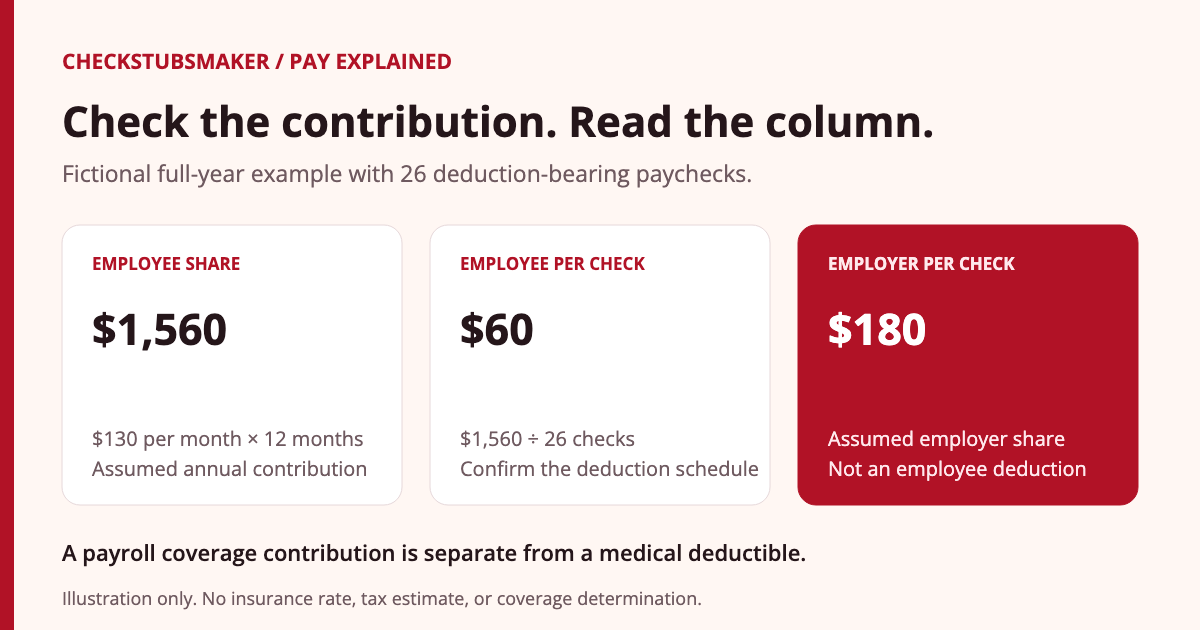
If the same $1,560 annual employee share were collected across 24 checks, it would be $65 per deduction-bearing check. The number of pay dates does not, by itself, prove the number of benefit deductions. Ask for the actual collection schedule.
This example does not calculate withholding or net pay. A pre-tax contribution can also affect taxable wages, so a deduction’s face amount is not necessarily the dollar-for-dollar change between two otherwise comparable net payments.
Is a PPO payroll deduction always pre-tax?
No. PPO describes a plan type rather than a tax classification. The IRS cafeteria-plan FAQ explains that qualifying arrangements allow certain benefits on a pre-tax basis, subject to their rules.
Ask payroll whether the particular line is pre-tax or after-tax and which wage bases it affects. Do not infer a tax result from the three letters or assume every dependent-coverage situation has the same treatment. Our taxable-wages guide helps distinguish gross pay from taxable amounts.
Why might the deduction change?
Possible explanations to investigate include a new contribution rate, coverage-tier change, newly effective enrollment, a catch-up collection, or a correction. These are review questions, not a conclusion about your statement.
- Compare the current and previous statements.
- Find the election or notice showing the expected rate and effective date.
- Check whether the rate is monthly, annual, or per paycheck.
- Ask which coverage period and adjustment the line represents.
- Request a written explanation and any correction that payroll confirms is needed.
A focused question is: “My [pay date] statement shows [label] of [amount]. Please confirm the plan, employee share, deduction schedule, coverage period, tax classification, and any catch-up or credit included.”
Which documents answer payroll and coverage questions?
Use the enrollment confirmation and employee contribution schedule to check the election and cost. Use the statement to reconcile what payroll collected.
The Department of Labor’s plan-information guidance describes the Summary Plan Description and Summary of Benefits and Coverage for applicable plans. These help explain plan benefits and conditions. Premium or contribution information may be supplied separately, so obtain that schedule as well.
A deduction line is not enough to confirm active enrollment or a pending claim. Contact the benefits administrator or plan for those questions. For a confirmed payroll mistake, retain the explanation and any corrected record; our correction guide can help organize the request.
Frequently asked questions
Does PPO on a pay stub always mean health insurance?
In a health-benefit context it refers to Preferred Provider Organization. Confirm the actual employer code and enrollment.
Is the employer’s PPO contribution taken from my paycheck?
A separately reported employer-paid cost is different from your employee deduction. Verify the column and net-pay calculation.
Does paying the premium meet my deductible?
The coverage contribution and the deductible are separate costs. Review your plan’s terms.
Why is my per-check amount different from the monthly rate?
The employer may distribute the annual contribution across a specified number of deduction-bearing checks. Confirm that schedule and any adjustment.
Can the letters PPO prove that a deduction is pre-tax?
No. Payroll and the applicable benefit arrangement determine the tax classification.
Prepared by the CheckStubsMaker Editorial Team using official benefit definitions, payroll evidence, and an original contribution example. See our editorial policy. This guide does not select a health plan or determine coverage or individual tax treatment.