To read tips on a pay stub, separate tips already received from tips being paid through the current payroll. Reported tip income can affect tax calculations even when you already have the money. Match any “paid tips” or offset entry to an actual earlier payment, then reconcile the remaining paycheck. Employer labels vary, and a tip-related deduction should be explained rather than assumed correct.
For U.S. tipped employees · Sources checked November 2, 2026 · The example illustrates payment reconciliation only. It does not calculate a tax rate, minimum wage, tip credit, or qualified-tip deduction.
A small direct deposit can be confusing when the statement also lists tips. The first question is where the money went: some tips may have been received during the work period, while other tips may still be payable with wages.
Which tip entries should you identify?
Read the statement’s headings and ask payroll for the meaning of each code. Organize the entries by what they represent rather than treating every line containing “tip” as new money in the deposit.
| Possible entry | Question to resolve | Record to compare |
|---|---|---|
| Reported tips | Which tips and work dates are included? | Your tip report and daily records |
| Paycheck tips | Which amount is being paid with this payroll? | Payroll distribution details |
| Tips paid / tip offset | Which exact amount was already received? | Cash payout or transfer history |
| Tip-pool entry | What was contributed, allocated, or paid? | Pool statement and actual distributions |
| Tip-related tax line | What tax, wage base, and period does it represent? | Payroll explanation and withholding record |
Current amounts and YTD totals are separate views. Use the YTD guide if the running total makes a period’s tips appear larger than the amount currently payable.
Why might tips appear and then be subtracted?
A payroll system can record tips already received for reporting and tax calculations without paying them a second time. Chase Payroll’s support FAQ, for example, distinguishes tips already received from tips paid through the paycheck. That is a provider-specific explanation; your employer should identify how its own system presents the amounts.
An offset may therefore reconcile a prior payout. Verify that you actually received the matching amount. If you did not, ask for the dates and distribution details rather than dismissing the discrepancy as a normal deduction.
Also distinguish physical cash from the IRS’s broader use of “cash tips.” IRS tip-reporting guidance includes forms such as charged tips and electronic payments in that term. A customer’s payment method does not, by itself, tell you whether the employee has already been paid.
How do you reconcile wages, tips, and a deposit?
Assume a fictional period has $600 in wages, $250 in tips to be paid through this payroll, and $150 in reported tips that the employee already received separately. Assume no tip-pool adjustments, no pre-tax deductions, no other payments, and $100 in total taxes withheld.
The $100 is deliberately assumed. It is not a percentage recommendation or a valid calculation for a real paycheck.
| Illustrative entry | Role in reconciliation | Amount |
|---|---|---|
| Wages | Payable in this payroll | $600.00 |
| Tips paid with payroll | Payable in this payroll | $250.00 |
| Reported tips already received | Recorded, but not payable again | $150.00 |
| Total earnings recorded | $600 + $250 + $150 | $1,000.00 |
| Taxes withheld | Assumed total | −$100.00 |
| Already-paid-tip adjustment | Removes the earlier payment from this deposit | −$150.00 |
| Current payroll payment | $1,000 − $100 − $150 | $750.00 |
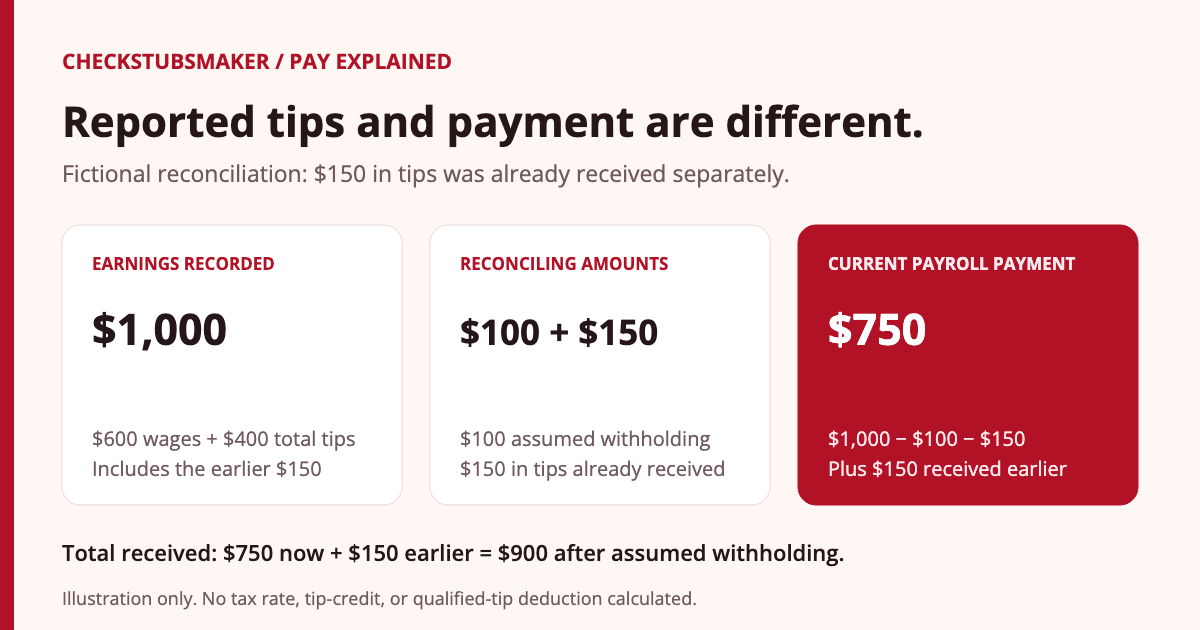
You can cross-check the current payment as $600 + $250 − $100 = $750. Across both payment channels, $1,000 − $100 = $900. This checks the arithmetic under the assumptions; it does not establish that a real employer’s tip reporting or wage compliance is correct.
Our gross-versus-net guide explains the earnings/payment distinction. Use the bank-statement comparison when the records cover different payment channels or dates.
Which records help verify the tips?
Keep the daily tip record, reports submitted to the employer, payout records, payroll statements, and any pool summaries. The IRS guidance describes daily recordkeeping, employer reporting, and return reporting as related responsibilities. Follow its current rules for what to report and when.
Compare the same dates and identify money transferred to or received from a pool. Ask which payout a statement entry refers to when shift dates and payroll dates differ. Retain an explanation for corrections instead of replacing the history with an unsupported total.
A simple personal reconciliation can list the date, tips reported, amount already received, amount expected through payroll, and any confirmed adjustment. Keep the calculation separate from the employer-issued record.
Does “no tax on tips” mean no taxes on the pay stub?
No. The qualified-tip deduction and payroll withholding are different questions. IRS Publication 15 for 2026 explains that qualifying tips may be deductible for federal income-tax purposes while Social Security and Medicare taxes generally still apply under the tip-tax rules.
The IRS tips FAQ describes the deduction for eligible qualified tips during 2025–2028, subject to limits and conditions. A line labeled “tips” does not establish that every dollar qualifies. Keep reporting the income and review the current eligibility requirements for the tax year.
IRS Topic 761 also discusses using an updated Form W-4 and the applicable withholding procedures to reflect an expected deduction. The deduction does not automatically remove all withholding from every tip payment. If wages available for withholding are insufficient, ask payroll about any uncollected tax and the applicable IRS instructions.
Are a tip credit and an already-paid-tip adjustment the same?
No. Under federal wage rules, a tip credit concerns an employer’s permitted use of tips toward a minimum-wage obligation when the required conditions are met. An already-paid adjustment in a payroll reconciliation concerns whether money has already reached the employee.
The Department of Labor’s tipped-employee fact sheet explains federal tip-credit conditions and identifies compulsory service charges as different from tips under the FLSA. State rules can be more protective. Do not use the reconciliation example to decide whether a tip credit, pool, deduction, or service-charge arrangement is lawful.
What should you ask if a tip amount looks wrong?
Send payroll a focused question: “Please reconcile tips for [dates], showing tips reported, amounts paid separately, amounts paid in this payroll, pool adjustments, and related withholding. The entry [label/amount] does not match my record of [payment/date].”
Ask for the supporting distribution record and a corrected statement if an error is confirmed. Keep the original, your daily records, and the written response. Our pay-stub correction guide explains how to organize the discrepancy. For a wage-rights question, use the relevant labor agency rather than relying on the label alone.
Frequently asked questions
Why are cash tips listed if I already received them?
They may be recorded for reporting and withholding. Confirm which amount was received earlier and how payroll accounts for it.
Does a tip offset always mean the calculation is correct?
No. Match it to actual payouts and request an explanation for any difference.
Are credit-card tips always included in my next deposit?
No single payment method establishes the payroll timing. Check whether your employer already distributed them or is paying them through payroll.
Does the qualified-tip deduction eliminate Social Security and Medicare taxes?
No. The federal income-tax deduction is separate from the applicable payroll-tax rules.
Is a mandatory service charge automatically a tip?
No. Federal guidance distinguishes compulsory service charges from voluntary tips. Check the applicable rules and actual arrangement.
Prepared by the CheckStubsMaker Editorial Team using IRS, Department of Labor, and payroll-provider evidence with an original reconciliation example. See our editorial policy. This guide does not determine an individual tax deduction or employer wage compliance.