Child support on a pay stub is a payroll withholding entry for a support obligation. The description may identify support, an order, or a case-related deduction; ask payroll to explain the exact code. Compare the amount with the income withholding order and the agency’s payment record. A stub records what payroll withheld and does not, by itself, establish when the agency credited or distributed the payment.
For U.S. employees · Sources checked October 29, 2026 · The example is fictional and assumes valid withholding under the applicable order and limits. It does not calculate anyone’s support obligation.
An unfamiliar deduction can raise several different questions: what payroll withheld, what the order required, and what the case account shows. Keep those questions separate so the right office can investigate each one.
How does child support appear on an earnings statement?
Check the deductions area for the current payroll period. Obtain the full meaning of any shortened label rather than guessing from its letters. Ask whether the entry combines amounts or separates current support, past-due support, and other authorized components.
For a specific payroll example, New York City’s Office of Payroll Administration explains that its statements itemize multiple collections and show arrears deductions separately. That describes NYC’s system; another employer may use a different layout.
A deduction does not automatically indicate missed payments. California Child Support Services explains that income withholding does not imply an employee failed to pay. Read the actual notice and case information before drawing conclusions.
Use current-period deductions for the particular paycheck. A YTD amount is cumulative and is not automatically the remaining balance owed. Our deduction-code guide and YTD guide explain those fields.
Which records should you compare?
| Record | What to check | What to clarify |
|---|---|---|
| Income withholding order or notice | Case identity, amounts, frequency, and effective instructions | Which order and any amendment payroll is applying |
| Employer pay stub | Pay date and current support deduction | How the code and amount were calculated |
| Agency payment history | Receipt, credit, and distribution information available for the case | How a particular remittance was applied |
As a state example, Minnesota’s child-support guidance describes employer withholding, transfer to its payment center, and distribution. It also directs parents to online payment records. Use the corresponding official service for your case.
Record dates exactly as labeled. A payroll withholding date and a case-credit date can describe different steps, so ask for the remittance reference before treating the date difference as an error.
How does the deduction affect take-home pay?
Assume a fictional employee has $2,000 gross earnings. Legally required payroll deductions total $400, and a voluntary after-tax deduction is $100. There are no pretax deductions, reimbursements, other garnishments, fees, or additional adjustments.
Assume the applicable order calls for $250 current support and $50 toward arrears for this payroll period, and the $300 withholding complies with all applicable requirements. These amounts are assumptions, not recommended deductions or a maximum-withholding calculation.
| Entry | Illustrative calculation | Amount |
|---|---|---|
| Gross earnings | Starting wages | $2,000.00 |
| Required payroll deductions | Assumed total | −$400.00 |
| Disposable earnings | $2,000 − $400 | $1,600.00 |
| Current support withheld | Assumed order amount | −$250.00 |
| Arrears withheld | Assumed additional component | −$50.00 |
| Voluntary after-tax deduction | Separate from support | −$100.00 |
| Remaining net pay | $1,600 − $300 − $100 | $1,200.00 |
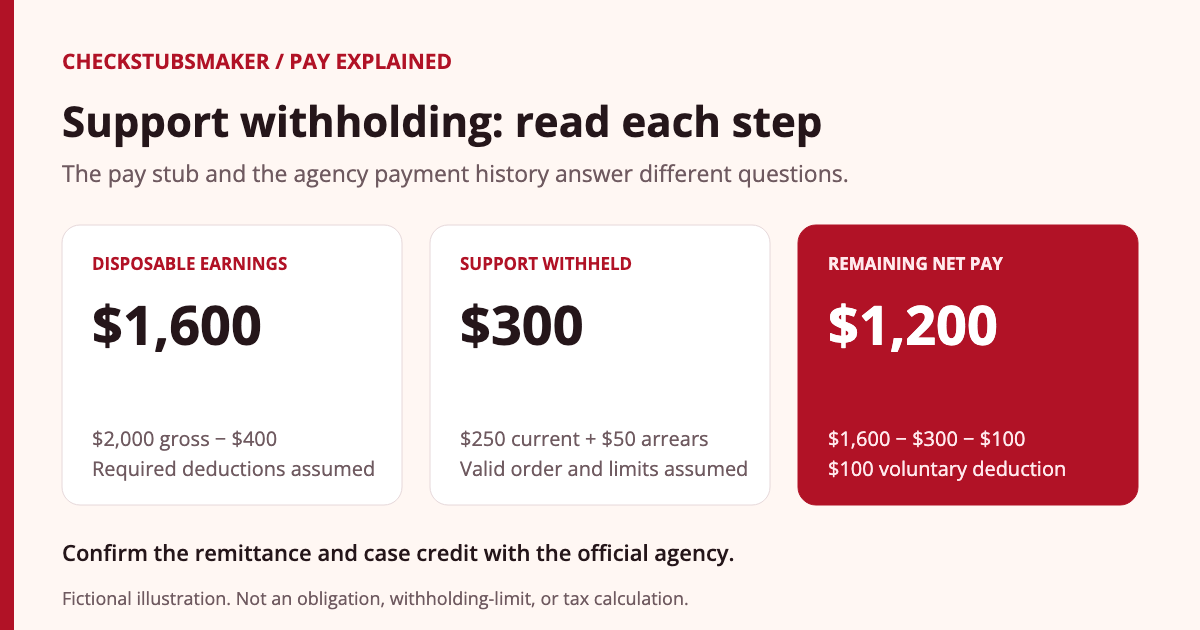
The example explains the statement’s arithmetic. It does not establish the case balance, prove receipt by the agency, or decide whether a real withholding amount is permitted.
Is disposable earnings the same as net pay?
No. DOL Fact Sheet 30 defines disposable earnings for federal garnishment purposes after legally required deductions. Voluntary deductions generally do not reduce that base. Consequently, the final take-home amount can be lower.
The fact sheet describes support-specific federal limits: up to 50% or 60% depending on support of another spouse or child, with an additional 5% for support more than 12 weeks in arrears. More protective state limits can apply. These are ceilings, not instructions to withhold that percentage from every paycheck.
Ask payroll for the applicable base, order amount, limits, and allocation explanation. Do not apply an ordinary consumer-debt garnishment formula to a support order or infer priority among multiple orders from this example.
Is child support a pretax benefit deduction?
No. The IRS states that child support is not deductible by the payer and is not taxable to the recipient. A support deduction should not be treated like a qualifying pretax benefit simply because payroll withholds it.
Check the distinct tax and deduction fields rather than subtracting support from every wage base. For the broader reading process, see taxable wages on a pay stub.
What if payroll withheld money but the agency record is unclear?
- Identify the exact payment. Save the pay date, deduction amount, case identifier, and statement.
- Ask payroll for remittance details. Request the amount sent, date, destination, and available reference.
- Contact the official case service. Ask it to trace the remittance and explain the credit or distribution.
- Document the response. Keep the explanation with the original payroll record and payment history.
A useful message is: “My statement dated [date] shows $[amount] withheld for case [identifier]. Please help reconcile that withholding with the remittance and case-credit record.” Avoid posting full case identifiers or payroll documents in a public discussion.
Ask the agency for instructions if a payment is missing or an additional payment is being considered. A bank deposit to the employee confirms a different transaction; see our pay-stub and bank-statement comparison.
Who can correct or change a support withholding entry?
Ask payroll to investigate a processing or calculation error. An objection to the underlying order requires the issuing agency or court’s process. For example, New Jersey’s employer FAQ distinguishes employee disputes from the employer’s duty to follow the order and official stop instructions.
Do not assume payroll can stop because a balance looks paid, a child reaches a particular age, or you request a different amount. Ask the issuing office what official notice or procedure applies to the actual case.
For a payroll mistake, preserve the original and request a documented pay-stub correction. Keep any corrected statement and agency response together.
Frequently asked questions
Does child support always use the same payroll code?
No. Obtain the full meaning from your employer and link it to the relevant order.
Is the YTD deduction my remaining arrears balance?
Not automatically. Use the agency’s case accounting and ask it to reconcile the balance.
Does the deduction prove the other parent received the money?
It shows payroll withholding. Confirm receipt and distribution through the official payment record.
Can I subtract child support when calculating a pretax wage base?
Do not treat it as a pretax benefit. Child support is not deductible by the payer for federal income-tax purposes.
Can payroll change the court-ordered amount on my request?
Ask the issuing agency or court about the required process. Payroll should investigate its own errors and apply the official instructions.
Prepared by the CheckStubsMaker Editorial Team using the official sources linked above and an original example. See our editorial policy. This guide explains records; the actual order, applicable law, and issuing office govern a real case.