ESPP on a pay stub usually identifies an employee stock purchase plan contribution taken from pay to buy company shares. These contributions commonly use after-tax dollars and reduce cash take-home pay. A payroll deduction is not the same as a completed stock purchase or a tax payment. Check your enrollment election, eligible compensation, purchase schedule, and stock-plan records.
For U.S. employees · Sources checked October 23, 2026 · All contribution rates, prices, deductions, and share quantities below are fictional. Plan terms and tax treatment vary.
An ESPP line can appear before any shares show in your brokerage account. To understand that timing, connect the payroll contribution with the plan’s purchase process. The statement and the stock-plan account describe different stages of the transaction.
What does ESPP mean on an earnings statement?
ESPP stands for employee stock purchase plan. Fidelity’s plan-service FAQ describes an arrangement in which elected payroll deductions accumulate and are used to buy company stock on a scheduled purchase date.
The full code matters. An employee contribution, a refund of unused contributions, a purchase record, and a later compensation adjustment are not interchangeable entries. Ask payroll or the stock-plan administrator what a particular label represents.
Do not assume the plan purchases shares on every payday. Look for the actual purchase date and confirmation in the plan account. A pay stub showing a contribution establishes what payroll recorded, not the number or current value of shares you own.
Is an ESPP deduction taken before or after tax?
The Schwab Equity Award Center’s ESPP overview describes contributions from after-tax pay. An after-tax contribution reduces the cash available in your paycheck without itself reducing the wage base merely because it funds a stock purchase.
A contribution may still be calculated as a percentage of eligible gross compensation. The calculation base and the tax treatment are separate questions. A “5% election” does not necessarily mean 5% of the bank deposit.
Check your employer’s definition of eligible compensation. Bonuses, overtime, commissions, and other earnings may receive different treatment under a plan. Confirm the actual rules rather than using total gross pay automatically.
An ESPP also differs from a 401(k) retirement contribution. Similar-looking deduction lines do not give the two plans the same tax rules. Our taxable-wages guide explains why deduction treatment matters.
How do you check the ESPP amount on a paycheck?
Suppose a fictional plan defines this payment’s eligible compensation as $4,000. The employee elected a 5% contribution, so $4,000 × 5% = $200 goes toward the ESPP.
For the cash-payment comparison, assume the statement’s gross earnings are also $4,000 and all other employee deductions total $850. That total is supplied solely for illustration; it is not a tax estimate. There are no other payment adjustments.
| Entry | Calculation or assumption | Amount |
|---|---|---|
| Gross earnings | Also assumed to be eligible compensation | $4,000.00 |
| Other employee deductions | Assumed total | −$850.00 |
| ESPP contribution | $4,000 × 5% | −$200.00 |
| Net cash pay | $4,000 − $850 − $200 | $2,950.00 |
In this example, the $200 funds the stock-purchase process. It is not another $200 of federal withholding. Compare the $2,950 with payment records using our gross versus net guide.
If payroll instead uses $3,600 as eligible compensation under the fictional plan, a 5% election would produce $180. An unexpected contribution can therefore arise from the eligible-pay definition, not only from an incorrect percentage.
How do payroll deductions become purchased shares?
Continue the first example: six contributions of $200 total $1,200. Assume that entire amount is available for one purchase, with no refund, fee, carryover, or other adjustment. At a fictional final purchase price of $40 per share, the purchase would be $1,200 ÷ $40 = 30 shares.
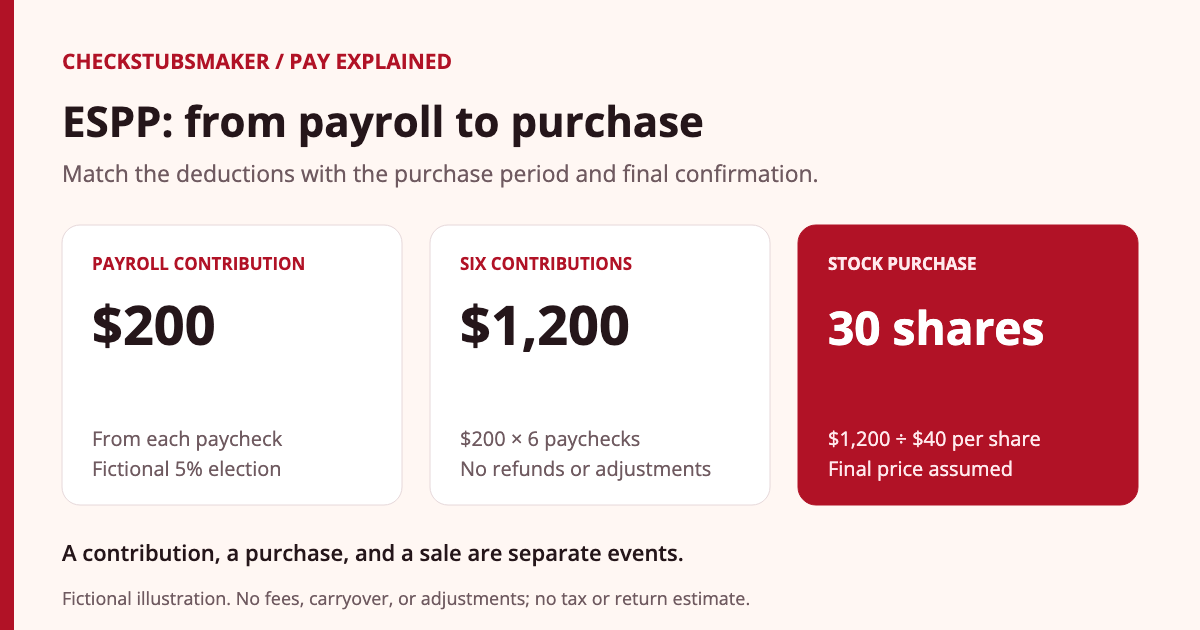
Use the actual final purchase price from the plan confirmation. Any discount or lookback feature depends on the plan. The $40 assumption does not describe a market quote or imply that every ESPP offers the same terms.
Likewise, a payroll YTD contribution figure does not equal current portfolio value. The record may span multiple purchases, refunds, or offering periods. Our YTD guide explains the difference between a running payroll total and a current-period amount.
Which records should you compare?
| Record | What to check | Question to resolve |
|---|---|---|
| Enrollment confirmation | Elected amount, effective dates, and eligible pay | What contribution did you authorize? |
| Pay stubs | Individual deductions and any refunds | What did payroll record? |
| Plan contribution history | Amounts assigned to the purchase period | What funds were available for that purchase? |
| Purchase confirmation | Purchase date, final price, quantity, and adjustments | What shares were actually purchased? |
| Sale and tax records | Disposition dates, proceeds, basis details, and compensation reporting | What information is needed for tax reporting? |
Keep the offering or purchase-period identifier when available. A calendar-year payroll total and one purchase-period balance may cover different dates. Reconcile the same period before treating a difference as missing money.
Does after-tax payroll funding make the stock transaction tax-free?
No. After-tax contributions describe the source of the purchase money. They do not resolve the tax consequences of a discount, purchase, transfer, or sale.
IRS Topic 427 explains statutory stock-option treatment. For a qualifying Section 423 ESPP, income generally is not recognized at grant or exercise; a later disposition can produce tax consequences. Do not apply that statement automatically to every plan called an ESPP.
IRS Publication 525 explains how holding-period and discount rules can produce ordinary compensation income as well as capital gain or loss. A sale after the special holding period does not necessarily eliminate compensation income. This guide does not calculate a sale’s tax treatment.
Form 3922 concerns specified transfers of shares acquired under Section 423(c) and supplies relevant dates and values. It is different from a payroll contribution record. Retain applicable purchase confirmations, employer reporting, and brokerage records, and reconcile them when preparing a return.
What if the ESPP amount is unexpected or shares are missing?
- Check the election. Confirm the percentage or dollar amount and its effective date.
- Check eligible compensation. Identify which earnings the plan includes.
- Identify the stage. Is the entry a contribution, refund, purchase, or compensation adjustment?
- Match the purchase period. Sum only the deductions assigned to that period, including corrections.
- Review plan rules. Ask about limits, change deadlines, unused amounts, and the purchase schedule.
- Request a written reconciliation. Contact payroll for the deduction and the plan administrator for the purchase record.
For example: “My pay statements show $[total] contributed for [period]. Please reconcile those deductions with the plan’s available contribution balance, purchase confirmation, refunds, and any carryover.”
For changes or withdrawal requests, follow the actual plan process and keep confirmation. Do not assume an instruction takes effect immediately or reverses a completed purchase. Preserve supporting documents using an appropriate retention period.
Frequently asked questions
Is ESPP a tax on my paycheck?
Usually the code identifies a stock-purchase contribution. Confirm the exact label, because a separate compensation or tax adjustment may also appear.
Does each deduction buy shares immediately?
Not necessarily. Contributions can accumulate until the plan’s scheduled purchase date.
Is the election percentage based on my deposit?
Use the plan’s definition of eligible compensation. Do not assume the base is net pay.
Does ESPP YTD show my current stock value?
No. Payroll contributions and the market value of shares are different measures.
Can I change or stop the deduction at any time?
The plan’s election windows, deadlines, and rules control the process. Check the effective date of any accepted change.
Prepared by the CheckStubsMaker Editorial Team using the primary sources linked above and original examples. See our editorial policy for sourcing and correction standards. Consult the actual plan and applicable tax rules for individual transactions.