FUTA on a pay stub refers to federal unemployment tax, which the employer pays. It should not be withheld from employee wages. If a payroll statement displays FUTA, check whether it is in an employer-tax or informational section. If an amount labeled FUTA appears to reduce your net pay, ask payroll to identify the tax and reconcile the calculation.
For U.S. employees · Sources checked October 23, 2026 · Examples use stated assumptions and 2026 federal rules. They do not determine an employer’s actual unemployment-tax liability.
A payroll statement can show company costs alongside deductions taken from your earnings. Adding every displayed tax together can therefore produce the wrong take-home-pay calculation. FUTA is a useful example of why the column heading matters as much as the code.
What does FUTA mean on a paycheck statement?
FUTA stands for the Federal Unemployment Tax Act. IRS Publication 15 explains that the federal tax works with state unemployment systems and is paid only by the employer. It is not employee income-tax withholding.
A payroll system may include the company’s tax expense in a separate display. That informational amount is different from money subtracted from your wages. The code alone does not establish which column you are viewing.
Check the statement’s headings, legend, and gross-to-net summary. If a report merges employer and employee taxes into one large table, request the detailed breakdown before deciding which items affected the payment.
How is FUTA different from FITW, FICA, and state unemployment?
| Entry | What it represents | Employee payment check |
|---|---|---|
| FUTA | Employer federal unemployment tax | Do not subtract it from employee gross wages |
| FITW | Employee federal income-tax withholding | Identify the current withholding deduction |
| Social Security and Medicare | Taxes with employee and employer components | Separate the employee share from company expense |
| State unemployment entry | A different tax governed by the applicable state system | Ask which jurisdiction and payer the entry identifies |
| Other company contributions | Costs the employer may display for information | Confirm whether they affect employee net pay |
Our FITW guide covers federal income-tax withholding, and the FICA guide explains Social Security and Medicare. Neither label should be treated as interchangeable with FUTA.
Do not extend the federal employer-only rule to every state unemployment or disability code. Ask payroll for the full tax name and applicable rule. Our deduction-code guide explains how to organize that request.
What are the FUTA rate and wage base?
Under the 2026 rules described in Publication 15, the standard FUTA rate is 6% on the first $7,000 of wages subject to FUTA for each employee during the year. The wage base is a limit on wages subject to this tax, not a limit on what an employee may earn.
IRS Topic 759 explains the credit for qualifying state unemployment taxes. A maximum 5.4% credit can produce a 0.6% federal rate after credit. Full credit requires the relevant conditions, including qualifying state taxes paid in full and on time, matching taxable wages, and no applicable credit reduction.
The IRS credit-reduction guidance explains why some employers owe more. State determinations are annual, and the DOL announces credit-reduction states after the November 10 deadline. This October 23 guide does not present a final 2026 state list or assume every employer qualifies for 0.6%.
Coverage tests, excluded wages, special employment categories, and other adjustments can also matter. Employers should calculate liability using the current guidance applicable to their circumstances.
How can FUTA appear without reducing take-home pay?
Suppose a fictional employee has $1,800 in gross wages and $350 in total employee deductions. The $350 is assumed for this reading example, not a tax estimate. Net pay is $1,800 − $350 = $1,450.
Separately, assume all $1,800 is subject to FUTA and remains within the employee’s annual federal wage base. The employer qualifies for the full state-tax credit, with no credit reduction or other adjustment. Under those assumptions, its FUTA amount is $1,800 × 0.6% = $10.80.
| Entry | Where it belongs | Amount |
|---|---|---|
| Gross wages | Employee payment calculation | $1,800.00 |
| Employee deductions | Subtract from employee gross | −$350.00 |
| Net wages | Employee amount to receive | $1,450.00 |
| Employer FUTA | Separate company tax expense under the assumptions | $10.80 |
| Employee FUTA deduction | No FUTA withholding from wages | $0.00 |
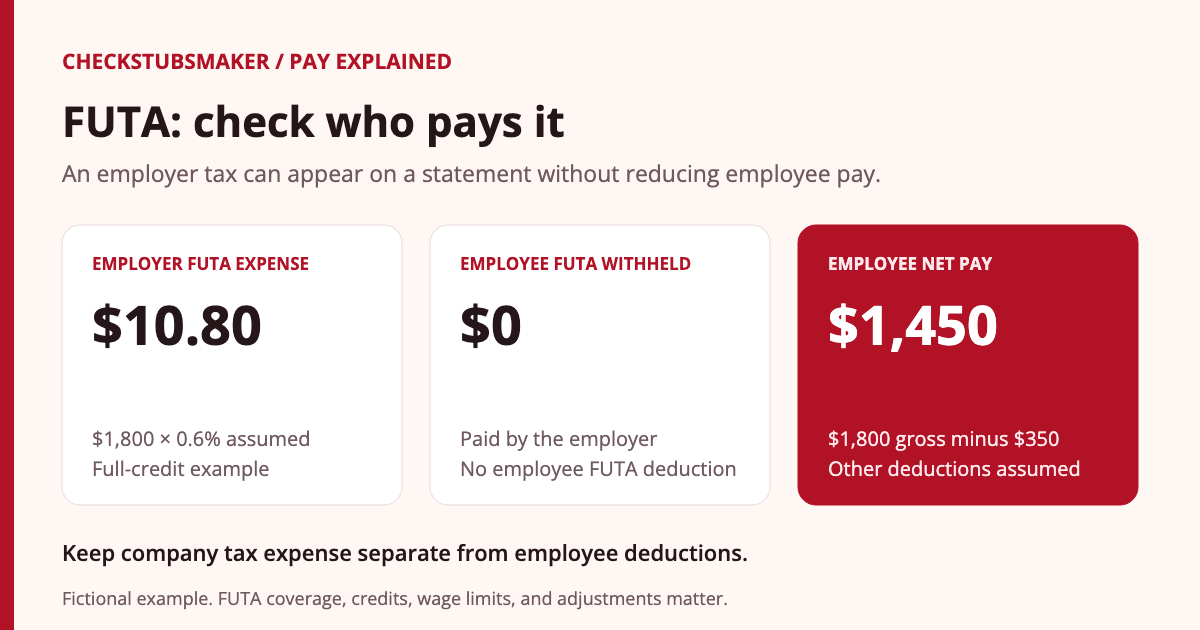
Subtracting the employer’s $10.80 again would produce $1,439.20, an incorrect result for this example. The correct approach is to reconcile actual employee deductions with gross and net pay, then match net pay with the payment received.
Why might the FUTA amount stop or change during the year?
An employer’s current FUTA expense can stop increasing for an employee once that employee’s covered wages reach the annual federal wage base. A zero current entry can therefore coexist with positive earnings and earlier FUTA totals.
Check which amount is displayed: current tax expense, cumulative tax expense, or cumulative taxable wages. These are different measures. A $7,000 wage-base figure is not a $7,000 tax deduction.
Changes or corrections can also affect an employer’s displayed cost. Ask payroll to explain the calculation rather than treating a changed company expense as a change in your own tax withholding. Our YTD guide explains how to read cumulative columns.
What if FUTA appears to have been deducted from your wages?
- Identify the exact line. Save the full code, current amount, column heading, and pay date.
- Recalculate net pay. Use the actual employee deduction entries and any separately identified payment adjustments.
- Check the code’s meaning. Ask whether it really identifies federal FUTA or a different payroll item.
- Request a reconciliation. Ask payroll to explain whether the amount affected net wages.
- Request an official correction if needed. Keep the original statement, corrected record, and payment explanation together.
A focused question could read: “My statement dated [date] shows $[amount] under [heading/code]. Please confirm whether this is employer FUTA expense. My net-pay calculation appears to include it as a deduction; please reconcile the payment.”
Use the employer’s official payroll channel and preserve the issued records. Our retention guide discusses keeping documents associated with unresolved differences.
Does a FUTA entry determine unemployment-benefit eligibility?
No. A company tax entry does not calculate a personal benefit balance or guarantee an approved claim. The DOL unemployment-insurance overview explains that eligibility is determined under state rules.
If you need to apply for benefits, use the appropriate state agency’s process and supply the records it requests. Do not infer your benefit amount from the employer FUTA figure on one statement.
Frequently asked questions
Do employees pay FUTA?
No. The employer pays the federal unemployment tax; it is not withheld from employee wages.
Does every FUTA amount use 0.6%?
No. That rate after credit assumes eligibility for the full credit. Credit reductions and other adjustments can change employer liability.
Is the $7,000 wage base a limit on my salary?
No. It limits the annual wages subject to this federal tax, not your earnings.
Should FUTA stopping increase my deposit?
It should not create an employee FUTA saving because FUTA was not an employee deduction in the first place.
Does a FUTA line prove the employer paid the tax?
No. A displayed payroll expense alone is not confirmation that the corresponding tax payment was deposited.
Prepared by the CheckStubsMaker Editorial Team using the primary sources linked above and original examples. See our editorial policy for sourcing and correction standards. Actual employer liability depends on coverage, wages, credits, and applicable adjustments.