LTD on a pay stub usually means long-term disability insurance. In an employee-deductions section, it commonly identifies a premium paid toward coverage. In an employer-contributions section, it may show the company’s cost. A premium is different from a disability benefit payment, and the code alone does not establish coverage terms, claim approval, or whether future benefits are taxable.
For U.S. employees · Sources checked October 23, 2026 · All earnings, premium rates, and deductions below are fictional examples, not insurance quotes or tax estimates.
A small LTD deduction can raise two different questions: why did this amount leave the paycheck, and what coverage does it support? Start with the payroll calculation, then check the enrollment record and plan documents for the coverage details.
What does LTD mean on an earnings statement?
Long-term disability insurance is designed to replace part of income when a qualifying disability prevents work under the policy’s terms. MetLife’s workplace LTD overview describes that income-protection purpose. The actual policy determines eligibility and benefits.
Read the full payroll description. A basic plan, optional additional coverage, employer contribution, and premium adjustment can use related codes. Your employer’s legend or benefits office should identify the specific entry.
LTD also differs from short-term disability coverage, paid leave, workers’ compensation, and Social Security disability benefits. Do not apply the terms of one program to another merely because several entries mention disability.
Is the LTD line a premium deduction or a benefit payment?
| Possible entry | What to establish | Useful supporting record |
|---|---|---|
| Employee LTD premium | The amount charged to the employee for coverage | Enrollment election and premium schedule |
| Employer LTD contribution | The company’s cost, displayed separately from employee deductions | Employer contribution explanation |
| LTD premium adjustment | Which coverage dates and prior charges it changes | Adjustment notice and affected statements |
| Disability benefit payment | The benefit period, amount, and applicable withholding | Insurer or administrator payment statement |
| Taxable-value or offset entry | What the entry represents and how it affects wages or payment | Payroll calculation and funding arrangement |
Do not subtract employer contributions again when checking net pay. Likewise, an employee premium is not cash paid to the employee as a disability benefit. If the statement combines several categories, ask for the detailed breakdown.
Our deduction-code guide explains how to identify an unfamiliar code without assuming every employer uses the same abbreviation.
How can you check an LTD premium deduction?
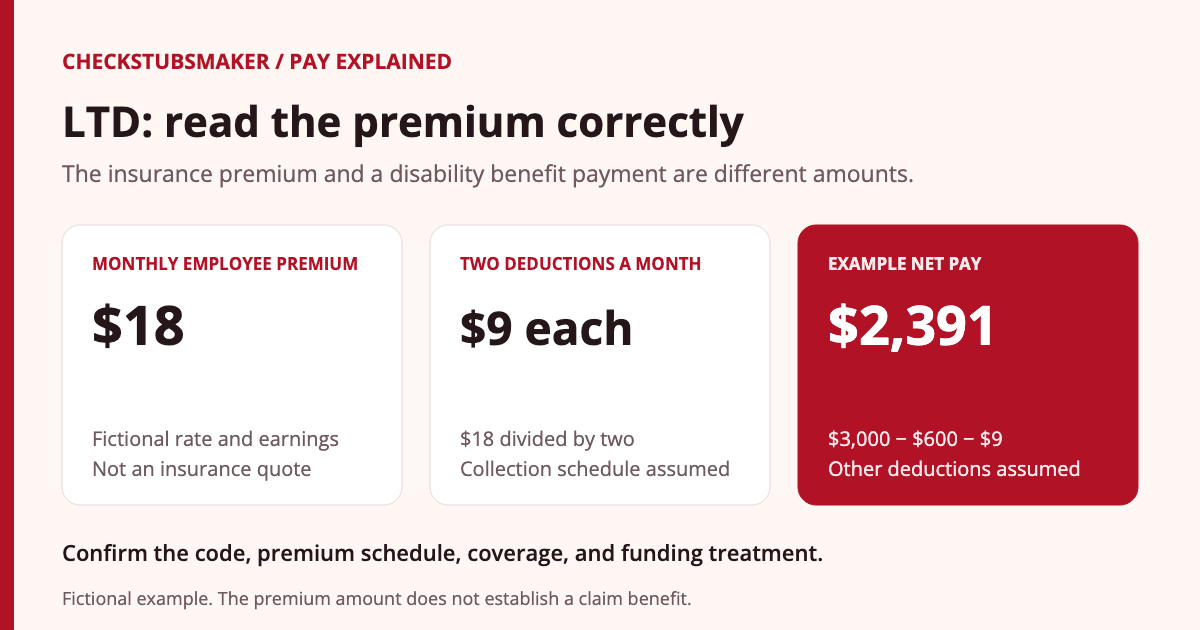
Assume a fictional plan charges the employee $0.30 per $100 of covered monthly earnings, with $6,000 of earnings included in that calculation. The assumed monthly premium is ($6,000 ÷ $100) × $0.30 = $18.
Suppose this fictional employer collects the employee’s entire premium through two equal deductions each month. Each deduction is $18 ÷ 2 = $9. The premium schedule, eligible-earnings definition, and collection method are assumptions, not terms offered by a particular insurer.
For one paycheck, assume $3,000 gross earnings, $600 of other employee deductions, and the $9 LTD premium paid after tax. There are no other payment adjustments.
| Entry | Meaning in this example | Amount |
|---|---|---|
| Gross earnings | Current paycheck | $3,000.00 |
| Other employee deductions | Assumed total, not a tax calculation | −$600.00 |
| Employee LTD premium | One of two monthly deductions | −$9.00 |
| Net cash pay | $3,000 − $600 − $9 | $2,391.00 |
In a different payroll schedule, dividing a monthly premium by two may be wrong. Ask how the employer collects premiums across its actual pay dates, including any paychecks on which no premium is taken.
Also check the earnings definition. Covered earnings for insurance pricing need not equal the total gross earnings shown on every pay stub. Our gross versus net guide helps separate the earnings calculation from the payment received.
Does paying the premium after tax affect future LTD benefit taxes?
The IRS disability-insurance FAQ distinguishes these general federal income-tax outcomes:
- Entire premium paid by the employee with after-tax money: disability benefits under that arrangement generally are not included in income.
- Employer-funded coverage: benefits attributable to employer payments generally are included in income.
- Shared funding: the portion attributable to employer funding is generally taxable when the employee’s share was paid after tax.
- Employee premiums paid through a cafeteria plan without inclusion in taxable income: the IRS treats those premiums as employer-paid for this purpose.
After-tax payment does not mean the employee is paying income tax on the premium as a separate tax bill. It describes the money used to pay the premium and helps distinguish the funding arrangement.
Do not decide the taxability of an entire claim from one current deduction. The Standard’s income-replacement tax guide explains that group-policy funding history and applicable averaging rules can matter. Ask the administrator how the actual arrangement was funded and how the taxable portion was determined.
Our taxable-wages guide explains the difference between a deduction and a tax base. The payroll code alone cannot establish every federal, state, or reporting consequence of a later benefit payment.
Does an LTD deduction prove that a claim will be paid?
No. Confirm enrollment and the coverage effective date, then read the policy’s eligibility conditions, disability definition, waiting period, limits, exclusions, and any coordination with other income. A premium amount does not determine those terms.
For an ERISA-covered plan, request the relevant summary plan description and governing documents. The DOL plan-information overview explains the role of plan descriptions and information about filing claims. Not every disability arrangement is governed by ERISA.
A claim decision or insurer payment statement serves a different purpose from a pay stub showing premiums. Keep claim and payroll documents together when an issue involves both enrollment and payment.
Why did the LTD premium change or disappear?
Compare the two affected statements with enrollment and premium notices. Ask whether the change reflects covered earnings, the applicable premium rate, a coverage election, an employer contribution, or a correction for earlier dates.
For a missing deduction, ask which coverage period the payroll entry normally supports. A skipped charge does not alone prove coverage ended. An extra charge does not alone prove additional coverage began.
If unpaid leave, a job change, or separation affects collection, ask benefits how premiums and coverage are handled under the actual plan. Do not assume a normal payroll deduction can continue when there is no regular paycheck.
When checking YTD premium totals, include any refund, catch-up amount, or reversal. Compare like-for-like periods rather than multiplying one changed deduction by every paycheck in the year.
What should you ask payroll or the benefits administrator?
- Identify the entry. Is it an employee premium, employer contribution, adjustment, benefit, or taxable-value item?
- Confirm the premium calculation. Request the covered-earnings amount, rate, employee share, and collection schedule.
- Confirm enrollment. Ask for the plan name, coverage level, and effective dates.
- Confirm funding treatment. Ask whether premiums were funded before tax, after tax, by the employer, or through a combination.
- Resolve any mismatch. Request an official payroll or enrollment correction and retain the response.
A focused request could read: “Please reconcile the $[amount] LTD entry on my statement dated [date] with my coverage election and premium schedule. Please identify the coverage dates and whether this is an employee deduction or employer cost.”
Save the election, relevant statements, funding explanation, and corrections. Our retention guide explains why records supporting an unresolved issue may need to be kept longer.
Frequently asked questions
Does LTD mean I received disability income?
Not necessarily. In a deduction section, it commonly identifies an insurance premium.
Is LTD the same as short-term disability?
No. They are different coverage categories. Check the actual policy terms and payroll code.
Should an employer LTD contribution reduce my deposit?
An informational company cost should not be subtracted again as an employee premium. Ask payroll how the displayed entries affect net pay.
Does after-tax LTD always make every future payment tax-free?
Do not infer that from one statement. The actual funding arrangement and applicable rules determine the result.
Can I cancel the premium just by changing my pay stub?
No. Use the plan’s enrollment or change process and confirm the effective date with the administrator.
Prepared by the CheckStubsMaker Editorial Team using the primary sources linked above and original examples. See our editorial policy for sourcing and correction standards. Coverage and tax treatment depend on the policy, funding history, and applicable rules.