“Exempt” on a pay stub needs context. In a federal tax field, it may describe a Form W-4 claim for exemption from federal income-tax withholding. That does not automatically exempt wages from Social Security or Medicare taxes. In a job-classification field, “exempt” may concern overtime rules instead. Ask payroll which field and rule the label represents; zero federal withholding alone does not prove exempt status.
For U.S. employees · Sources checked November 3, 2026 · This guide uses the final 2026 Form W-4. Examples are fictional and do not determine whether an individual qualifies for exemption.
Before changing a withholding election, identify what the statement is actually saying. A tax election, a payroll calculation, and an employment classification can use similar language while describing different rules.
What can “exempt” mean on a paycheck statement?
| Context | What to check | What it does not establish |
|---|---|---|
| Federal withholding | W-4 election and effective date | A blanket exemption from every tax |
| State or local tax | The jurisdiction’s form and rules | That a federal election resolves the state question |
| Job classification | Applicable wage-and-hour exemption | Eligibility for federal withholding exemption |
| Unexplained payroll field | The employer’s definition and calculation | That a label or number has one universal meaning |
The Department of Labor’s FLSA adviser discusses exemptions from wage-and-hour provisions. Those classifications are separate from a tax-withholding election. A job title or a pay-stub label alone does not decide the applicable exemption.
For a withholding amount labeled FITW or federal income tax, our FITW guide explains how to locate and compare the entry.
Who can claim federal withholding exemption for 2026?
The 2026 Form W-4 instructions require both a prior-year and a current-year condition: no federal income-tax liability for 2025 and an expectation of no such liability for 2026.
The form’s definition uses specified return lines and refundable credits, or qualifying nonfiling circumstances. Review those instructions; receiving a refund is not a substitute for that test.
Also consider the full current-year situation, including other income and jobs. One small paycheck does not describe a full year. If you cannot establish the conditions, review the IRS guidance or obtain help before certifying an exemption.
Does receiving a refund mean you were tax-exempt?
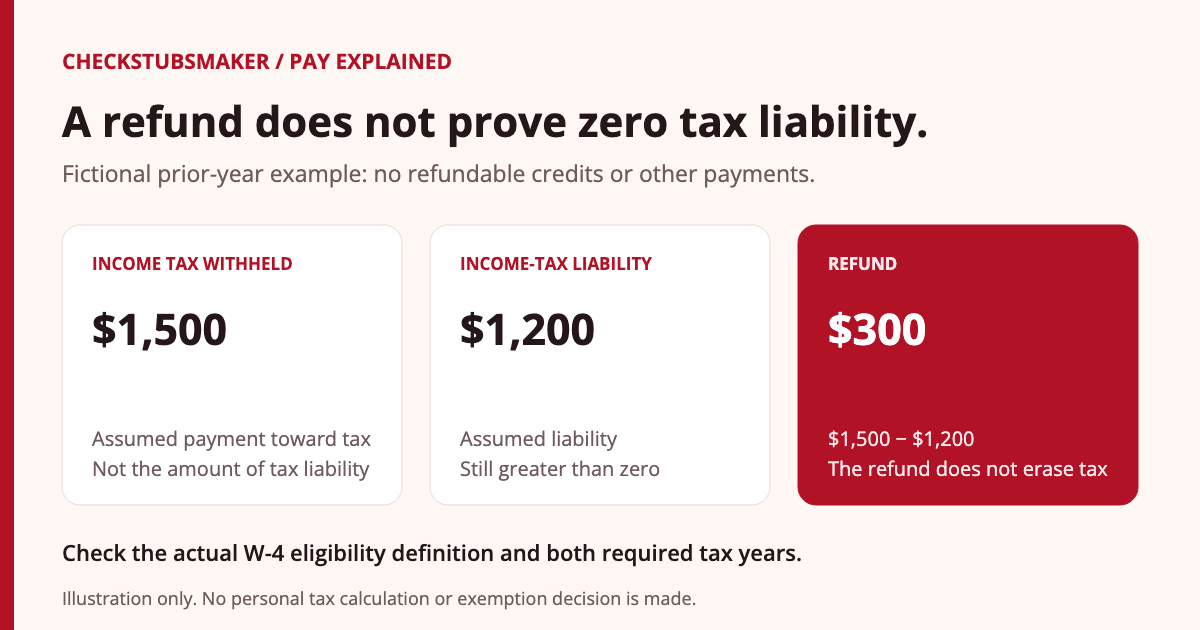
No. A refund can occur when payments exceed a tax liability that is greater than zero.
Assume a fictional prior-year return has $1,200 of federal income-tax liability after the relevant nonrefundable credits, $1,500 of federal income-tax withholding, no refundable credits, and no other payments or adjustments. The refund would be $300.
| Item | Meaning in this example | Amount |
|---|---|---|
| Income-tax liability | Assumed tax after the specified credits | $1,200.00 |
| Income tax withheld | Assumed payment toward that tax | $1,500.00 |
| Refund | $1,500 − $1,200 | $300.00 |
Review your actual return using the W-4 definition. Do not copy the fictional amounts or use refund size as an eligibility test.
Can Social Security and Medicare still be withheld?
Yes. IRS Publication 505 for 2026 states that the federal withholding exemption concerns income tax, not Social Security or Medicare tax.
For a narrow illustration, assume $1,000 of wages is fully subject to the ordinary employee Social Security and Medicare taxes, below the annual Social Security wage base and with no Additional Medicare withholding. Using the 2026 rates in IRS Publication 15, $1,000 × 6.2% = $62 of Social Security tax and $1,000 × 1.45% = $14.50 of Medicare tax.
Those two amounts total $76.50 even if federal income-tax withholding for that paycheck is zero. This limited calculation excludes state taxes and other deductions and does not establish why the federal amount is zero. See our FICA guide for the separate payroll-tax entries.
Why might federal withholding be zero without an exemption?
IRS Topic 753 explains that payroll uses W-4 information about filing status, jobs, credits, deductions, other income, and additional withholding. A calculated zero and a certified exemption are different possibilities.
Ask payroll whether the zero resulted from an exemption election, the normal calculation using the form on file, or another specific cause. Check the current period and YTD columns separately. Our YTD guide explains why a running total can remain positive after a current deduction becomes zero.
If you expected withholding, resolve the cause rather than assuming a zero entry means no tax will be due for the year.
How is exemption claimed on the 2026 W-4?
Eligible employees use the 2026 form’s exemption checkbox below Step 4(c), complete the steps its instructions specify, and submit it to payroll. Follow the current instructions rather than an older layout.
The 2026 W-4 names February 16, 2027 as the deadline for submitting a new form to continue the exemption. An exemption is not a permanent election.
Publication 505 also addresses changes: if circumstances change so that income tax will be payable after all, it requires a new W-4 within 10 days. If someone exempt in 2026 expects to owe income tax for 2027, it specifies a new form by December 1, 2026. Review the rule that actually applies rather than treating the February renewal date as the only relevant deadline.
What should you check before and after a change?
- Identify the exact tax or classification field in question.
- Review the applicable W-4 instructions and the information needed for the year.
- Confirm which election payroll currently has on file.
- Submit any valid update through the employer’s process and keep confirmation.
- Ask when the update takes effect and check the next applicable statement.
- Keep state or local withholding questions separate.
The IRS Tax Withholding Estimator can help eligible users review federal withholding. Use complete income information; a single pay stub may not capture other household earnings or prior withholding.
A focused payroll request is: “My statement dated [date] shows [label] and federal withholding of [amount]. Please confirm the W-4 election on file, its effective date, and whether this entry reflects an exemption or the regular calculation.”
Our W-4 versus W-2 guide explains the form’s role. Ask payroll about a confirmed processing error, and use the correction guide to retain supporting records.
Frequently asked questions
Does exempt mean I pay no taxes?
No. Identify the particular exemption and tax. Federal withholding exemption does not remove every payroll tax.
Does a zero federal deduction prove I claimed exempt?
No. Ask payroll which election or calculation produced the zero.
Does a refund automatically make me eligible?
No. Review the prior-year and current-year conditions using the IRS definition.
Is overtime-exempt status the same as tax-exempt status?
No. Wage-and-hour classification and federal withholding are separate questions.
Does a federal withholding exemption renew automatically?
No. Check the current form’s annual renewal instructions and any earlier update requirement triggered by changed circumstances.
Prepared by the CheckStubsMaker Editorial Team using current IRS and Department of Labor sources with original examples. See our editorial policy. This guide does not determine individual exemption eligibility, employment classification, or tax liability.