FITW on a pay stub means federal income tax withholding: money taken from employee wages toward federal income tax. It is separate from Social Security, Medicare, and state or local taxes. Check the current amount, year-to-date total, federal taxable wages, and the Form W-4 information used by payroll. The amount withheld is a tax payment, not a statement of your final tax rate.
For U.S. employees · Sources checked October 23, 2026 · All payroll amounts below are fictional reading examples, not withholding estimates.
A smaller deposit can be easier to understand once you identify the right tax line. FITW explains one part of the difference between gross earnings and take-home pay. It does not explain every deduction or establish what you will owe when you file.
What does FITW stand for on a paycheck?
The IRS uses FITW for federal income tax withholding. An employer may use a different label, such as federal withholding, FIT, or FWT. Confirm the code using the statement’s legend or payroll’s explanation.
| Payroll line | What to identify | Common comparison mistake |
|---|---|---|
| FITW or federal income tax | Federal income tax taken from wages | Treating it as the total of all payroll taxes |
| Social Security and Medicare | Separate employee payroll-tax amounts | Adding them to FITW when checking that one line |
| State or local withholding | The tax and jurisdiction named by payroll | Assuming federal withholding covers these amounts |
| Federal taxable wages | The wages used for federal income-tax withholding | Reading the wage base as a tax deduction |
| Federal withholding YTD | The cumulative amount for the year in that payroll record | Expecting the full total to be deducted again today |
Our FICA guide explains Social Security and Medicare, while the deduction-code guide helps organize unfamiliar labels. A combined payroll display may require a more detailed report to separate the taxes.
How is FITW calculated?
IRS Publication 15 explains withholding from wages, and Publication 15-T provides the federal calculation methods. The result depends on the relevant wages, payroll frequency, Form W-4 information, and applicable withholding method. It is not one fixed percentage for every worker.
Federal taxable wages can differ from gross earnings because particular payroll items receive different tax treatment. Start with the federal wage base shown or explained by payroll. Our taxable-wages guide describes why different tax bases can appear on the same statement.
A ratio such as “FITW divided by gross pay” describes that payment mathematically. It does not reveal the full withholding calculation, your tax bracket, or your final effective tax rate. Two employees receiving the same gross pay can have different withholding inputs.
How does FITW affect net pay?
Suppose a fictional statement shows $2,400 gross earnings, $180 FITW, and $260 in all other employee deductions combined. These are assumed amounts for reading a statement. The example does not calculate withholding from a W-4 or represent a recommended deduction level.
| Entry | Role | Amount |
|---|---|---|
| Gross earnings | Starting amount | $2,400.00 |
| FITW | Assumed federal income tax withheld | −$180.00 |
| Other employee deductions | Assumed combined total | −$260.00 |
| Net pay | $2,400 − $180 − $260 | $1,960.00 |
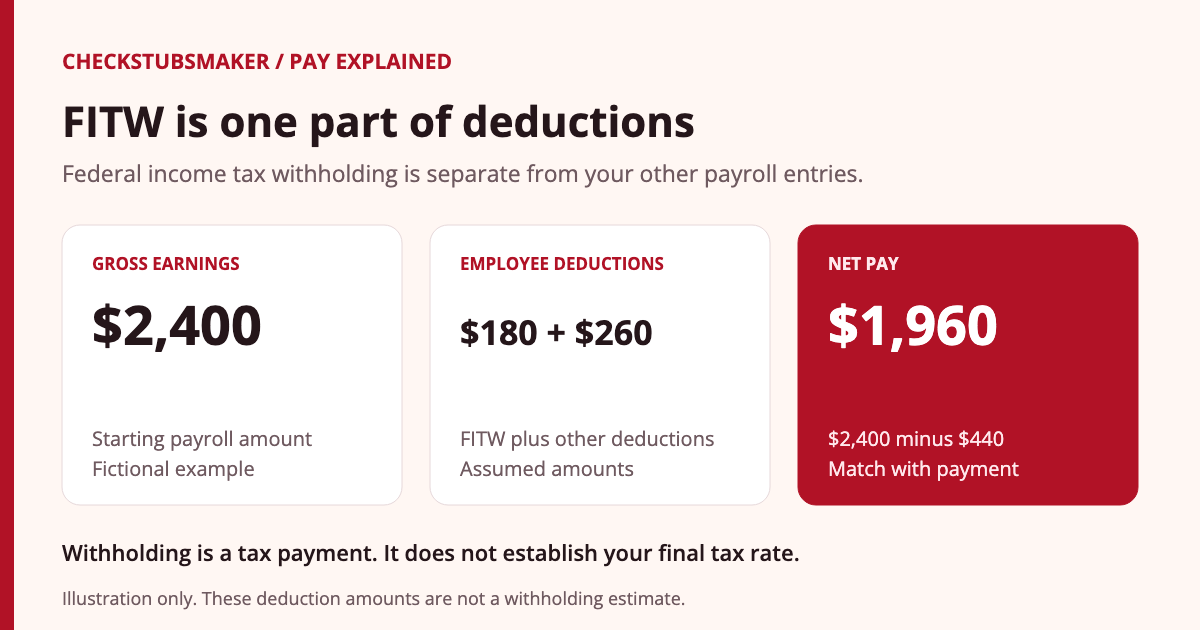
Subtracting only FITW would leave $2,220, which would not match this example’s deposit. The remaining $260 also matters. Conversely, the combined $440 in deductions should not be described as $440 of federal income tax.
For a deposit comparison, use net pay after all employee deductions and account for split payments. Our direct-deposit guide explains how to match the payment with account credits.
Why did FITW change, or why is it zero?
Compare two statements side by side. Check earnings, taxable wages, payroll frequency, W-4 inputs, additional withholding, and any correction. A bonus or another supplemental payment can involve a different withholding method; a larger dollar deduction does not automatically establish a higher final tax rate.
Publication 15 also describes circumstances in which federal withholding can be zero, including a valid exemption claim or a calculation that produces no withholding. A zero line does not establish that the employee owes no federal income tax overall.
Do not assume “exempt” applies to Social Security or Medicare merely because it applies to federal income-tax withholding. Ask which tax the code describes. If a zero amount was unexpected, request the calculation and a review of the W-4 information on file.
Check whether an apparent change is actually a change in columns: a current-period amount and a cumulative YTD amount answer different questions. Also verify that the two statements represent comparable payments.
How should current FITW relate to YTD withholding?
In a simple uninterrupted payroll record, prior YTD withholding plus current withholding equals the new YTD total. For example, $3,960 + $180 = $4,140. This assumes no additional payment, reversal, correction, or imported balance affects the comparison.
If the totals do not reconcile, ask for the intervening payroll activity. Do not add the current $180 to a YTD figure that already includes it. Our YTD guide explains that double-counting risk.
IRS Publication 505 explains withholding as part of paying tax during the year and taking credit for tax withheld on the return. Keep employer-issued annual documents and resolve differences rather than treating a single payroll statement as a completed tax calculation.
How can you check or change your federal withholding?
The IRS Tax Withholding Estimator can help eligible users review withholding across their circumstances. Gather recent pay stubs for all relevant jobs, your spouse’s information if filing jointly, and other records requested by the tool. Follow its eligibility instructions.
If you decide to change withholding, submit an accurately completed Form W-4 through your employer’s official process. Check a later statement after payroll implements it. The W-4 versus W-2 guide explains the difference between payroll instructions and annual wage reporting.
Changing future withholding does not itself correct an inaccurate earlier statement. Ask payroll separately whether earlier deductions, records, or reporting need correction.
What information should you ask payroll to confirm?
- The tax code. Confirm that FITW is federal income-tax withholding in this system.
- The covered payment. Identify the pay date and current-period amount.
- The inputs. Request the federal taxable wage base, frequency, W-4 information used, and additional withholding.
- The method. Ask whether the payment was regular wages, supplemental wages, or a correction.
- The running total. Reconcile current withholding with the prior and new YTD figures.
A focused request could say: “Please explain the $[amount] federal withholding on my statement dated [date], including the taxable wages and W-4 inputs used. It differs from the previous payment by $[difference].”
Frequently asked questions
Is FITW the same as FICA?
No. Federal income-tax withholding is separate from Social Security and Medicare taxes.
Is FITW my final federal tax rate?
No. Withholding is a payment toward tax. The return determines the final result using the applicable income, deductions, credits, and rules.
Does zero FITW mean payroll made a mistake?
Not necessarily. Ask for the inputs and calculation, especially if zero was unexpected.
Can I request extra federal withholding?
Form W-4 provides a way to request additional withholding. Complete it accurately and submit it to your employer.
Should the FITW YTD total equal today’s deduction?
No. YTD is cumulative. Today’s amount is only one part of that total.
Prepared by the CheckStubsMaker Editorial Team using the primary sources linked above and original examples. See our editorial policy for sourcing and correction standards. Actual withholding depends on the employee’s circumstances and applicable payroll rules.