FSA on a pay stub usually means a contribution to a flexible spending arrangement through your employer. Identify whether the code refers to a health FSA, a limited-purpose health FSA, or dependent care. A current payroll deduction, YTD contributions, annual election, and available reimbursement amount are different figures. This guide’s examples concern an eligible employee’s health FSA.
For U.S. employees · Sources checked October 21, 2026 · All elections, payments, and claims below are fictional. Limits are stated for plan years beginning in 2026.
A $100 deduction does not necessarily mean only $100 is available for eligible health expenses. The pay stub records payroll activity, while the benefit administrator tracks the election and claims. Compare those records by purpose and date before deciding that a balance is wrong.
What does the FSA deduction code identify?
Look at the code’s full description and enrollment confirmation. An employer might use “MED FSA,” “HCFSA,” or another label for a health FSA. A dependent-care contribution may use a separate code. Abbreviations are employer-specific; they do not establish the account’s rules by themselves.
HealthCare.gov’s FSA overview describes using a job-based health FSA for eligible out-of-pocket health expenses. It also explains that employers may contribute, but are not required to. Confirm which source of funding a displayed amount represents.
| Field | What it generally tracks | Where to confirm |
|---|---|---|
| Current employee FSA deduction | The employee salary reduction in this payment | Pay stub and effective election |
| YTD employee contributions | Payroll contributions recorded during the reporting year | Payroll history and reporting dates |
| Annual election | The amount elected for the plan year | Enrollment confirmation |
| Claims or reimbursements | Eligible expenses submitted or paid under the plan | Administrator’s claim history |
| Available amount | Availability under that account’s reimbursement rules | Administrator’s balance explanation |
A limited-purpose health FSA and a dependent-care arrangement have different eligibility or expense rules. Do not apply the medical example below to child-care reimbursements. Our deduction-code guide explains how to investigate an unfamiliar payroll label.
How do you calculate an FSA deduction per paycheck?
For a simple full-year election, divide the employee’s annual salary-reduction election by the number of scheduled deductions. Confirm the payroll calendar and plan instructions; the number of deductions can differ from the number of payments you receive.
Assume a fictional employee elects $2,400 for a calendar-year health FSA and the employer schedules 24 equal deductions. The employee is eligible, remains covered, and has no employer funding, carryover, midyear changes, or payroll corrections.
$2,400 ÷ 24 deductions = $100 per deduction.
After six deductions, payroll has recorded 6 × $100 = $600 in employee contributions. The remaining scheduled deductions total $1,800. Those figures explain the contribution schedule; they are not a claim-payment ledger.
Use actual scheduled deductions rather than dividing by an assumed 26. Our biweekly versus semimonthly guide explains why the schedules differ. A midyear enrollment or missed deduction requires the employer’s actual allocation, not the full-year shortcut.
Why can the available health FSA amount exceed contributions taken so far?
IRS Publication 969 explains that the health FSA’s elected reimbursement amount must be available during the coverage period regardless of contributions already made. Reimbursement still requires eligible expenses incurred during coverage and compliance with the plan’s claim rules.
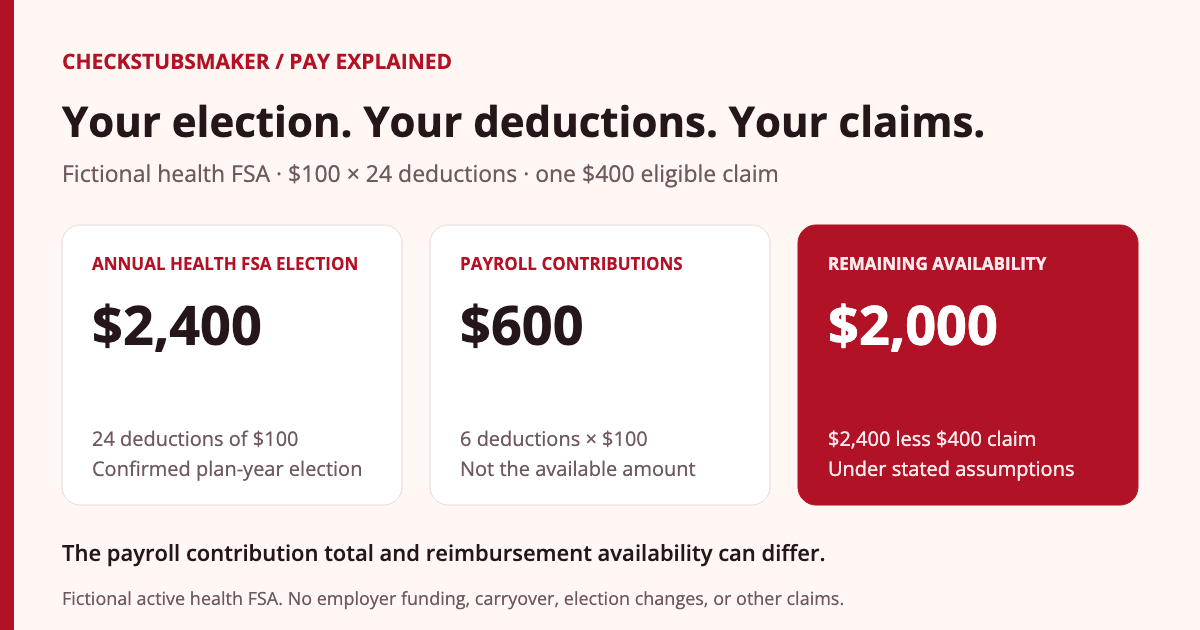
Continue the fictional example after six deductions. Assume the administrator has paid one properly substantiated $400 eligible claim, with no other claims or adjustments.
| Record | Calculation | Amount |
|---|---|---|
| Annual employee election | Confirmed plan-year election | $2,400 |
| Contributions taken so far | 6 × $100 | $600 |
| Eligible claim reimbursed | One approved claim | $400 |
| Remaining reimbursement availability | $2,400 − $400 | $2,000 |
The $2,000 is remaining reimbursement availability under these assumptions. It is not $600 minus $400, and it is not additional wages owed in the next deposit. The employee still has the scheduled contribution arrangement.
Does a health FSA deduction reduce taxable wages?
Publication 969 describes the federal income-tax and employment-tax advantages of qualifying health FSA contributions. Treatment depends on a compliant arrangement and an eligible participant. Do not assume every deduction containing “FSA” receives identical treatment.
For a separate simplified wage example, assume $3,000 gross earnings and a $100 qualified health FSA salary reduction, with no other wage adjustments and wages below the Social Security cap. Federal income-tax, Social Security, and Medicare wages would each be $2,900 under those assumptions.
The $100 contribution is not the amount of tax saved. Tax withholding and net pay need their own calculations. Our taxable-wages guide explains wage bases, while our gross versus net guide explains the payment calculation.
What are the 2026 health FSA limit and year-end options?
IRS Publication 15-B lists a $3,400 employee health FSA salary-reduction limit for plan years beginning in 2026. The employer may set a lower election limit. This is not the dependent-care limit, an HSA limit, or a promise that every employee can elect that amount.
Under Revenue Procedure 2025-32, section 4.15, a plan that permits carryover can allow up to $680 of unused 2026 health FSA amounts to carry forward. Confirm the actual plan provision and permitted amount.
Publication 969 explains that a health FSA can provide either a carryover or a grace period of up to 2½ months. The same health FSA cannot offer both. Neither option is automatic, and unused amounts outside the applicable rules may be forfeited.
Distinguish the deadline to incur an expense from the deadline to submit its claim. Ask for both dates in writing. A later claim-submission deadline does not, by itself, extend the period in which a new expense qualifies.
For example, $300 remaining at year-end does not establish a $300 cash payout. Check the carryover or grace-period provision and any other plan conditions before deciding how that amount can be used.
What records should you keep for reimbursements?
HealthCare.gov describes submitting proof of the medical expense and confirming it was not covered by the health plan. Follow the administrator’s substantiation instructions, including requests following a benefit-card transaction.
Keep the provider’s itemized documentation, relevant insurance explanation, claim submission, and reimbursement notice. Match those records to the expense and coverage dates. A payroll deduction proves a contribution was recorded; it does not prove that a particular medical expense was eligible or reimbursed.
Preserve payroll statements and administrator records separately, with a note connecting them when necessary. Our record-retention guide explains why benefit questions can justify keeping documents longer than a routine storage review.
What should you check if an FSA amount looks wrong?
- Confirm the account type. Identify health, limited-purpose, or dependent care.
- Find the effective election. Check the plan year, coverage dates, annual amount, and any approved change.
- Reconcile payroll. Count the actual deductions and inspect corrections or employer contributions separately.
- Reconcile the administrator. Compare claims paid, pending claims, carryover, and the definition of “available.”
- Request a written breakdown. Ask payroll about deductions and the administrator about claims or reimbursement availability.
A useful request is: “My health FSA election is $[amount] for [plan year]. Please confirm the scheduled deductions, contributions recorded, claims paid, and remaining reimbursement availability as of [date].”
When leaving a job or changing coverage, ask the administrator about the coverage-end date, claim deadlines, and any applicable continuation options. A remaining portal balance alone does not establish post-employment eligibility.
Frequently asked questions
Is an FSA the same as an HSA?
No. They are different arrangements with different eligibility and funding rules. If you use an HSA, ask whether the particular FSA is compatible with HSA eligibility.
Does YTD FSA mean my available balance?
Not necessarily. Payroll YTD commonly records contributions. Check how the administrator defines the available amount and which claims it includes.
Can I take the unused amount as cash?
Do not treat unused health FSA amounts as wages owed. Check the plan’s reimbursement and year-end rules; the IRS describes restrictions on refunding unused balances.
Can I change the deduction whenever I want?
Check the plan’s election-change rules and any permitted qualifying circumstances. A desired cash-flow change does not automatically permit a midyear election change.
Does a reimbursement cancel the payroll deduction?
No automatic cancellation follows from a claim payment. Contributions follow the election and payroll schedule; reimbursements follow eligible-expense and claim rules.
Prepared by the CheckStubsMaker Editorial Team using the primary sources linked above and original examples. See our editorial policy for sourcing and correction standards. Actual benefits depend on the account type, plan document, employee eligibility, and applicable rules.