Severance pay on a pay stub generally identifies compensation connected with the end of employment. Ordinary cash severance is taxable wages, so the net payment can be lower than the gross amount in the separation agreement. Check the earnings code, agreed calculation, payment dates, employee withholding, and any other deductions. Keep severance separate from final worked wages and unused-leave payments.
For U.S. employees · Sources checked October 21–22, 2026 · All payment amounts and agreement terms below are fictional. The tax example uses 2026 rules.
A letter promising $6,000 of gross severance does not necessarily promise a $6,000 bank deposit. You need the payroll breakdown to connect the agreement with the amount received. Start by identifying the payment before deciding whether money is missing.
What does severance mean on an earnings statement?
Read the full earnings description and the employer’s written explanation. Payroll may identify severance with a separate code or dollar entry. A label does not, by itself, show which agreement terms have been satisfied or when another installment is due.
The Department of Labor’s severance overview explains that the FLSA itself does not require severance pay. Severance commonly depends on an agreement between employer and employee. Other applicable laws, plans, or arrangements can affect the actual rights involved.
| Possible component | What to compare | Useful supporting record |
|---|---|---|
| Final worked wages | Hours or salary through the covered work dates | Time records and normal compensation terms |
| Severance | The agreed gross amount or formula | Separation agreement or applicable plan |
| Unused leave payment | Eligible hours, rate, and payout treatment | Leave policy, balance, and applicable requirements |
| Expense reimbursement | The specific expenses being reimbursed | Approved expense report and receipts |
| Employee deductions | Taxes and any other amounts taken from pay | Payroll calculation and deduction explanation |
Different components can appear together, but that does not make them interchangeable. Our PTO guide discusses leave balances and earnings separately. A leave payout should not automatically be counted as another severance installment.
How should you compare a severance agreement with the pay stub?
Find the gross amount, formula, scheduled payments, and any stated conditions. Confirm whether an amount described as “four weeks” uses a defined weekly compensation figure or some other calculation. Do not assume every employer uses the same formula.
For example, suppose a fictional agreement provides four weeks of severance at an agreed $1,500 weekly amount. The gross calculation is 4 × $1,500 = $6,000. That example does not establish a universal entitlement based on service or salary.
Now compare that $6,000 with the severance earnings line, not only with total gross pay. If the same statement includes $1,000 of final worked wages, total gross earnings would be $7,000, while the severance component would still be $6,000. Check whether any other earnings are included before comparing totals.
Also distinguish cash severance from any employer-paid benefit described in the package. A statement about continued coverage does not necessarily represent additional cash in the employee’s deposit. Request a component-by-component explanation when the written package combines several benefits.
Is severance taxable, and is it always withheld at 22%?
IRS Publication 525 explains that severance is included in income and is subject to income-tax withholding and Social Security and Medicare taxes. This guide concerns ordinary cash severance; differently characterized settlement amounts or benefits need their own review.
IRS Publication 15 includes severance among supplemental wages. The federal withholding method depends on how the payment is identified and processed. For qualifying separately identified supplemental wages, an optional 22% method can apply under the publication’s conditions. Other methods and special rules apply in other circumstances.
Withholding is not the final income-tax calculation on a return. The 22% figure also does not include Social Security, Medicare, or any applicable state or local withholding. Our taxable-wages guide explains the difference between a wage base and tax withheld.
What could a $6,000 severance payment look like after withholding?
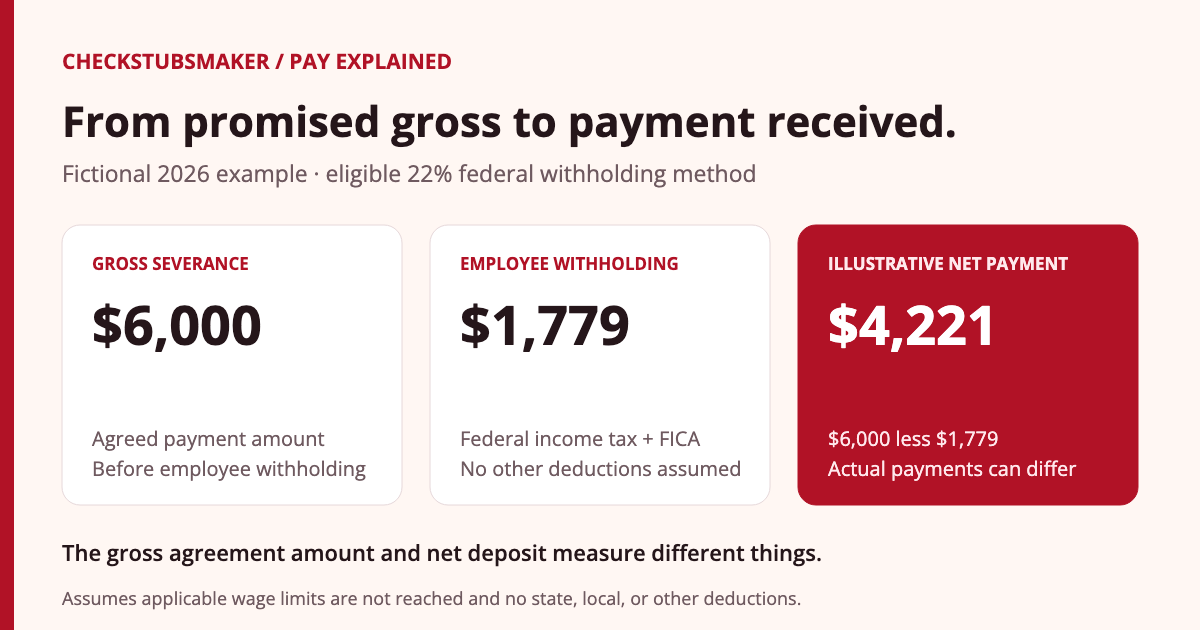
Assume the fictional $6,000 ordinary cash severance is separately identified and the employer uses the permitted 22% federal supplemental-wage method. Federal income tax was withheld from the employee’s regular wages in the current or immediately preceding calendar year, and annual supplemental wages do not exceed $1 million.
Also assume this payment remains entirely below the employer’s 2026 Social Security wage cap and Additional Medicare withholding threshold. For this example only, there is no state or local withholding, benefit deduction, garnishment, reimbursement, or other adjustment.
| Line | Calculation | Amount |
|---|---|---|
| Gross severance | Agreed payment | $6,000.00 |
| Federal income tax withheld | $6,000 × 22% | −$1,320.00 |
| Employee Social Security | $6,000 × 6.2% | −$372.00 |
| Employee Medicare | $6,000 × 1.45% | −$87.00 |
| Illustrative net payment | $6,000 − $1,779 | $4,221.00 |
The difference is $1,779 in the three employee withholding lines. It is not evidence that the employer reduced the $6,000 gross promise to $4,221 gross. Employer tax costs are separate and are not included as employee deductions in this example.
Use actual YTD wages and deduction lines when checking your payment. The Social Security cap, Additional Medicare rules, other withholding methods, and state requirements can change the result. See our FICA guide and gross versus net guide for the payroll categories.
What if severance is paid in installments or the deposit is missing?
Compare the scheduled installments with individual payroll records. A promised total and an installment amount are different. If the agreement schedules two gross $3,000 installments, a single $3,000 earnings line should be checked against that schedule before assuming half the package disappeared.
For each installment, record the payment date, gross severance, deductions, net amount, and payment method. Do not assume a pay stub proves that the bank credit has posted. Our direct-deposit guide explains how to match the payroll payment with the bank transaction.
If a statement exists but money has not arrived, ask whether it represents a scheduled payment, completed payment, reversal, replacement, or another payroll entry. Confirm the destination using a secure channel and request the payment status or trace information when appropriate.
Keep the payment schedule distinct from the final date you worked. An earnings-period label may need explanation for a post-employment payment. Our pay-period versus pay-date guide explains the separate date fields. The agreement and applicable requirements determine actual payment obligations.
How should you review YTD totals and the annual form?
The IRS W-2 instructions generally report wages paid during the calendar year. Do not assign an installment to a tax year solely because the employment ended in that year.
Compare each payment with the employer’s current and YTD earnings and withholding. Include separate payments and corrections. If the YTD severance total already includes the current installment, adding it again would count the same amount twice.
Retain the agreement, statements, payment confirmations, and any later W-2 or W-2c. Our retention guide explains why an unresolved payment or reporting issue can require keeping particular records longer.
What should you ask payroll if the amount seems wrong?
- Reconcile the gross component. Compare the agreed severance formula with the severance earnings line.
- Separate other payments. Identify final wages, leave, reimbursements, and employer-paid benefits.
- Check the withholding method. Ask how federal withholding was calculated and which wage limits applied.
- Review other deductions. Request the reason and supporting basis for each unexpected entry.
- Match the payment schedule. Account for installments, reversals, replacements, and actual deposits.
- Keep the written response. Save any corrected statement with the original record.
A focused request could say: “The agreement lists $[gross] of severance. Please reconcile that amount with the statement dated [date], including installments, withholding, other deductions, and the payment status.”
Frequently asked questions
Is severance the same as my last normal paycheck?
No. A final statement can combine several components. Identify the severance separately from compensation for work performed.
Does a 22% withholding line mean my final tax rate is 22%?
No. It is a withholding method under specified conditions. Your final income-tax result depends on the return and applicable rules.
Does leaving employment eliminate Social Security or Medicare withholding?
No general exemption follows merely from leaving the job. Ordinary severance remains subject to the applicable wage-tax rules and limits.
Should severance show hours worked?
Ask what any displayed hours or units represent. A formula expressed in weeks of compensation does not establish that you worked those hours after separation.
What if the employer’s statement and bank deposit disagree?
Compare net payment, dates, payment method, and any separate or reversed transaction. Request a payroll reconciliation rather than editing the employer’s statement.
Prepared by the CheckStubsMaker Editorial Team using the primary sources linked above and original examples. See our editorial policy for sourcing and correction standards. Actual payment rights and tax treatment depend on the arrangement, payment type, and applicable rules.