A pay stub for a cash payment should explain the employee’s earnings, deductions, and net wages, just as a statement for another payment method does. Ask the employer for an itemized payroll record and a separate confirmation of the cash actually received. Cash payment does not by itself make wages tax-free or establish independent-contractor status. Wage-statement requirements depend on the applicable rules.
For U.S. employees · Sources checked October 22, 2026 · All hours, rates, deductions, and cash amounts below are fictional illustrations, not tax estimates.
Receiving an envelope of cash tells you the amount handed over. It may not explain the work dates, gross earnings, taxes withheld, or benefit deductions. Keeping those details together makes it easier to check a payment and request a correction.
Can an employee receive cash wages and a pay stub?
Yes, cash payment and a written earnings statement can go together. Cash can be an authorized payment method under applicable law; the employer still needs to meet the wage, payroll, and reporting requirements that apply to the job.
The Department of Labor’s pay-stub FAQ distinguishes federal recordkeeping from providing statements: the FLSA requires accurate records but does not itself require employers to give employees pay stubs. That does not settle a state-law obligation.
For a specific state example, California’s Labor Commissioner FAQ, question 8, explains that cash-paid employees are entitled to the required itemized wage information. Use the rules applicable where you work; do not assume California’s requirements or deadlines are the nationwide standard.
DOL Fact Sheet 21 describes records covered employers must keep for non-exempt workers, including hours, pay rates, additions and deductions, wages paid, and payment dates. A payment method does not replace the need for an accurate payroll history.
What is the difference between a cash pay stub and a receipt?
| Record | Useful information | Question it helps answer |
|---|---|---|
| Employer-issued earnings statement | Covered dates, earnings, employee deductions, and net wages | How was this payment calculated? |
| Cash payment receipt | Actual amount handed over, date, and payment reference | What cash was received? |
| Time and work records | Days, hours, rates, and relevant changes | Does payroll reflect the work performed? |
| Personal payment log | Your contemporaneous notes about each payment | Which amounts or dates need an explanation? |
| Annual tax documents | Employer-reported annual wages and withholding | Does annual reporting agree with the payroll history? |
A receipt saying “cash received” may omit the entire gross-to-net calculation. A detailed statement, meanwhile, does not independently confirm how much cash changed hands. Request both types of information when reconciling a payment.
If you later deposit the cash into your bank account, keep the deposit record as supporting information. It does not by itself identify the employer, work period, or deductions. You may also deposit less than the full payment because you kept some cash.
How should a cash payment match the net amount on a stub?
Assume a fictional employee worked 40 regular hours at $20 per hour during one workweek. There is no overtime, bonus, reimbursement, or other earning in this example. Gross earnings are 40 × $20 = $800.
Suppose the fictional employer-issued statement itemizes employee deductions that total $110. We use that assumed total solely to demonstrate reconciliation; it is not a tax calculation, recommended deduction, or universal percentage. An actual statement should identify the real deduction entries.
| Entry | How to check it | Amount |
|---|---|---|
| Regular gross earnings | 40 hours × $20 | $800.00 |
| Total employee deductions | Assumed sum of itemized entries | −$110.00 |
| Net wages | $800 − $110 | $690.00 |
| Cash counted and received | Amount recorded on payment receipt | $690.00 |
| Unexplained difference | Net wages minus cash received | $0.00 |
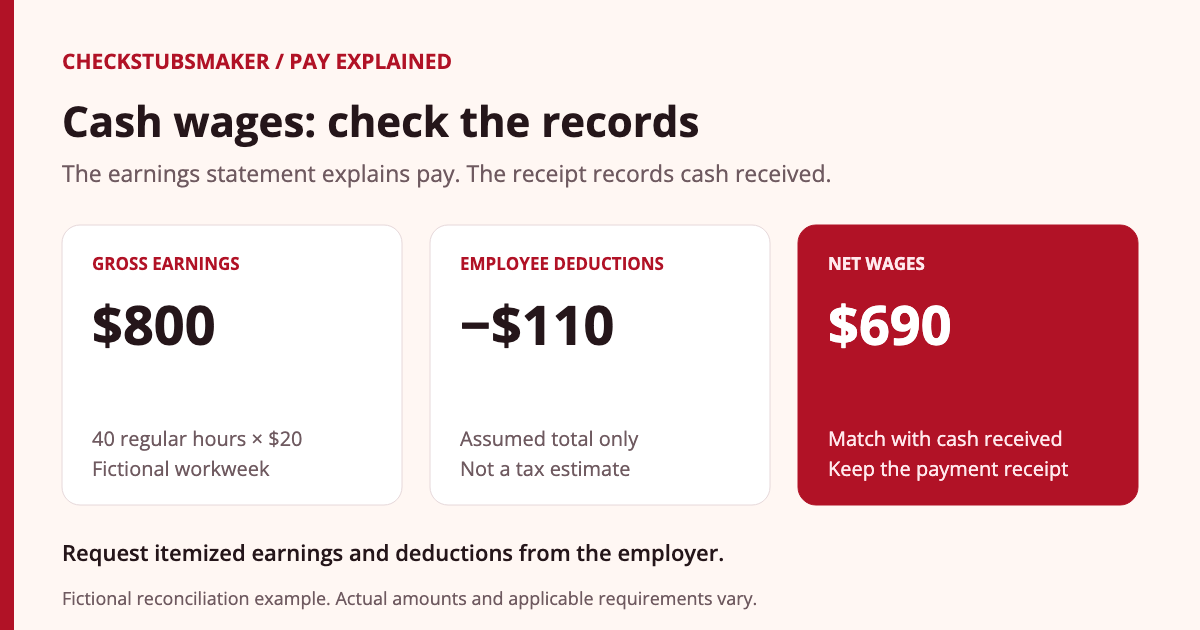
If the employee instead counts $670, the first unexplained difference is $690 − $670 = $20. That calculation identifies a question to resolve; it does not establish the cause. Ask whether there was a counting error, a separate payment, or an adjustment missing from the statement.
Compare cash received with net pay, not automatically with the $800 gross amount. If hours above the applicable overtime threshold are involved, review them separately using the relevant rules; our overtime guide explains the basic payroll comparison.
How do you get a pay stub when you are paid in cash?
- Contact the employer’s payroll or HR representative. Ask whether statements are available through a portal, email, or another official process.
- Identify the exact payment. Give the pay date and covered work dates. Distinguish the pay period from the payment date.
- Request the calculation. Ask for earnings, rates and hours where applicable, each deduction, and net wages.
- Request the payment record. Ask for confirmation of the amount actually paid in cash and any separate payment.
- Save the response. Keep the employer-issued statement, receipt, and any correction together.
A practical request could say: “Please provide the earnings statement for the cash payment dated [date], covering [work dates]. I received $[amount]. Please include the earnings calculation, itemized deductions, net wages, and payment confirmation.”
For an old job, use the process in our previous-employer guide. If no statement is available, retain your personal notes and ask for a written payroll explanation. Label your own log accurately; it is not an employer-issued pay stub.
Do cash wages have taxes, and does cash make you a contractor?
IRS Publication 15 explains employment-tax and withholding rules for employee wages. Paying ordinary covered employee wages in currency does not create a general exemption from income-tax withholding, Social Security, or Medicare. Specific exemptions and special employment categories require their own review.
Read the actual deduction entries rather than assuming taxes were withheld because a cash payment was smaller than expected. Likewise, a deduction printed on a statement does not alone resolve whether payroll reporting and deposits were handled correctly. Ask for an explanation when the records disagree.
The IRS worker-classification guidance considers control, independence, and the overall relationship. Receiving cash alone does not determine employee or contractor status. Other legal purposes can use different classification tests.
Do not create employee withholding figures merely to make a contractor payment resemble payroll. If classification or tax reporting is disputed, preserve the actual records and seek qualified help. Our W-4 versus W-2 guide explains those employee forms’ separate roles.
What should you do if the cash and statement disagree?
Check the hours and rate first, then the individual deductions, then the payment. Our deduction-code guide can help organize the questions, but the employer must explain its own codes.
Count the payment and record the actual amount promptly. Read any receipt before acknowledging it and ask for a correction if it states an amount you did not receive. Preserve dated notes and relevant messages.
Ask payroll to reconcile an unexplained balance in writing. If a corrected statement is issued, retain both versions and identify the replacement. For unresolved wage concerns, consult the appropriate state labor agency or the DOL complaint resources for matters covered by federal wage laws.
How should you organize cash-wage records for income verification?
Group each statement with its corresponding receipt and payment date. Keep work records and employer correspondence in the same folder. For multiple payments, use a clearly labeled personal index so a single receipt is not counted twice.
Ask the requesting organization which records it accepts. Employer-issued statements, verification letters, receipts, and tax documents serve different purposes; no single document guarantees approval. Provide accurate originals through the requested secure process.
Follow a suitable record-retention period, and keep records connected with an unresolved dispute. A pay stub also does not replace the proper annual filing documents; see filing taxes with a last pay stub.
Frequently asked questions
Is being paid in cash automatically illegal?
No. Cash can be a permitted payment method. The applicable wage, statement, tax, and reporting requirements still need to be met.
Is a cash receipt the same as a pay stub?
No. A receipt records the payment received. A pay stub explains the payroll calculation. Keep the relevant information from both.
Can I make my own employer pay stub?
Request the employer-issued record. You can maintain an accurate personal log, but do not present it as a statement issued or approved by an employer.
Should the cash amount equal gross or net wages?
In a simple wages-only payment, compare the cash with net wages after actual deductions. Reconcile any separately paid amount or other component.
Does cash payment mean I should receive a 1099?
Payment method alone does not decide worker classification or the correct annual form. Resolve the relationship and reporting treatment using the applicable rules.
Prepared by the CheckStubsMaker Editorial Team using the primary sources linked above and original examples. See our editorial policy for sourcing and correction standards. Statement requirements, payment procedures, and tax treatment depend on the facts and applicable rules.