Holiday pay on a pay stub can mean pay for a holiday you did not work or extra earnings for work performed on a designated holiday. Read the code, dates, hours, and rate to identify which arrangement applies. Paid holiday leave is not automatically hours worked for the ordinary federal overtime test, and the holiday label alone does not establish a right to double time.
For U.S. employees · Sources checked November 17, 2026 · Examples use fictional employer policies and the ordinary federal weekly overtime framework. State rules, agreements, and covered government contracts can add requirements.
A holiday row can increase paid hours without increasing actual work hours. Another holiday row may record only a premium on hours already included in regular work. Adding every row’s units together can therefore misstate the time worked.
What does the holiday code represent?
Ask whether the entry concerns an observed paid day off, work on a designated holiday, an additional premium, or a correction. The employer’s code legend and holiday policy should explain its purpose.
| Entry | What to establish | What not to assume |
|---|---|---|
| Holiday leave | Paid time for an eligible holiday not worked | That every paid hour is an hour actually worked |
| Holiday work | Work hours and the applicable compensation | That the label always means double time |
| Holiday premium | Whether the rate is an addition or the full rate | That premium units are additional work hours |
| Holiday adjustment | Affected date and original payment | That the amount is recurring earnings |
Keep a holiday payment separate from a leave balance. A field showing eight available floating-holiday hours is different from eight hours paid on this paycheck. Our floating-holiday guide covers that related benefit.
Does federal law require paid holidays or double time?
The Department of Labor’s holiday-pay guidance explains that the FLSA does not itself require payment for holiday time not worked. The DOL’s FLSA FAQ also explains that the law has no general double-time requirement.
That is a statement about the FLSA, not the answer to every holiday-pay question. Check the employer’s written policy, any applicable agreement, and governing state or other requirements. DOL separately identifies holiday-benefit requirements for certain covered government-contract work.
Confirm the employer’s observed holiday date, eligible employee group, pay basis, and any policy conditions. A public holiday calendar is not, by itself, your employer’s payment agreement. Likewise, an agreement promising extra pay should be reviewed on its own terms.
Example: 32 hours worked plus eight paid holiday hours
Assume a fictional hourly employee earns $25 per hour, works 32 hours in one workweek, and receives eight hours of paid holiday leave under the employer’s policy. The employee performs no work during those eight leave hours and has no other earnings or adjustments in this example.
| Component | Calculation | Gross earnings |
|---|---|---|
| Actual regular work | 32 hours × $25 | $800.00 |
| Paid holiday leave | 8 hours × $25 | $200.00 |
| Total earnings | 40 paid hours | $1,000.00 |
| Actual hours worked | Excludes the eight leave hours | 32 hours |
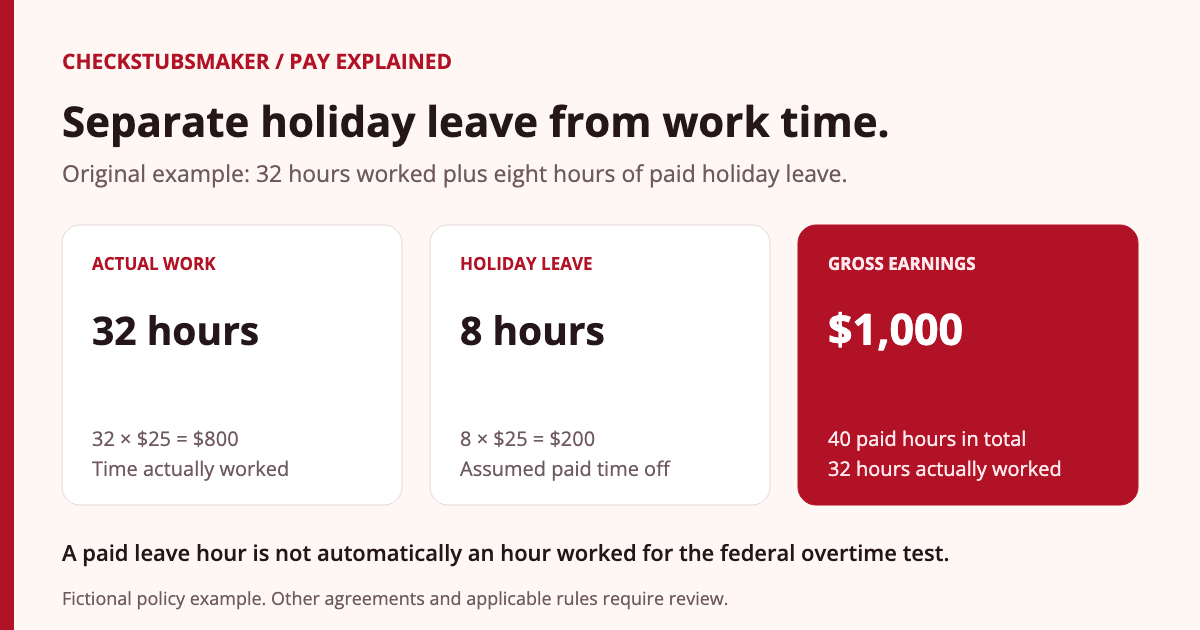
The $1,000 is gross earnings before employee deductions. The 40 paid hours do not show that the employee worked 40 hours. Compare the holiday row with the approved schedule and time record before treating a difference as missing work.
For a salaried employee, holiday time may be separated for display while remaining part of the same salary installment. Do not automatically add a holiday row on top of a salary that already includes the same pay. See hourly versus salary pay stubs.
Example: what if the employee worked on the holiday?
Consider a different fictional week. The employee works 40 hours in total, including eight on the designated holiday. The assumed policy pays the ordinary $25 rate for all work plus an additional $25 premium for each holiday hour. There are no overtime hours or other earnings in this separate example.
Base wages are 40 × $25 = $1,000. The additional premium is 8 × $25 = $200. Total gross earnings are $1,200. The eight premium units are a subset of the 40 actual work hours, not another eight hours worked.
Under this assumed policy, each holiday hour receives $50 in combined earnings. Another statement could show the full $50 rate for those eight hours instead of an added $25 premium. Confirm the display before deciding a rate is missing or counting both methods together.
The double-rate result comes from the fictional policy, not a claim that all holiday work must be paid this way. Our shift-differential guide explains another situation where premium units can overlap with worked hours.
Does paid holiday leave count toward weekly overtime?
The DOL Hours Worked Advisor explains that holiday time off is not hours worked merely because it is paid. For the ordinary federal weekly test, identify actual work hours rather than adding every paid-leave hour to the overtime count.
For example, 40 actual work hours plus eight hours of genuine paid holiday leave would not, solely because there are 48 paid hours, establish eight federal overtime hours. An employer agreement or another applicable rule may provide a more generous treatment.
If holiday work, a premium, and overtime occur together, ask for the full calculation. 29 CFR 778.203 addresses qualifying special-day premiums and their treatment. Do not assume every payment called a holiday premium is interchangeable with statutory overtime. The examples above do not calculate a combined premium-and-overtime case.
Our overtime guide explains the basic weekly comparison and the difference between full overtime earnings and an additional premium.
What should you ask about a missing holiday payment?
- Identify the observed date and the applicable policy or agreement.
- Confirm whether the employee worked or took paid leave.
- Check eligibility, actual hours, and the code’s rate definition.
- Reconcile regular earnings, leave earnings, premiums, and any overtime separately.
- Request an employer explanation or correction for a confirmed discrepancy.
A focused request is: “Please explain the holiday entries for [date] on my [pay date] statement, including policy eligibility, leave or worked hours, whether the rate is full or additional, and the overtime treatment.” Preserve the time record and response. See requesting a pay-stub correction.
Frequently asked questions
Does every employee receive paid federal holidays?
The FLSA does not itself establish that entitlement. Check the actual policy, agreement, and applicable rules.
Is holiday pay always double time?
No. Confirm the promised rate and whether the statement shows a full rate or an additional premium.
Are paid holiday hours always hours worked?
No. Genuine holiday time off is different from work performed on the holiday.
Should I add holiday premium units to regular hours?
Not automatically. They may describe a subset of the work hours already counted.
Is a holiday leave balance another payment?
No. Available time and earnings paid are different fields; confirm what the label measures.
Prepared by the CheckStubsMaker Editorial Team using primary DOL and regulatory sources with original employer-policy examples. See our editorial policy.