Hourly pay generally starts with a rate multiplied by the relevant hours; salary starts with an agreed compensation amount allocated to the payment period. Both pay stubs should be read for earnings, employee deductions, and the final payment. The hourly or salary label alone does not establish overtime-exempt status, actual hours worked, or a guaranteed take-home amount.
For U.S. employees · Sources checked November 16, 2026 · Examples use fictional pay agreements and stated overtime assumptions. This guide explains payroll records; it does not classify an individual job or determine every state-law requirement.
Two employees can each have $2,000 gross earnings while their statements explain that number differently. One may have 80 straight-time hours at $25; another may receive one installment of an annual salary. To compare them properly, identify the pay basis and period before looking at deductions or deposits.
What changes between an hourly and a salary statement?
An hourly statement commonly identifies the applicable rates and quantities for regular work, overtime, and paid leave. A salary statement may identify a full-period salary amount, adjustments, or separate additional earnings. Employer layouts vary.
| Question | Hourly arrangement | Salary arrangement |
|---|---|---|
| Starting earnings calculation | Relevant hours multiplied by applicable rates | Agreed salary allocated to the period, plus or minus applicable adjustments |
| What needs supporting detail? | Work hours, rate changes, paid time, and additional earnings | Salary agreement, payment schedule, adjustments, and any overtime treatment |
| Does the label decide exemption? | No; check the actual applicable requirements | No; a salary alone does not establish exemption |
| What determines cash delivered? | Earnings, employee deductions, and payment adjustments | Earnings, employee deductions, and payment adjustments |
Also distinguish pay basis from pay frequency. An employee can be hourly and paid every two weeks, or salaried and paid twice a month. “Biweekly” describes the schedule, not whether the person earns an hourly rate. See biweekly versus semimonthly pay.
Example: how can both employees have $2,000 gross?
Assume one fictional employee earns $25 per hour and has 80 straight-time hours across two 40-hour workweeks. Assume no paid leave, overtime, other earnings, or adjustments in this comparison. Gross earnings are 80 × $25 = $2,000.
Separately, assume another employee has an agreed $52,000 annual salary distributed in 26 equal full-period installments. A full installment is $52,000 ÷ 26 = $2,000. This arithmetic does not establish that employee’s exemption status or describe a partial employment period.
| Arrangement | Calculation | Gross payment |
|---|---|---|
| Hourly employee | 80 straight-time hours × $25 | $2,000.00 |
| Salaried employee | $52,000 ÷ 26 full installments | $2,000.00 |
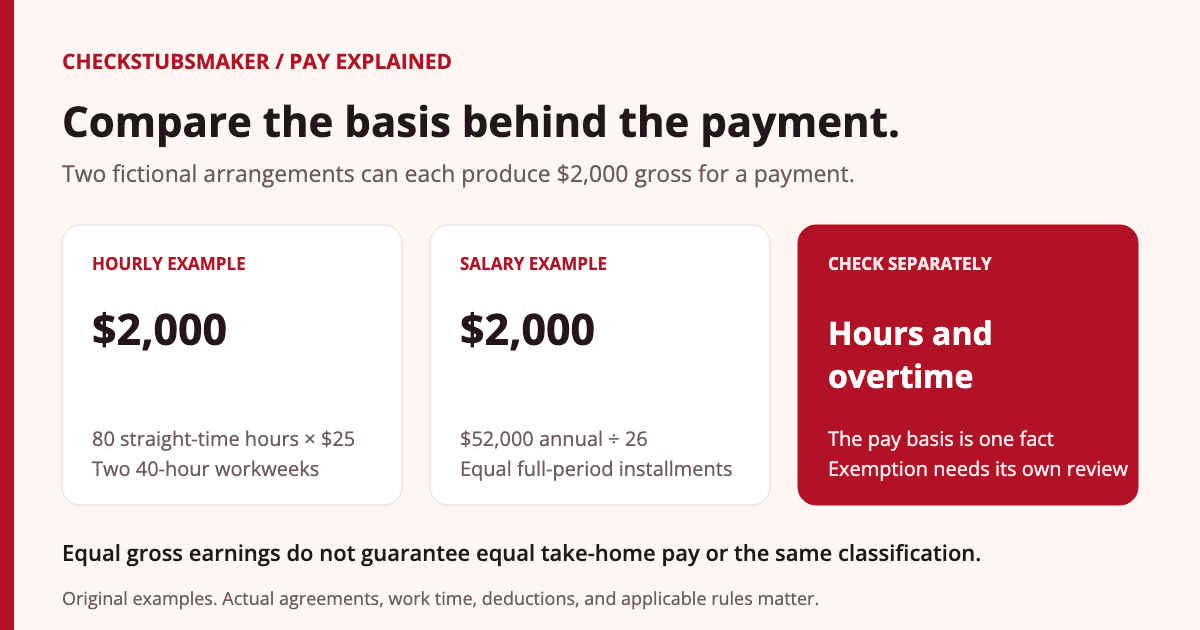
The annual salary divided by 26 is appropriate here because the agreement explicitly uses 26 equal installments. Do not use that factor for every employer or every year. Confirm the actual payment calendar and the handling of partial periods, adjustments, and any extra scheduled payday.
For future income estimates, a full-year salary rate and the wages expected to be paid during a particular calendar year can differ. Our annual-income guide explains that distinction.
Does an 80-hour salary field prove the employee worked 80 hours?
Not necessarily. Ask whether the field records actual work, standard allocation hours, paid leave, or another payroll convention. Do not convert a display field into a time record without knowing its purpose.
Conversely, salary pay does not remove the need to identify relevant work time when reviewing a nonexempt employee’s overtime. The earnings statement and underlying time record answer different questions. Our hours-on-a-pay-stub guide shows how to keep hours, units, and paid time separate.
A salary payment can also be accompanied by bonus, shift, leave, or correction rows. Those components may explain a changed gross amount without changing the annual salary agreement. Identify them individually instead of treating every larger check as a permanent raise.
Does being salaried automatically mean no overtime?
No. 29 CFR 541.2 explains that a job title alone does not establish exemption and directs the analysis to the actual applicable compensation and duty requirements. The DOL exemption overview describes the relevant federal categories and their requirements.
A salary is one pay arrangement, not a complete exemption determination. Different exemptions can have different conditions, and state requirements may also matter. Likewise, do not assume that changing a payroll label changes an employee’s legal status.
For one original nonexempt example, assume a $1,000 weekly salary is specifically agreed to compensate 40 straight-time hours, and the employee works 45 hours. Assume the ordinary federal weekly overtime method applies, with no other earnings affecting the regular rate.
Under those assumptions, the regular rate is $1,000 ÷ 40 = $25. The five overtime hours are paid at $37.50 each, adding $187.50. Total gross earnings are $1,187.50.
29 CFR 778.113 explains deriving the regular rate from the hours a salary is intended to compensate. The example assumes a salary covering 40 hours only; it is not a formula for every salaried worker, a fluctuating-workweek arrangement, or a complete state-law calculation.
For a genuinely exempt arrangement, the applicable salary-basis rules and permitted adjustments require separate review. 29 CFR 541.602 addresses salary-basis conditions and exceptions. Ask payroll to explain an actual reduction rather than assuming either that salaries can never change or that any reduction is allowed.
Do hourly and salaried employees have different payroll tax systems?
The label alone does not set a separate federal withholding percentage. IRS Publication 15-T uses the applicable wages, payment frequency, Form W-4 information, and withholding method. Relevant benefit treatment and other payroll facts also affect the calculation.
Equal gross payments therefore need not produce equal bank deposits. Employee retirement contributions, insurance premiums, additional withholding, and other actual deductions can differ. Compare federal taxable wages with the correct federal field, not automatically with gross earnings.
Use taxable wages, gross versus net pay, and W-4 versus W-2 for those separate parts of the statement. An employer contribution shown for information should not be subtracted again as an employee deduction.
What should you check when pay changes from hourly to salary?
- Confirm the written compensation amount, pay basis, effective date, and payment frequency.
- Ask how the employer classifies the role for overtime and which requirements it applies.
- Identify any split period containing both old and new pay arrangements.
- Review actual hours, additional earnings, benefits, and withholding separately.
- Reconcile the first affected payment and request an employer-issued correction for an actual error.
A useful question is: “Please explain how my [effective date] change is reflected in the [pay date] statement, including the period allocation, hours field, overtime treatment, additional earnings, and deductions.” See the correction guide for documenting the issue.
Frequently asked questions
Does salary automatically mean overtime-exempt?
No. The actual applicable exemption requirements must be met; the pay label alone does not decide the question.
Is hourly pay the same as weekly pay?
No. Hourly describes a pay basis, while weekly describes how often a payment is scheduled.
Should every salary installment equal annual salary divided by 26?
No. Confirm the agreed payment schedule, calendar, full or partial period, and adjustments.
Can two employees with the same gross have different net pay?
Yes. Their actual withholding inputs, benefit contributions, and other deductions can differ.
Can I treat standard salary hours as an actual time record?
Only after confirming what the field represents. Ask for the relevant time record when actual hours matter.
Prepared by the CheckStubsMaker Editorial Team using primary federal regulatory, DOL, and IRS sources with original examples. See our editorial policy. No individual exemption determination is made.