A shift differential is extra pay for working designated shifts. On a pay stub, it may appear as a separate earnings row or be included in a combined rate. Check the eligible hours, differential rate, and employer policy. Under the general federal overtime rules, night-shift differentials are included in the regular-rate calculation; they are not automatically a substitute for overtime pay.
For U.S. employees · Sources checked November 14, 2026 · Examples use fictional hourly rates and the ordinary federal weekly overtime framework for a covered, nonexempt employee. Other agreements, state rules, and special arrangements need separate review.
A line showing 40 regular hours and 24 shift-differential units may describe 40 hours worked, with 24 of those hours qualifying for extra pay. Adding both rows as if they were separate work time would make the total misleading. Start by identifying what the units represent.
What does a shift-differential row mean?
Your employer might use a label such as night differential, evening premium, shift pay, or an internal abbreviation. A code is a starting point, not a complete description of eligibility. Ask for the policy and the payroll legend.
The Department of Labor’s overtime glossary describes a shift differential as additional pay for designated shifts. The particular employer arrangement determines which hours qualify and the promised amount.
| Field | Question to answer | Supporting record |
|---|---|---|
| Hours or units | Are these eligible hours already included in worked time? | Approved time record and shift code |
| Rate | Is this an added amount, percentage, or combined hourly rate? | Written pay policy or agreement |
| Earnings amount | Does eligible time multiplied by the applicable rate explain it? | Payroll calculation |
| Current or YTD | Is this one payment or a running total? | Statement heading and earlier payments |
Do not confuse a time balance, a shift allowance, and an hourly premium just because they appear near one another. See hours on a pay stub for the difference between actual work time and payroll display units.
How do you check the differential amount?
Assume an employer’s fictional policy adds $2 for each eligible hour. If 24 of 40 worked hours qualify, the extra earnings are 24 × $2 = $48. At a $20 base rate, straight-time base earnings are 40 × $20 = $800, making $848 gross before deductions in a week with no overtime or other earnings.
The qualifying 24 hours are part of the 40 worked hours. They are not another 24 hours to add to the time total. A system using a combined rate might instead show 24 hours at $22 and 16 at $20: $528 + $320 produces the same $848.
A percentage arrangement needs its stated calculation base. For example, 10% of an assumed $20 base rate is $2 per eligible hour. That arithmetic does not establish that your employer uses a 10% differential, applies it to every shift, or includes the same pay components in its base.
Is extra night pay legally required, and does it replace overtime?
The DOL’s night-work guidance says the FLSA does not itself require extra night pay. That does not resolve a promised premium under an agreement or a requirement under another applicable rule. Check the actual policy and jurisdiction.
For the ordinary covered, nonexempt federal workweek, overtime generally begins after 40 hours worked and uses at least one and one-half times the regular rate. A shift premium and an overtime obligation answer different questions.
29 CFR 778.207(b) specifically includes night-shift differentials in the regular rate and distinguishes them from qualifying overtime premiums. Merely labeling a payment “premium” does not establish that it can replace statutory overtime.
The regular rate may include more than the base rate. If the employee works at different rates, receives other includable earnings, or has a special work-period arrangement, request the actual calculation. The next illustration deliberately uses one constant shift rate to keep the arithmetic transparent. Our overtime guide explains the general earnings displays.
Example: checking 45 hours when every hour earns the differential
Assume a covered, nonexempt employee works 45 hours in one workweek, all eligible for a $2 hourly differential on top of a $20 base rate. There are no other earnings affecting the regular rate, no paid leave, and no special overtime arrangement. The regular rate is $22 per hour.
| Component | Calculation | Gross earnings |
|---|---|---|
| Base wages for all worked time | 45 × $20 | $900.00 |
| Differential for all eligible time | 45 × $2 | $90.00 |
| Extra overtime premium | 5 × ($22 × 0.5) | $55.00 |
| Total gross wages | $900 + $90 + $55 | $1,045.00 |
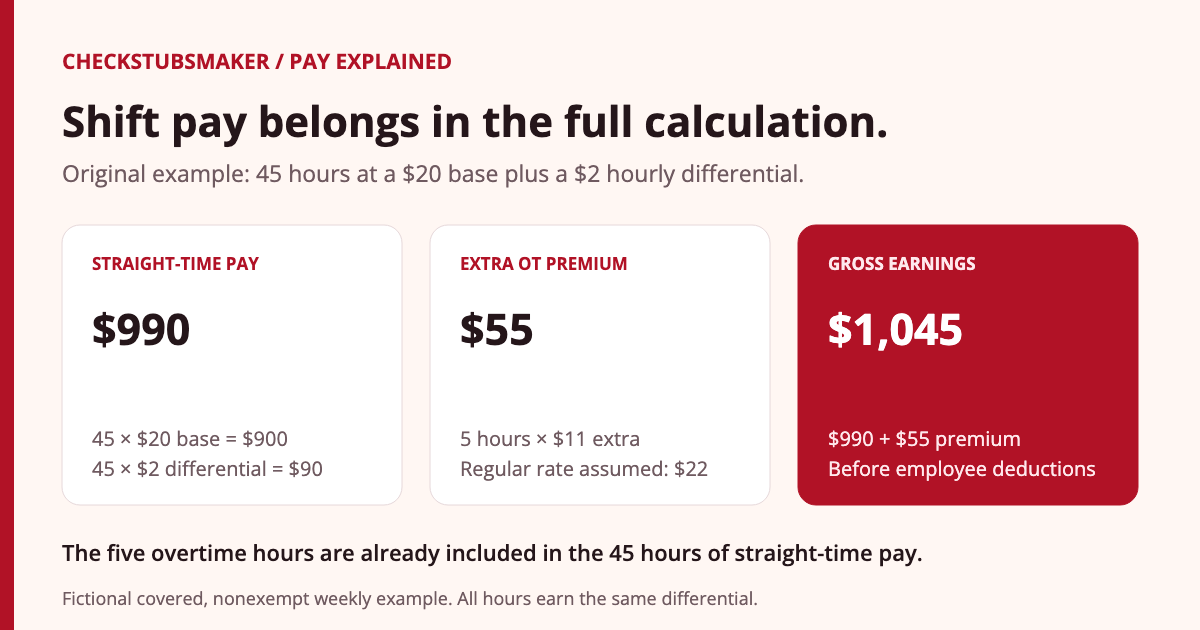
You can cross-check using full overtime earnings: 40 × $22 = $880, plus 5 × $33 = $165, for the same $1,045 gross. Do not add the full $165 overtime amount to the $990 straight-time earnings already covering all 45 hours; that would count the overtime hours’ straight-time pay twice.
If an employer used only the $20 base when calculating the extra half-time premium, that premium would be $50 instead of $55 under these stated assumptions. The $5 difference gives a specific calculation to ask about. It does not establish the correct answer for a different real-world pay arrangement.
This is gross pay. Taxes, benefit contributions, and other employee deductions remain separate. Use gross versus net pay before comparing the earnings total with a deposit.
Why might the differential change between checks?
Compare eligible shift hours, rate changes, transfers, policy effective dates, approved time codes, and corrections. Fewer premium-eligible hours can reduce the amount even when total work hours are unchanged. A catch-up adjustment can increase one check without changing the normal rate.
Check whether the row shows only the added differential or the combined rate. Moving from a $2 premium-only display to a $22 combined display does not, by itself, mean a tenfold increase in the premium.
For YTD review, compare the same earnings code and include any reversals or earlier adjustments. An adjustment posted now may relate to an earlier work period. Our retro-pay guide explains why current payment and affected work dates can differ.
What should you ask payroll?
- Confirm the full earnings-code meaning and policy version.
- Identify the actual shift dates and eligible hours.
- Request the premium rate or percentage base and the earnings calculation.
- For overtime weeks, ask how differential pay entered the regular rate.
- Keep the original record and any employer-issued correction.
A useful request is: “Please reconcile the [code] earnings on my [pay date] statement with the approved shift hours, applicable differential, and overtime regular rate for each affected workweek.” See requesting a pay-stub correction for organizing the supporting records.
Frequently asked questions
Do differential hours always add to regular worked hours?
No. They may identify a subset of time already included in the regular-hours total.
Is every night worker entitled to the same premium?
No. Check the applicable agreement, employer policy, and governing rules. The FLSA itself does not require extra night pay.
Can I calculate overtime using the base rate alone?
Do not assume that. Night-shift differentials belong in the regular-rate calculation under the cited federal rule.
Is the differential a payroll deduction?
An ordinary shift differential is earnings. Confirm the heading and employer code if the entry appears elsewhere.
Does this example cover weeks with different shifts or rates?
No. It assumes every worked hour earns the same differential. Ask for the actual regular-rate calculation when earnings vary.
Prepared by the CheckStubsMaker Editorial Team from primary DOL and federal regulatory sources with original numerical examples. See our editorial policy.