There is no single pay-stub count for every mortgage. Ask your lender which dates the statements must cover, how recent the newest statement must be, and what additional income verification is required. The CFPB’s preparation checklist includes pay stubs for the last 30 days; the exact request depends on the loan, income source, and verification method. Two biweekly statements do not automatically satisfy every request.
For U.S. mortgage applicants · Sources checked November 3, 2026 · This guide explains document preparation, not loan qualification. Your lender must confirm the requirements for your application.
“Send recent pay stubs” can leave two questions unanswered: how recent, and covering what period? Resolving those questions before uploading a file helps you supply the correct records without guessing at a lender’s underwriting decision.
How many pay stubs should you gather?
Start with the lender’s written checklist. The CFPB’s loan-packet guide includes statements for the last 30 days. Fannie Mae’s consumer checklist suggests the most recent two months and says to confirm specifics with the lender. These preparation lists are not a promise that a fixed number of files completes underwriting.
Ask whether “last 30 days” refers to pay dates, earnings-period coverage, or another defined requirement. Then identify the statements that meet that request. If your income includes a bonus, overtime, commission, multiple jobs, or a recent change, describe that situation and ask what additional history is needed.
Keep records from each requested employer separate. A statement from a prior job does not explain the current job’s pay rate by itself.
Is a statement dated within 30 days the same as 30 days of pay?
No. A statement can be newly issued while covering a shorter earnings period. Our pay-period and pay-date guide explains those two dates.
The current Fannie Mae employment-documentation standard specifies a most recent pay stub dated within 30 days before the initial application, including YTD earnings and enough information to calculate income. That is a particular program standard, with additional document-age requirements and possible requests for more information. It is not a rule for every mortgage product.
Write down three separate items: the application date, the latest acceptable statement date, and the period the lender wants documented. A file can answer one of those questions while leaving another unresolved.
Why might two biweekly statements need clarification?
Assume two fictional consecutive statements cover September 1–14 and September 15–28, inclusive. Together they cover 28 calendar days. If a request specifically asks for earnings-period records through September 30, those files leave September 29–30 uncovered.
| Record | Assumed earnings dates | What it establishes |
|---|---|---|
| Statement A | September 1–14 | 14 calendar days of period coverage |
| Statement B | September 15–28 | Another 14 consecutive days |
| Combined | September 1–28 | 28 days, with no gap between these two periods |
| Question for the lender | September 29–30 | Does the request require these dates, and which record should supply them? |
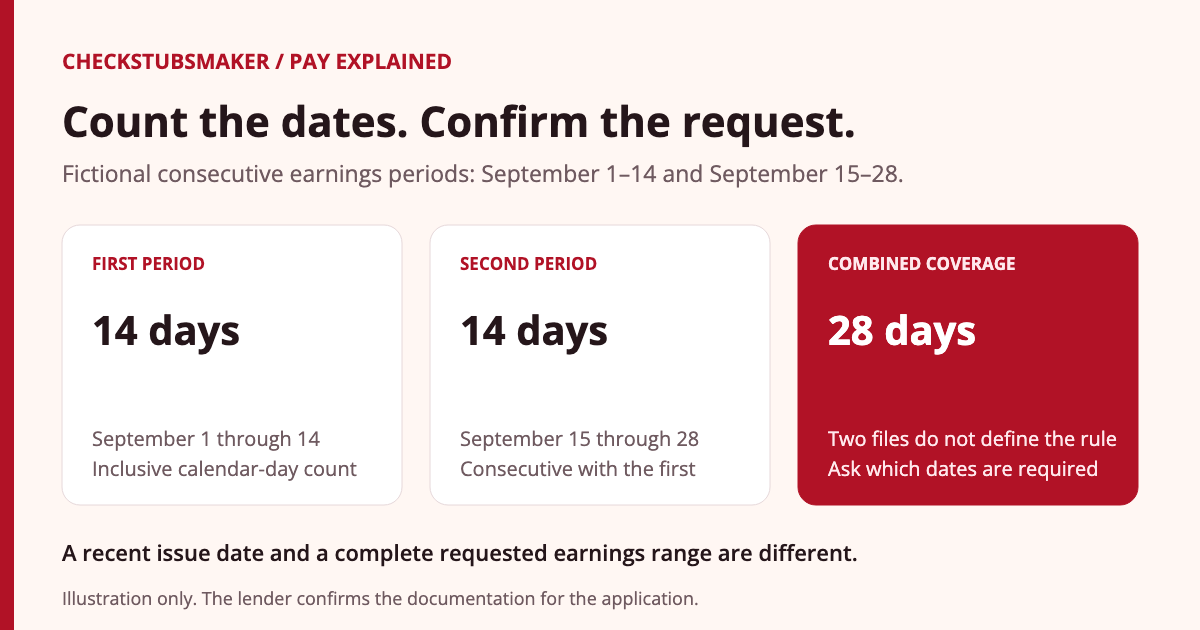
This example does not mean every lender needs a third statement. A YTD figure, employment verification, or a different defined request may affect what is required. Send a precise question instead of assuming approval or rejection from the number of PDFs.
What should you check on the statements?
Download complete employer-issued records. Fannie Mae’s documentation standard calls for legible information that identifies the employer and comes from an appropriate third-party source; employer payroll downloads can be acceptable under that standard.
| Item | Preparation step |
|---|---|
| Employee and employer | Confirm the record belongs to the applicant and identifies the payer |
| Dates | Identify pay date and period start/end separately |
| Current earnings | Separate regular earnings from one-time or variable entries |
| YTD earnings | Check the running total and the time it covers |
| Document completeness | Keep the requested pages readable and together |
Use our YTD explanation and gross-versus-net guide to identify the figures. A bank deposit is not necessarily gross earnings or qualifying income. Do not substitute the largest available number for the measure the lender requests.
Can a lender verify income without conventional pay stubs?
Ask about the route that applies to your circumstances. Fannie Mae’s standard describes employer and third-party verification options, including certain validation arrangements. A lender must determine whether the required conditions are met.
The CFPB’s preparation guide also discusses automated collection and additional records for self-employment or irregular income. An electronic route does not mean there is no verification; it changes how information is obtained.
If you lack access to earlier employee records, see our retrieval guide. If you are self-employed, ask for the business-document checklist; a self-employment ledger does not automatically replace every record a mortgage lender needs.
Do you need pay stubs just to receive a Loan Estimate?
CFPB guidance on Loan Estimates says documents cannot be required as a condition of providing a Loan Estimate for covered mortgages. It identifies six application information items, including income, that trigger that process.
That is different from completing later verification after you choose to proceed. Do not interpret the Loan Estimate rule as permission to skip documents requested for underwriting. The CFPB page also identifies loan types outside that disclosure process.
How should you submit and update the packet?
- Confirm the exact date range and requested income sources.
- Download the statements through payroll and check all requested pages.
- Label each file with the employer and period.
- Submit through the lender’s verified document channel.
- Keep the upload confirmation and any follow-up request.
- Ask when updated statements will be needed if the application continues.
A useful message is: “My attached statements cover [dates], with pay dates of [dates]. Please confirm whether these meet your recency and coverage requirements, and whether another statement or employer verification is needed.”
If the record itself is wrong, request an employer-issued correction. Explain the change to the lender instead of altering the earnings or dates yourself.
Frequently asked questions
Are two pay stubs always enough for a mortgage?
No. The required dates, income details, loan program, and verification method matter.
Does one monthly statement automatically meet a 30-day request?
Confirm its actual dates, issue date, YTD information, and the lender’s definition of the request.
Are downloaded payroll statements usable?
They can be acceptable under applicable documentation standards. Ask the lender about its format and completeness requirements.
Why is the lender requesting another statement?
Ask which date or information needs updating. A later request may address recency, a gap, or a change in income.
Does supplying the requested pay stubs guarantee approval?
No. Document submission is one part of the lender’s evaluation.
Prepared by the CheckStubsMaker Editorial Team using primary mortgage-documentation sources and an original date-range example. See our editorial policy. This article does not determine qualifying income, loan eligibility, or approval.