A pay stub can help document employment income for an apartment application, but the property’s stated requirements determine which records to submit. Ask how many statements are needed, which dates they must cover, and whether the review uses gross or net income. Supply accurate employer-issued records and explain any changes in hours, job status, or pay. A pay stub alone does not guarantee approval.
For U.S. rental applicants · Sources checked November 2, 2026 · Screening requirements and housing protections vary by property, program, and location. The calculations below are fictional illustrations.
Preparing a rental application is easier when the paperwork and the income figure answer the same question. Two deposits, two pay periods, and one month of earnings are not automatically equivalent.
How many pay stubs do you need for an apartment?
Obtain the specific property’s instructions before choosing a set of documents. FTC tenant-screening guidance recommends asking what information a landlord uses before paying an application or background-check fee.
Ask for the required number of statements, the date range, acceptable formats, and the process for documenting variable income. Also ask whether income is evaluated individually or by household and which income measure the application requests.
Apartments.com’s landlord guidance discusses recent pay stubs among income-verification documents. Its suggestions describe a screening approach; they do not establish one nationwide number of statements or a universal rent-to-income rule.
What should your pay statements show?
Download the requested records from payroll or ask your employer for copies. Keep every page and use consecutive periods when that is what the application asks for. Our pay-stub retrieval guide can help if access to a former employer’s system has ended.
| Detail | Check before submitting | Explain when relevant |
|---|---|---|
| Name and employer | The statement belongs to you and identifies the payer | Name changes or a different legal payroll entity |
| Dates and frequency | Pay-period dates, pay date, and pay schedule | A partial period, delayed payment, or new job |
| Gross and net amounts | The correct figure for the application’s question | Why a deposit differs from gross earnings |
| Earnings pattern | Regular pay versus overtime, bonus, or commission | A one-time amount or a recent pay change |
| YTD information | The period covered by the running total | A midyear start or a change in employment |
Request a correction from payroll if a statement contains an error. Preserve the original and any employer-issued replacement; changing an earnings figure yourself would make the submitted record inaccurate.
How do you calculate monthly income from a pay stub?
First confirm the requested definition. Gross income and take-home pay measure different amounts. Then identify the actual pay frequency. An average monthly conversion is a calculation, not a promise about the amount deposited in any particular calendar month.
Assume constant gross earnings, a full year at the same rate, and a schedule with 52 weekly or 26 biweekly payments. The following original examples exclude unpaid gaps, bonuses, overtime changes, and extra-pay-date years.
| Assumed schedule | Calculation | Average monthly gross |
|---|---|---|
| $900 weekly | $900 × 52 ÷ 12 | $3,900.00 |
| $1,800 every two weeks | $1,800 × 26 ÷ 12 | $3,900.00 |
| $1,800 twice a month | $1,800 × 24 ÷ 12 | $3,600.00 |
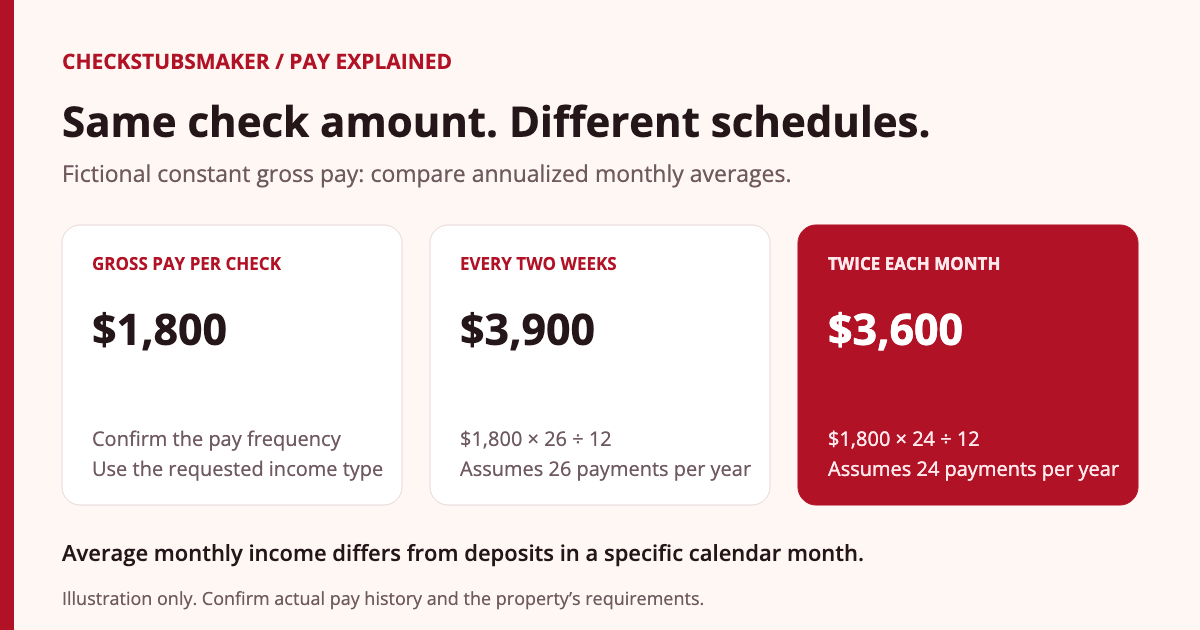
Our pay-schedule comparison explains that distinction. For irregular earnings, present the requested history and identify unusual periods instead of multiplying the highest paycheck. If the property applies an income multiple, ask which income and rent figures it uses; this example establishes no approval threshold.
How do apartments verify pay stubs?
A property may compare application details with supplied records, seek employment confirmation, or use a screening service. Ask what authorization is required and how the review works for your application. Do not assume every property uses the same provider or verification method.
Keep payroll contact details available and identify the relevant statement dates. If a bank transaction needs explanation, compare it with net pay and the deposit allocation rather than gross earnings. See our pay-stub and bank-statement comparison.
What if you do not have recent pay stubs?
Ask which alternative fits your actual income source. Avail’s income-verification guide discusses employer letters for a new position, tax records, bank records, and documentation of other income. Acceptance depends on the application and applicable rules.
- Starting a job: ask whether the employer’s offer or employment letter is accepted and which pay and start-date details are required.
- Self-employed: ask about the requested business records and reporting period. Our ledger guide explains how to organize actual income and expenses.
- Receiving benefits or retirement income: ask which current official statement or award letter is appropriate.
Describe the document accurately. A self-prepared summary does not become an employer-issued payroll record. If you have concerns about a requirement or lawful income source, check the housing rules for your location or seek local housing assistance.
How can you make the submission clear?
- Use the property’s verified application channel.
- Label files with the document type and date range.
- Keep the requested pages legible and complete.
- Ask which sensitive fields may be redacted before changing a submitted copy.
- Attach a short explanation for a genuine pay change or unusual period.
- Save the submitted set and confirmation.
An explanation might say: “These statements cover [dates]. My pay schedule is [frequency]. The payment dated [date] includes a one-time bonus of [amount]. Please confirm which additional records you need.” This gives the reviewer context without presenting an exceptional payment as recurring income.
What if the reviewer questions your records or denies the application?
Ask which entry or document needs clarification. A missing page, an unfamiliar payroll entity, and an inaccurate screening report require different follow-up.
CFPB guidance explains the adverse-action notice required when a denial is based on a tenant screening report. It includes the reporting company’s details and rights to request a free report within 60 days and dispute inaccurate information. The same guidance discusses other report-based adverse actions.
That report-based process should not be assumed to apply identically to every direct document question. Identify the reason, preserve the communication, and use local assistance when your housing rights are unclear.
Frequently asked questions
Are two pay stubs always enough?
No. Ask the property for the specific number, date range, and document requirements.
Should I use gross or net income?
Use the measure requested by the application. Confirm it before comparing income with a rent requirement.
Can I multiply biweekly pay by two?
That shows two payments, not the annualized monthly average in a 26-payment example. Confirm the pay schedule and calculation method.
Can I apply without employee pay stubs?
Ask about records appropriate to your actual income, such as an employer letter, business records, or a current benefits statement.
Does submitting a pay stub guarantee approval?
No. The property evaluates the application under its criteria and applicable housing rules.
Prepared by the CheckStubsMaker Editorial Team with primary screening guidance and original calculations. See our editorial policy. This article does not determine housing eligibility or provide a universal rental-screening standard.